

Live Comments
US CPI Slows to 3.4% as Core Inflation Eases to 2.5%
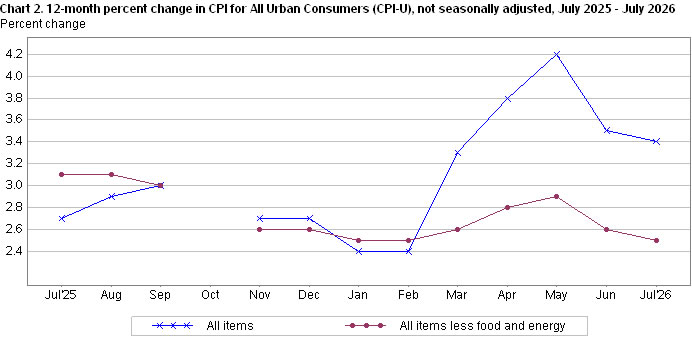
US inflation eased as expected in July, reinforcing case for Fed to stay on hold while it waits for clearer evidence on both prices and labor market. Headline CPI rose from -0.4% to 0.1% m/m, while annual rate slowed from 3.5% y/y to 3.4%. Core CPI increased from 0.0% to 0.2% m/m, with annual core inflation easing from 2.6% to 2.5%. All four readings matched consensus, leaving markets with confirmation of gradual disinflation rather than a fresh policy surprise.
Details were also relatively contained. Shelter rose 0.1% m/m and accounted for roughly two-thirds of monthly headline increase, while food gained 0.1%. Energy prices fell -1.5% m/m, although they were still up 14.7% y/y. Core increases were seen in medical care, airline fares, communication, education and recreation, while motor vehicle insurance declined. Most importantly, core inflation has now returned to 2.5%, matching pre-Iran-war readings from January and February after peaking at 2.9% in May.
For Fed, July report strengthens argument for patience rather than another immediate move. Weak payrolls have already raised hurdle for further tightening, while core inflation at 2.5% remains too high to justify easing. July CPI therefore supports a hold-and-wait stance, with focus shifting toward August employment and inflation data before September meeting. Renewed rise in oil also means July’s benign energy contribution may prove temporary, making August CPI a more important test of whether latest energy shock begins feeding back into broader inflation.
Data Summary
| Indicator | Actual | Expected | Previous |
|---|---|---|---|
| CPI m/m | 0.1% | 0.1% | -0.4% |
| CPI y/y | 3.4% | 3.4% | 3.5% |
| Core CPI m/m | 0.2% | 0.2% | 0.0% |
| Core CPI y/y | 2.5% | 2.5% | 2.6% |
Key Takeaways
- US CPI matched expectations across all four major readings, delivering confirmation of gradual disinflation rather than a fresh policy surprise.
- Headline CPI slowed from 3.5% to 3.4% y/y, while core CPI eased from 2.6% to 2.5%, returning core inflation to its January-February pre-Iran-war level.
- Monthly core CPI accelerated from 0.0% to 0.2%, showing underlying price pressure has not disappeared even as annual rate continues to moderate.
- Shelter rose just 0.1% m/m but accounted for roughly two-thirds of headline monthly increase. Energy fell 1.5% m/m, providing an important disinflationary contribution.
- Weak July payrolls have raised hurdle for another Fed hike, but 2.5% core inflation remains too high to justify near-term easing, reinforcing a hold-and-wait stance.
- July’s favorable energy contribution is already backward-looking. August CPI will be more important for assessing whether renewed oil surge starts feeding into broader inflation.
Fed’s Collins Open to September Hike as Cost Pressures Persist
Boston Fed President Susan Collins said she could support a rate increase in September if inflation fails to ease sufficiently, highlighting persistent cost-of-living pressures intensified by Iran war. Speaking in an interview with Financial Times on Wednesday, Collins said, “I do see the possibility that economic conditions in the coming months will require tighter policy, and I would be prepared to raise rates in that context.” She supported keeping rates unchanged in July and currently views monetary policy as only “slightly restrictive.”
Collins said inflation has continued to squeeze businesses and households across US Northeast, with price concerns surfacing in nearly every conversation with firms. Pressure is particularly acute for lower- and middle-income households, she said, with some struggling to “make ends meet” as elevated energy costs add to broader affordability problems.
While Collins expects inflation to continue declining gradually, she stressed that price growth has remained above Fed’s 2% target for more than five years, leaving policymakers with little room for complacency.
Her remarks reinforce Fed’s increasingly difficult September trade-off. Recent labor-market weakness has strengthened case for holding rates, but persistent inflation and renewed energy pressure could still justify further tightening if upcoming data disappoint. Collins is not currently a voting member of FOMC, but her willingness to contemplate a September hike adds to hawkish argument that current policy may not yet be restrictive enough to ensure inflation returns sustainably to target.
RBA Accepts Softer Inflation but Still Leaves Scope for One More Hike
RBA accepted that inflation has improved, but refused to turn that improvement into a declaration that rate hikes are finished. Cash rate was left unchanged at 4.35% unanimously, yet Board described policy as only “somewhat restrictive” and explicitly kept another increase on table, saying it could still raise rates “if upside risks materialise.” That is the clearest way to read Tuesday’s decision: softer inflation bought RBA time, not an all-clear.
New forecasts make that tension unusually visible. RBA cut June 2026 headline CPI forecast from 4.8% to 3.9% and December projection from 4.0% to 3.6%. Trimmed mean was lowered from 3.8% to 3.6% for June and from 3.5% to 3.3% for December. But Board did not carry that improvement forward aggressively. June 2027 headline inflation was revised up from 2.4% to 2.8%, with December raised from 2.4% to 2.6%. Trimmed mean was only marginally lowered from 3.1% to 3.0% for June 2027 and stayed at 2.6% for December. In other words, RBA believes current inflation picture is better than feared, but still does not trust disinflation enough to bring target return materially forward.
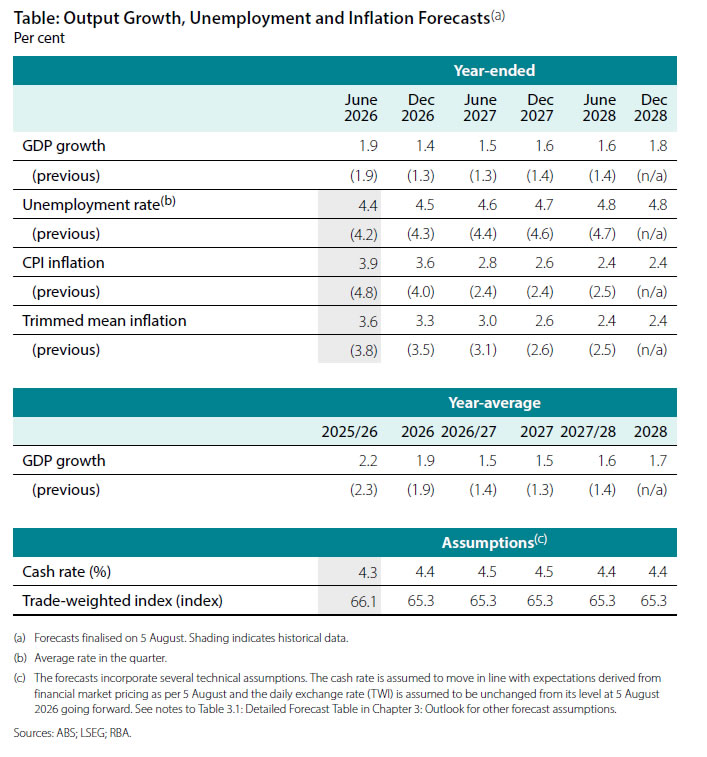
That explains why statement retained a tightening bias despite signs economy is responding. RBA said “headline inflation is still too high”, warned higher oil costs are feeding through to other prices, and noted inflation is not expected to return to around midpoint of target band until late 2027. Yet there is also clear evidence previous hikes are biting: consumer spending is slowing, housing prices have fallen in some capitals, new housing lending has weakened and labour conditions have eased more than expected. Unemployment forecasts were lifted from 4.2% to 4.4% for June 2026 and from 4.3% to 4.5% for December, even as later GDP forecasts were nudged higher.
The technical cash-rate assumption completes picture. RBA projections are built around a market path that rises toward 4.5%, meaning forecast convergence of inflation toward target is not based on 4.35% being held forever. That is a meaningful hawkish signal. RBA is saying current rate is restrictive enough to pause and watch, but not restrictive enough to declare victory.
For markets, that means tightening bias clearly survived Tuesday’s meeting. AUD bulls did not get a fresh hike signal, but AUD bears also did not get confirmation that peak rates are firmly in place.
Summary
RBA Decision
| Item | Decision / View |
|---|---|
| Cash rate | Held at 4.35% |
| Decision | Unanimous |
| Policy stance | “Somewhat restrictive” |
| Inflation assessment | “Still too high” |
| Tightening bias | Further hike possible if upside risks materialise |
| Technical cash-rate assumption | Rises toward 4.5% |
Key Forecast Revisions
| Forecast | August SoMP | Previous |
|---|---|---|
| CPI — Jun 2026 | 3.9% | 4.8% |
| CPI — Dec 2026 | 3.6% | 4.0% |
| CPI — Jun 2027 | 2.8% | 2.4% |
| CPI — Dec 2027 | 2.6% | 2.4% |
| Trimmed mean — Jun 2026 | 3.6% | 3.8% |
| Trimmed mean — Dec 2026 | 3.3% | 3.5% |
| Trimmed mean — Jun 2027 | 3.0% | 3.1% |
| Trimmed mean — Dec 2027 | 2.6% | 2.6% |
| Unemployment — Jun 2026 | 4.4% | 4.2% |
| Unemployment — Dec 2026 | 4.5% | 4.3% |
| Unemployment — Jun 2027 | 4.6% | 4.4% |
Key Takeaways
- RBA unanimously held cash rate at 4.35%, but tightening bias clearly survived.
- Board accepted softer near-term inflation, cutting June 2026 CPI forecast from 4.8% to 3.9% and trimmed mean from 3.8% to 3.6%.
- However, RBA did not translate softer inflation into a substantially faster return to target. June 2027 headline CPI was actually revised from 2.4% to 2.8%.
- Policy was described as only “somewhat restrictive”, rather than sufficiently restrictive, while Board explicitly retained option of raising rates again if upside risks materialise.
- Technical forecast assumption has cash rate moving toward 4.5%, reinforcing that projected disinflation is not based on 4.35% being held indefinitely.
- Labour outlook weakened, with unemployment forecasts raised across near-term horizon, confirming previous tightening is already slowing economy.
- Overall message is a hawkish hold: RBA accepted better inflation data but is not yet prepared to declare tightening cycle finished.