TL;DR: Gold has kept climbing even as Brent rebounded from $70 toward $90, a divergence that reflects markets betting the Fed won’t tighten again without proof oil is feeding into core inflation — and Wednesday’s CPI is the first test of that bet.
Gold Is Defying the Oil Signal
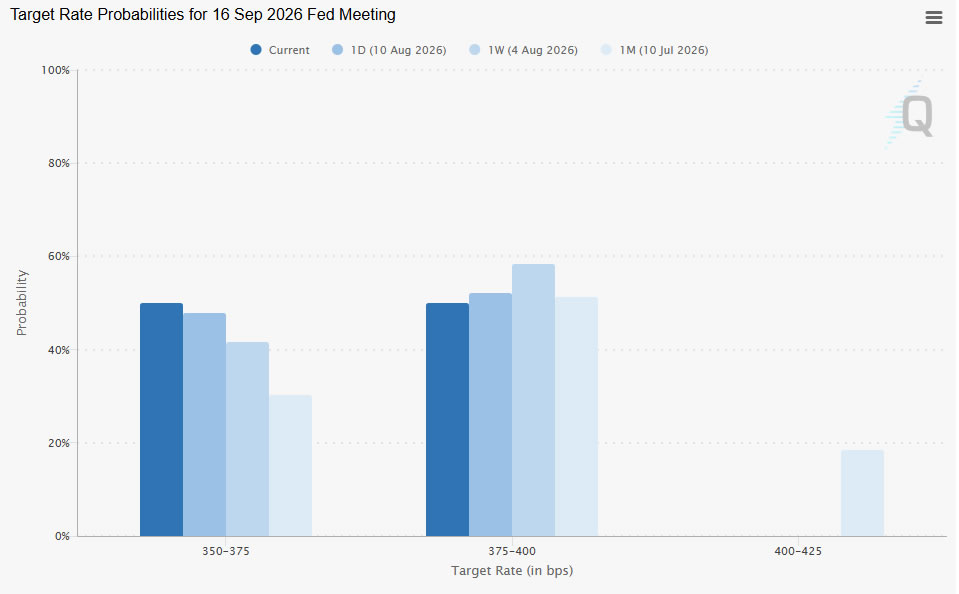
Gold heads into Wednesday’s US CPI release with an unusual message from cross-asset markets. Brent has rebounded from around $70 in July to near $90 this week, yet Gold has continued to climb. At the same time, the 10-year Treasury yield is still contained below 4.75%, while markets put roughly even odds on a September Fed hold. Oil has surged, but rate markets haven’t followed.
That matters because the relationship looked very different earlier this year. During the first Iran-war shock, higher oil translated much more directly into inflation fears, higher yields, and a more hawkish Fed outlook — Gold often struggled against that combination. This time, markets appear much less willing to assume another energy shock automatically means another round of tightening.
So Wednesday’s CPI isn’t simply an inflation release. It’s the first test of a broader market bet: can oil rise toward $90 without forcing the Fed back toward tightening? Gold is currently trading as though the answer may be yes.
Core CPI Could Return All the Way to Pre-War Levels
| Jan’26 | Feb’26 | Mar’26 | Apr’26 | May’26 | Jun’26 | |
|---|---|---|---|---|---|---|
| Headline CPI (y/y) | 2.4 | 2.4 | 3.3 | 3.8 | 4.2 | 3.5 |
| Core CPI (y/y) | 2.5 | 2.5 | 2.6 | 2.8 | 2.9 | 2.6 |
Consensus expects headline CPI to slow from 3.5% to 3.4% y/y, while core inflation is forecast to edge down from 2.6% to 2.5%. The monthly progression shows how far both measures have traveled since the first oil shock:
A 2.5% core reading would be significant because it would complete a full round trip back to levels seen before the Iran war disrupted the inflation picture. Core CPI was 2.5% in January and February, then accelerated to 2.6% in March, 2.8% in April, and 2.9% in May, before easing back to 2.6% in June — a July reading of 2.5% would therefore suggest underlying inflation has effectively unwound the entire first-war acceleration.
If today’s data meet consensus, markets would have strong evidence the first oil shock didn’t permanently dislodge underlying inflation. But there’s a catch.
Today’s CPI Comes From a World That Has Already Changed
July inflation data were collected before the current Hormuz escalation reached its most acute phase. The latest tanker attacks, collapsing shipping crossings, the reparations standoff between Washington and Tehran, and Brent’s push back toward $90 are largely early-to-mid-August developments — they sit mostly outside today’s CPI window.
That means a clean 2.5% core reading wouldn’t prove inflation has shrugged off the latest energy shock. It would prove something narrower, but still important: core inflation managed to return to pre-war levels during the calmer period between two oil shocks. That distinction is crucial because this second episode isn’t identical to the first.
This Oil Shock Is Smaller — But Potentially More Persistent
The first Iran-war shock was violent and immediate. Brent surged toward $120, and March CPI recorded a 10.9% m/m jump in energy prices, the largest since September 2005. Gasoline posted its largest monthly increase since the series began in 1967.
The current move is less severe in magnitude — Brent has rebounded from around $70 to $90 rather than exploding toward $120. But the character of the disruption is different. This is increasingly a prolonged negotiation and shipping crisis, with confirmed tanker strikes, sharply reduced Hormuz crossings, and a widening diplomatic standoff, rather than simply a repeat of a fresh outright closure.
That creates a genuine open question for inflation: a violent energy spike can fade quickly if physical disruption is resolved, while a smaller but persistent increase in transportation, insurance, and energy costs could potentially bleed into underlying prices differently. Markets don’t yet know which version they’re dealing with.
August CPI Is Where the Hawkish Thesis Starts Getting Tested
That’s why today’s CPI is best treated as a baseline. The more consequential test comes with August CPI on September 11, because that release will begin incorporating the current rebound in energy prices. Even then, direct energy effects should show up in headline inflation sooner than in core — second-round pass-through through transportation, production costs, goods, and services can take longer. But August will still provide the first meaningful evidence on whether underlying inflation can remain anchored while Brent trades around $90.
That question goes directly to the hawkish argument advanced by officials such as Neel Kashkari, Lorie Logan, and Beth Hammack, as well as dissenting voices at the latest FOMC meeting. Their concern isn’t simply that energy prices temporarily lift headline CPI — it’s that prolonged energy and supply pressure eventually spreads into core inflation and forces the Fed to maintain or increase restraint.
The next comparison is therefore unusually clean: if core inflation stays around 2.5–2.6% even after the renewed oil shock begins entering data, it would provide strong evidence energy pressure is staying largely contained. If core starts accelerating again, hawks would have much stronger evidence that second-round effects are taking hold. Today tells markets where that experiment starts.
Weak Payrolls Have Raised the Bar for Another Hike
The Fed is also confronting a labor backdrop similar to the start of the year, when markets and policymakers were debating rate cuts. July payrolls contracted, while May and June employment were revised substantially lower. That has made another rate hike much harder to justify, particularly with policy already at 3.50–3.75%.
There’s now a genuine reason for the Fed to eventually reduce restraint if labor deterioration continues. But inflation prevents an immediate pivot — core CPI around 2.5–2.6% is still above target, while renewed oil pressure creates another potential upside risk. The Fed therefore has little room to cut now, even as the case for additional hikes has weakened.
That leaves a fairly natural policy response if today’s CPI lands close to consensus: hold and wait. That would be the baseline as the Fed assesses August NFP on September 4, then August CPI on September 11, before the September 15–16 FOMC meeting. That policy expectation is supportive for Gold — another hike becomes harder to justify, while weaker labor conditions keep eventual easing risk alive.
Gold Is Trading the Rate Market’s Skepticism
Gold’s rally therefore looks less like a pure geopolitical or inflation-fear trade and more like a bet on the rate market refusing to follow oil. Brent has surged, but Treasury yields haven’t broken higher. Fed hike pricing has barely moved. Gold has strengthened anyway.
If markets genuinely believed $90 oil was about to restart a tightening cycle, those signals should look different. Instead, investors appear to be saying the Fed now needs evidence of actual pass-through into core inflation before it can justify more tightening — especially after labor-market deterioration. That gives Gold a relatively favorable setup into CPI: a benign reading doesn’t need to prove the latest oil shock is harmless. It only needs to avoid giving hawks enough evidence to rebuild tightening expectations today.
ActionForex’s Technical View on Gold
The technical problem is that Gold has already reached an important resistance zone. The rebound from 3,942.43 is pressing 4,417.62, the 161.8% projection of 3,942.43 to 4,203.21 from 3,995.82. At the same time, price is approaching the medium-term falling trendline that has defined the broader decline this year, making the reaction to CPI potentially sharper than usual.
As long as 4,317.72 support holds, the near-term outlook stays constructive. A core CPI reading around 2.5–2.6%, particularly if yields remain contained, should allow Gold to keep challenging current resistance. A decisive break would open room toward 4,575.31, the 38.2% retracement of the decline from 5,598.75 to 3,942.43.
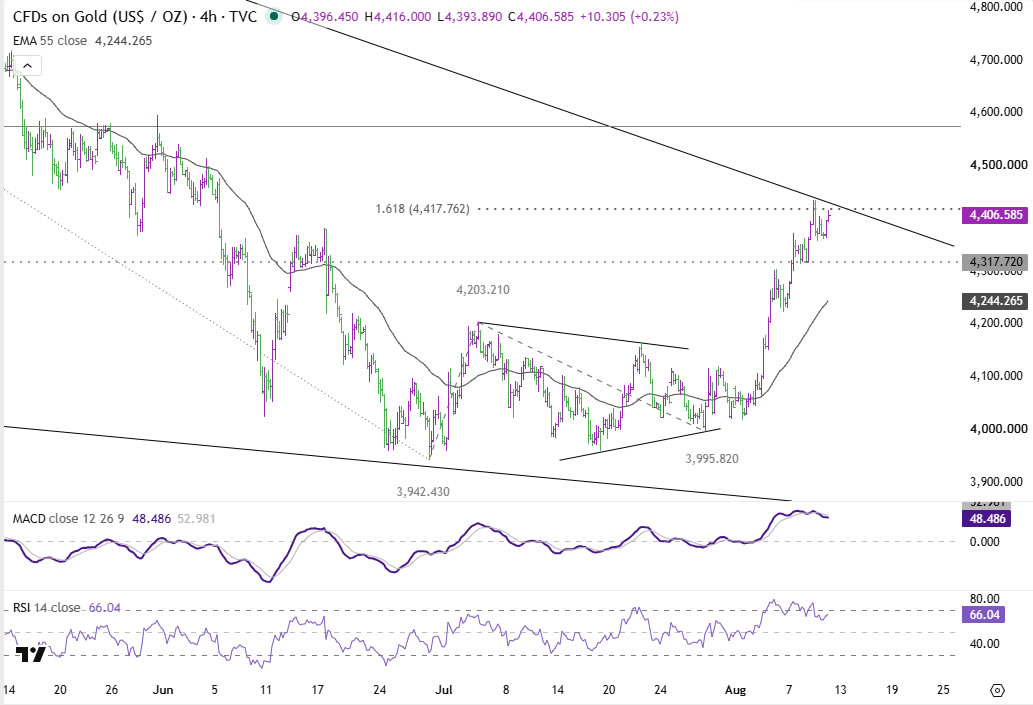
But positioning near resistance creates clear downside risk if inflation surprises substantially higher. A strong core CPI print could revive tightening expectations and trigger a sharp rejection. A break below 4,317.72 would indicate the rebound has lost near-term momentum, bringing a deep and swift pullback to the 55 4H EMA near 4,244.25 and possibly below.
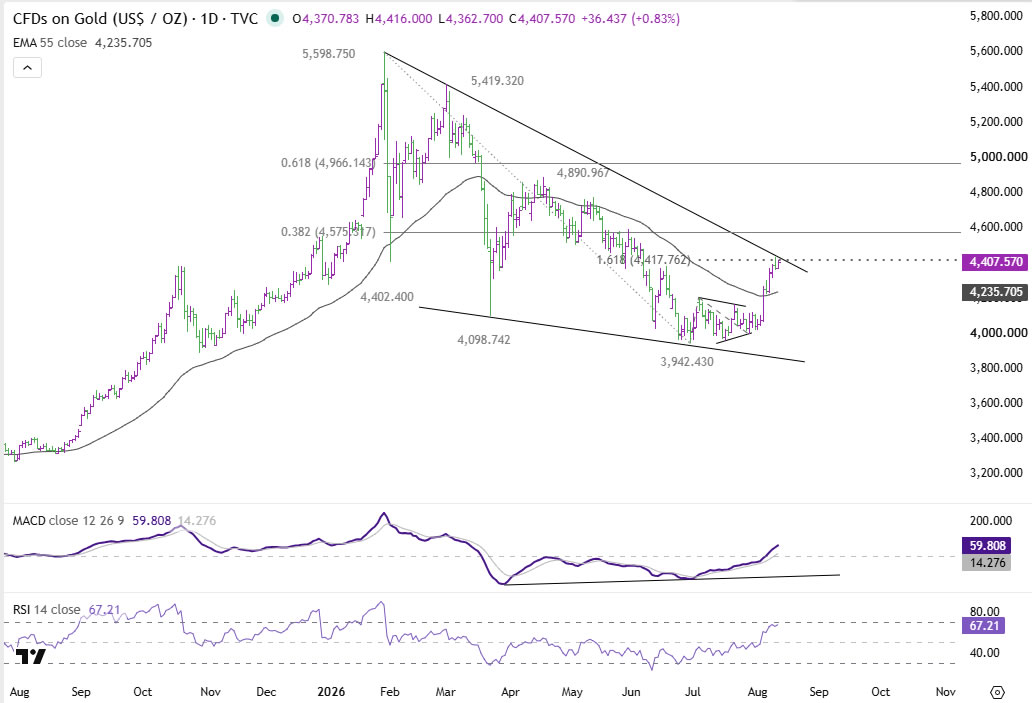
That makes the CPI outcome less symmetric than headline consensus suggests. A broadly expected reading keeps the existing Gold thesis intact; it probably takes a material upside surprise to seriously disrupt it.
Today Is the First Check. September Is the Bigger One.
Wednesday’s CPI can tell markets whether underlying inflation returned to pre-war levels before the latest oil rebound. It can’t yet tell them whether inflation will stay there. That’s why Gold’s current rally is fundamentally a bet on patience — markets are betting the Fed won’t react to $90 oil alone without evidence that higher energy prices are once again contaminating core inflation.
A 2.5–2.6% reading today would reinforce that view and likely keep Gold’s rebound alive, even if current resistance slows immediate upside. A substantial upside surprise would challenge it quickly. But the bigger verdict comes in September: today’s July CPI decides whether Gold can keep betting against another Fed hike, while August CPI will begin deciding whether $90 oil eventually proves that bet wrong.
Key Takeaways
- Gold has climbed even as Brent rebounded from $70 to $90, a divergence from earlier this year when oil spikes reliably lifted yields and hurt Gold.
- A 2.5% core CPI print today would complete a full round trip back to pre-war inflation levels, but the data predates the most acute phase of the Hormuz escalation.
- August CPI on September 11 is the more consequential test, since it will be the first release to capture the current oil rebound’s actual pass-through into prices.
- Weak payrolls and heavy downward revisions have raised the bar for another hike, but above-target core inflation still rules out an immediate Fed pivot to cuts.
- Gold faces resistance at 4,317.72-4,417.62; an in-line CPI print keeps the rebound intact toward 4,575.31, while a hot surprise risks a swift pullback to 4,244.25.