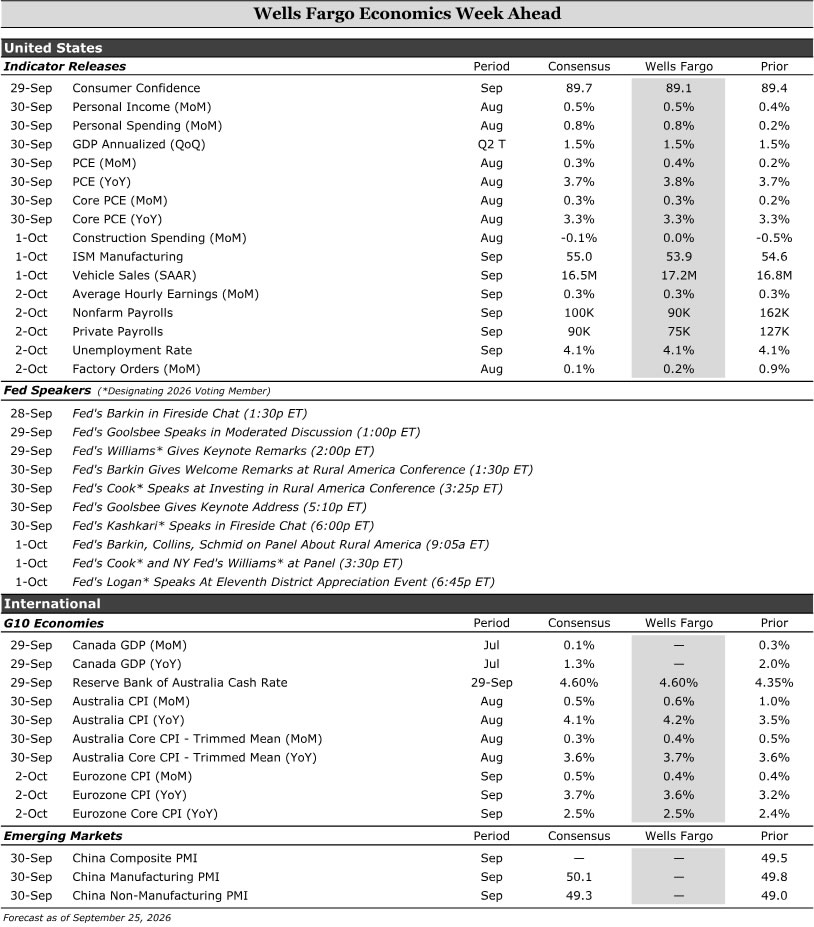
Next week will be busy. We expect consumer spending to rise 0.8% in August, while income growth of 0.5% and annual BEA revisions should show a resilient U.S. economy. The PCE deflator is expected to firm in August, although broader revisions should leave the recent inflation trend somewhat softer. On Friday, we expect payroll growth to moderate to 90K in September, with the unemployment rate holding steady at 4.1%.
Abroad, Canada’s July GDP is expected to be essentially flat, consistent with an economy that is slowing but not contracting. We expect the Reserve Bank of Australia to raise its Cash Rate by 25 bps to 4.60%, which we view as the terminal rate. In Europe, Eurozone inflation likely ticked higher in September, keeping the prospect of another ECB rate hike on the table. In China, September PMI data should point to a slight improvement in manufacturing, while non-manufacturing activity is likely to remain subdued.
United States:
- Personal Income & Spending (Wednesday), Nonfarm Payrolls (Friday)
Advanced Economies:
- Canada GDP (Tuesday), Reserve Bank of Australia (Tuesday), Eurozone CPI (Friday)
Emerging Markets:
- China PMIs (Wednesday)
Source: Bloomberg Finance L.P. and Wells Fargo Economics
U.S. Week Ahead
Personal Income & Spending • Wednesday
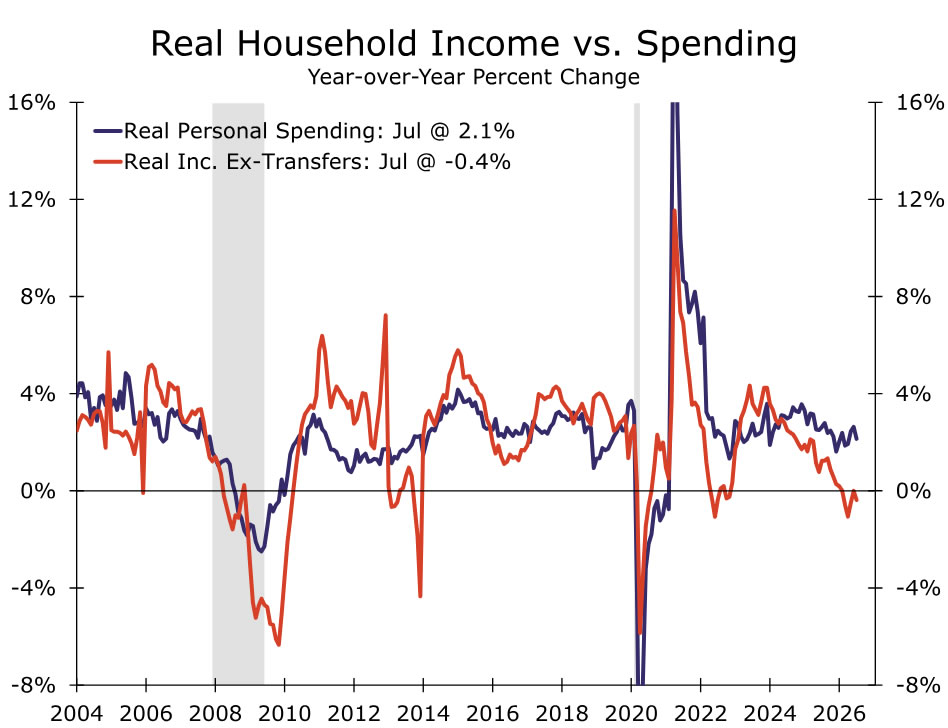
Wednesday we’ll get a slew of data to give us an updated view on the economy. August personal income & spending will likely verify recent consumer resilience seen in retail sales, while the Fed’s preferred PCE deflator will complete the inflation picture of the Summer. This report along with the third look at Q2 GDP comes with annual revisions going back five years altering more than just the recent inflation trajectory.
We forecast personal spending to jump 0.8% in August, supported by a rebound in goods consumption and steady-services spending. Personal income was also likely sturdy, up 0.5% during the month. Firmer prices are flattering the headline rates, and if our PCE deflator forecast of 0.4% is realized that would suggest real spending in the neighborhood of 0.4% and a 0.1% gain in real disposable personal income. Strong services revenue suggests we’ll see upward revisions to prior spending data, and annual adjustments to tax data will certainly alter the trajectory of income and thus personal savings. For inflation, methodology changes will leave a softer near-term inflationary trend but hotter August print.
Despite some likely varying adjustments to GDP growth, we expect the data to continue to show a resilient U.S. backdrop driven by high-tech capex spending and an adaptable consumer.
Source: U.S. Department of Commerce and Wells Fargo Economics
Nonfarm Payrolls • Friday
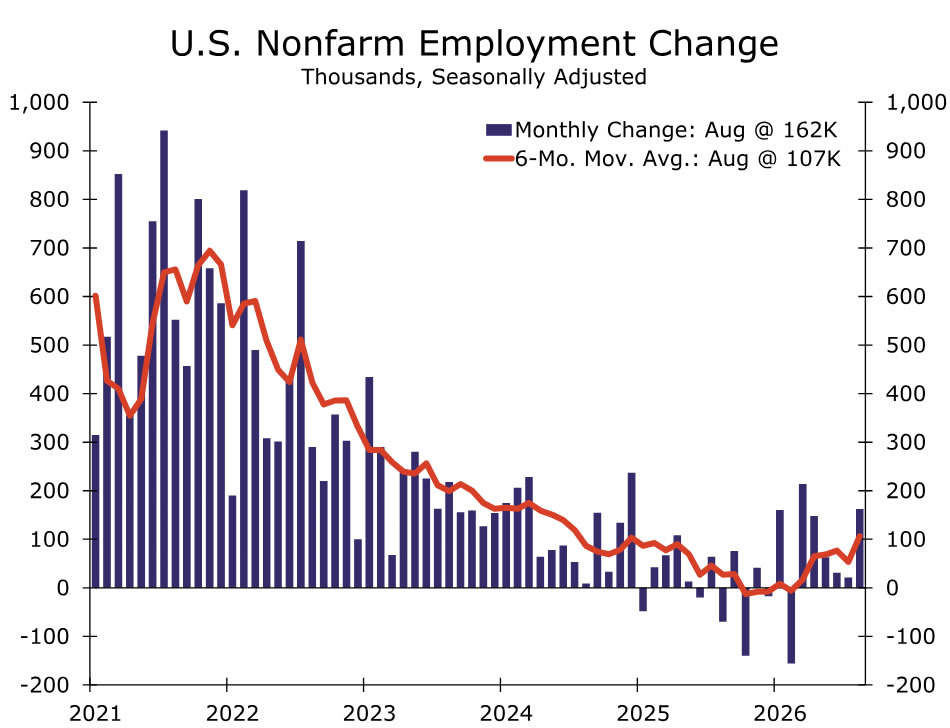
We expect nonfarm payroll growth to slow to 90K in September following August’s stronger-than-expected gain. Recent labor market data continue to point to a labor market that is resilient. Hiring measures from regional Fed surveys and small business surveys remain higher than a year ago, initial jobless claims continue to hover near multi-decade lows, and job postings have started to perk up modestly. One line item to watch: local government education payrolls, which saw a steep -62K decline in July and a partial 50K rebound in August. In theory, seasonal factors should smooth through this, but with the school year now underway, we’re on guard for continued volatility in this sector. Overall, the data suggest labor demand remains sufficient to support decent job growth.
We expect the unemployment rate to hold steady. Labor force participation showed tentative signs of stabilization in August after weakening through much of the year. Further normalization in labor supply growth could place modest upward pressure on the unemployment rate by the end of the year, but we do not expect that to happen in September. At 4.1%, the unemployment rate remains low by historical standards and would be consistent with a labor market where supply and demand are broadly in balance.
Wage growth should remain muted. We expect average hourly earnings to rise 0.3% over the month, lifting the year-over-year pace to 3.2%. While monthly wage gains have bounced around in recent months, the broader trend remains one of subdued labor cost growth. That should reinforce the view that the labor market is not generating meaningful upward pressure on inflation.
Source: U.S. Department of Labor and Wells Fargo Economics
Advanced Economies Week Ahead
Canada Monthly GDP • Tuesday
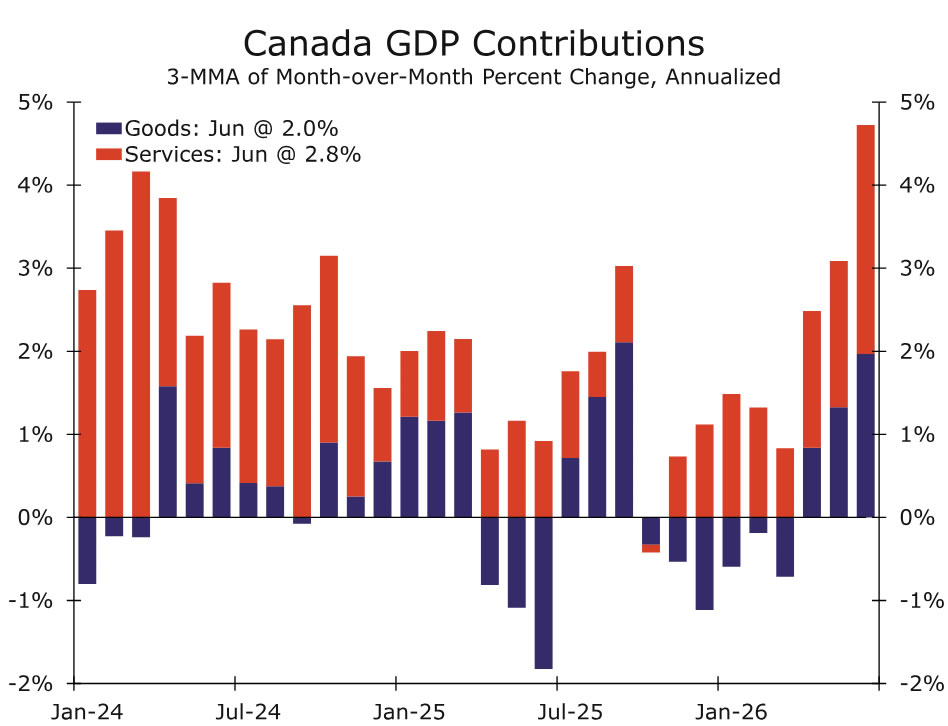
We expect Canadian economic activity to stall in July following a surprisingly resilient first half of the year. While growth appears to have lost some momentum at the start of Q3, the available data continue to suggest an economy that is slowing rather than contracting outright amid ongoing trade policy uncertainty. Statistics Canada estimates gains in real estate, rental & leasing and professional, scientific & technical services were offset by declines in retail trade and manufacturing—a mix that points to some divergence between a relatively stable service sector and goods-producing industries that remain more exposed to uncertainty surrounding trade and external demand.
For the Bank of Canada, the growth outlook remains a key part of an increasingly nuanced policy debate. Recent resilience in activity raises the risk that elevated energy prices and related inflation pressures prove more persistent than expected. At the same time, uncertainty surrounding trade policy and its potential effects on hiring, investment and consumer demand continue to argue for caution. On balance, a broadly stable July GDP reading should do little to shift the near-term policy outlook. While we don’t see it materially strengthening the case for rate cuts, recent remarks from Governor Macklem speak to how attentive the bank is to the recent inflation trajectory.
Source: Haver Analytics and Wells Fargo Economics
Reserve Bank of Australia Mon. Policy Meeting • Tuesday
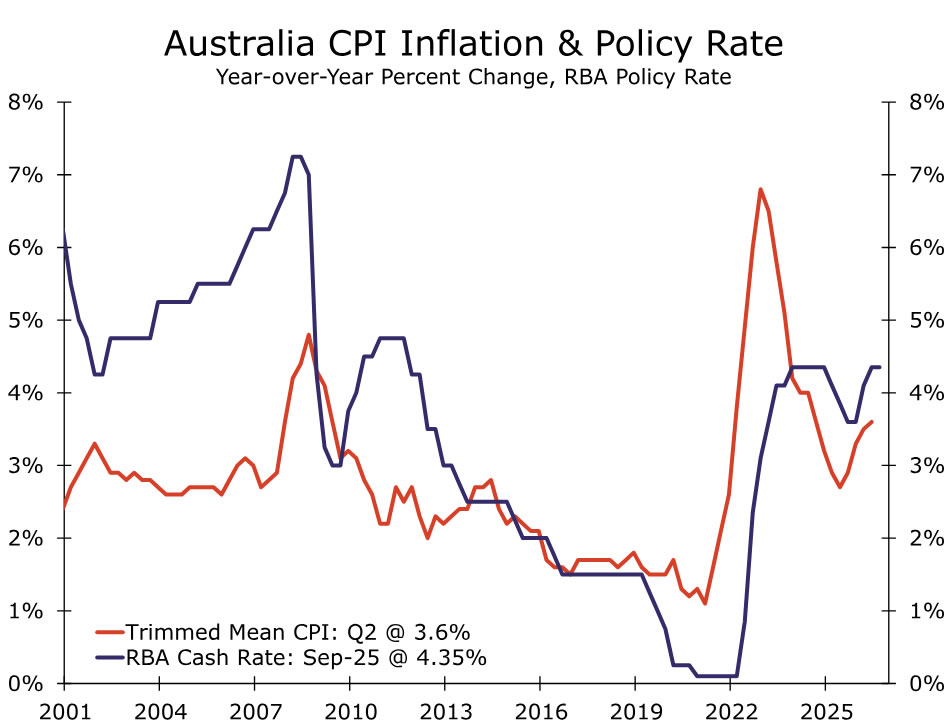
Next week, we expect the Reserve Bank of Australia (RBA) to raise its Cash Rate by 25 bps to 4.60%, which we see as the terminal rate. Persistent inflation pressures remain a concern, with energy prices at the pump near historic highs and at risk of keeping inflation elevated for longer. Governor Bullock and other RBA board members have repeatedly stressed that policy must limit indirect effects and keep inflation expectations anchored.
At the same time, signs of softer activity and labor demand should reduce the need for further tightening. September’s PMIs fell to a three-month low and pointed to modest growth, while the unemployment rate rose to 4.6%. We do not think these developments will prevent a hike next week, particularly as Bullock has indicated that unemployment between 4.5% and 5.0% could help ease inflation pressures.
After next week’s move, the RBA should have room to assess how this year’s rate hikes are feeding through to the economy. Despite markets pricing further tightening, subdued growth and early signs of labor market rebalancing support our view that 4.60% will mark the peak. A follow-up hike remains a risk, though it will depend on the inflation, labor market and growth data after the meeting.
Source: Bloomberg Finance L.P. and Wells Fargo Economics
Eurozone CPI • Friday
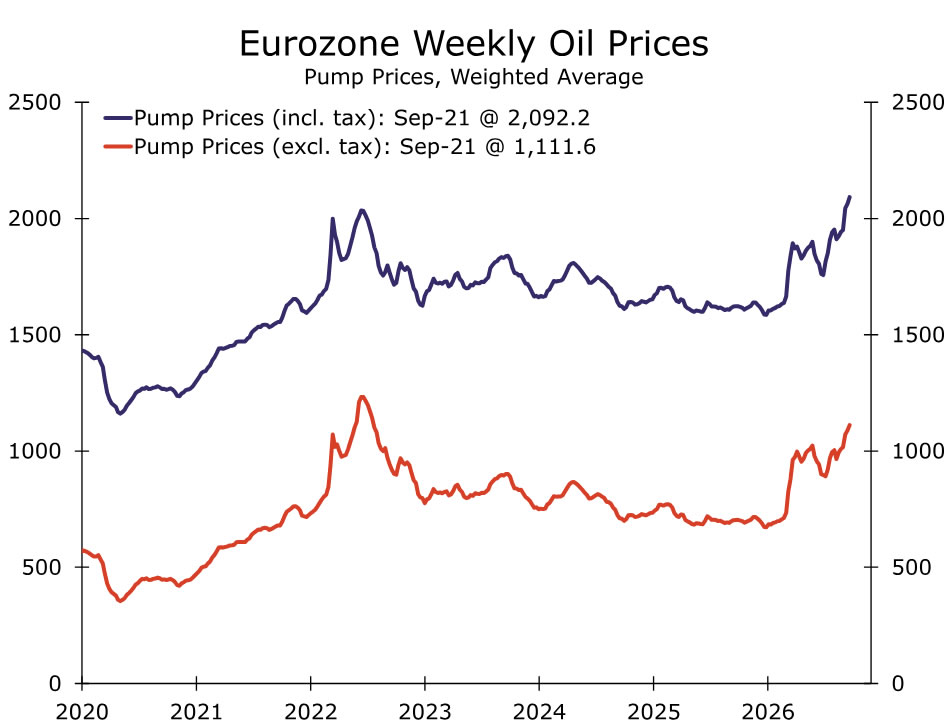
We expect Eurozone headline inflation to rise from 3.2% to 3.6% year over year in September, while core inflation should increase from 2.4% to 2.5%. Services inflation slowed to 3.0% last month, but next week’s report will provide an important test of whether higher energy costs are beginning to generate second-round effects. Fuel prices at the pump, including taxes, now exceed their 2022 peak, which could keep inflation pressures elevated.
At the same time, September’s PMIs suggest activity remains resilient and support growth of around 0.4% in Q3, with some of that momentum likely to carry into Q4. The combination of firmer inflation and steady activity should keep another rate hike in play. We expect one final 25 bps hike, which would bring the Deposit Rate to a terminal rate of 2.75%. However, the outlook will remain data dependent, particularly if underlying inflation rises by more than expected.
Source: European Commission and Wells Fargo Economics
EM Week Ahead
China PMIs • Wednesday
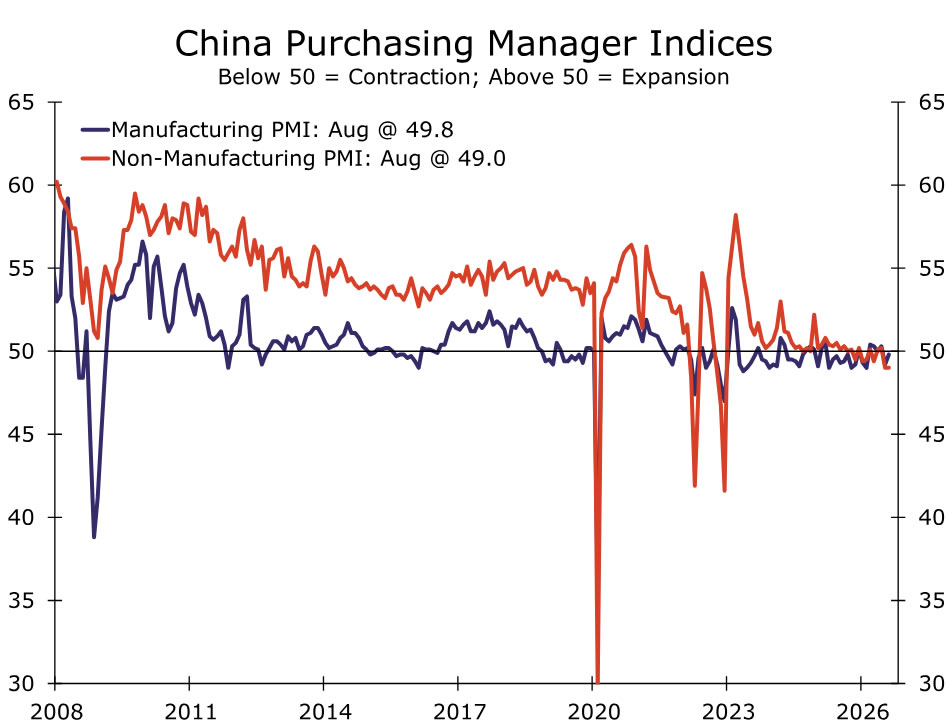
China’s September PMIs, due next week, should provide further insight into whether the economy regained momentum after a period of slower activity. Consensus expectations are for a modest improvement in manufacturing, supported by external demand for high-tech and AI-related exports. The more export-oriented RatingDog PMI, also due next week, could also remain relatively firm. Meanwhile, non-manufacturing PMIs are likely to remain subdued as continued property-sector weakness weighs on consumer confidence and domestic demand.
Faster implementation of existing fiscal stimulus and additional infrastructure spending could provide some support, though weak consumer sentiment and the ongoing property drag should limit the broader recovery. We continue to expect GDP growth to slow from 4.5% in 2026 to 4.3% in 2027.
Source: Bloomberg Finance L.P. and Wells Fargo Economics