


Our summary of recent economic events and what to expect in the weeks ahead.
Canadian Highlights
- Canadian bond yields rose alongside U.S. rates, leaving the key 5-year yield at its highest level since 2024.
- Economic data this week showed that population growth remains weak despite upward revisions, and household spending was likely resilient in Q3, underpinned by accumulated wealth and some drawdown of savings.
- The Bank of Canada is likely to remain on hold in October amid subdued core inflation and tariff-related growth risks. However, high energy prices are boosting upside inflation risks.
U.S. Highlights
- The global bond selloff intensified this week, with the 10-year Treasury yield reaching a new 19-year high.
- A proposed 90-day diesel export ban could lower domestic prices, but also curb refinery output and raise gasoline and global fuel costs.
- This week’s Fed speeches were notably unified, with all officials striking a hawkish tone amid signs that domestic activity is strengthening.
Canada – A Tug of War Between Energy Prices and Trade Uncertainty
With few top-tier data releases this week, Canadian markets largely took their cues from developments south of the border. In the U.S., stronger-than-expected economic data pushed bond yields higher. That move quickly spilled over into Canada, with the key 5-year Government of Canada yield climbing about 10 bps to around 3.7% (as of writing), a level last seen in 2024. This bond yield underpins pricing for the popular 5-year fixed-rate mortgage. Since July, the yield has risen about 70 bps, putting upward pressure on borrowing costs.
Elsewhere, oil prices moved lower over the week as crude exports from Saudi Arabia improved and there was renewed optimism around a U.S.-Iran deal. This provided some modest relief at the pumps for diesel prices, although gasoline prices were little changed. Even so, both remain elevated and are on track to put upward pressure on inflation this month.
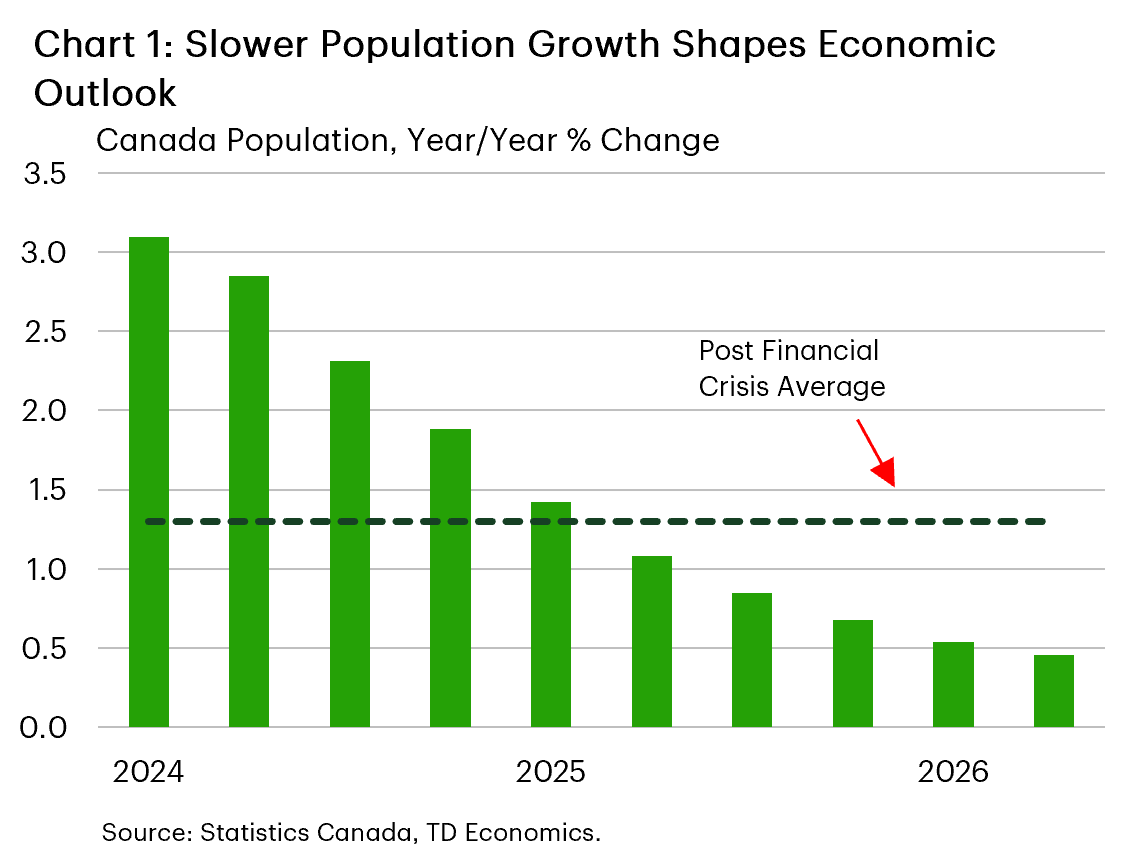
This week’s economic data painted a mixed picture. Canada’s population grew a modest 0.5% year-on-year at the start of the second quarter (Chart 1). However, that was stronger than we had anticipated, and historical population figures were also revised higher. Even with these adjustments, the broader message remains unchanged – population growth is weak and is likely to stay that way for some time. Over time, this should weigh on domestic demand and labour force growth – the latter of which should put downward pressure on the unemployment rate.
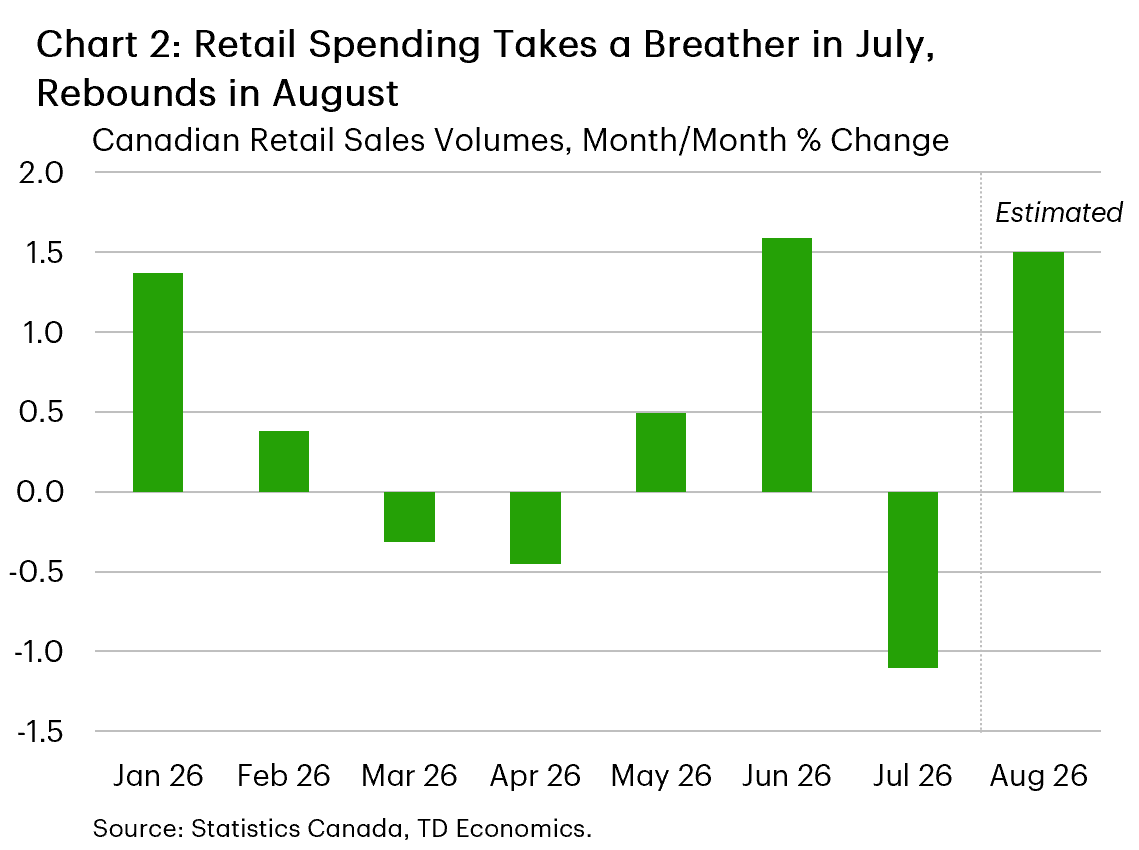
The week also provided a pulse check on the Canadian consumer. Inflation-adjusted retail sales volumes fell 1.1% month-on-month (m/m) in July, signalling some softness in household spending at the start of Q3. However, this followed a strong second quarter for consumption, making some moderation unsurprising (Chart 2). At the same time, StatCan’s preliminary estimate pointed to a 1.3% m/m rebound in nominal sales in August, comfortably outpacing inflation and suggesting a solid increase in volumes. Taken together, the data remain consistent with our expectation for healthy consumption growth in Q3, supported by wealth and a drawdown of savings.
For the Bank of Canada, there was likely little in this week’s data to materially alter the policy outlook. We continue to expect the Bank to remain on hold through the remainder of the year. Core inflation is likely to remain within the Bank’s comfort zone, and recently imposed tariffs should weigh on economic growth, providing little argument for higher rates. Financial markets are more hawkish, however, and are expecting at least one rate hike by year-end. We acknowledge the upside risk to inflation from elevated energy prices, a concern Governor Macklem reiterated in a speech this week. Whether the Bank ultimately raises rates will depend on which force exerts greater influence on inflation – the pass-through from higher energy costs or the drag on growth from trade uncertainty, and how sturdy demand is generally in Canada. For now, inflation excluding energy is contained at 2.3%, while Governor Macklem noted that growth could slow meaningfully in Q4 because of the new tariffs. Taken together, this supports the case for a pause in the near term, although upside inflation risks are clearly building.
U.S. – Resilient Growth Keeps the Fed on Edge
The global bond selloff intensified this week, with the U.S. 10-year Treasury yield reaching a 19-year high of 5.22%. The rout reflected a confluence of factors: strong PMI data pointing to resilient growth and persistent inflation pressures, hawkish Fed commentary, and lackluster demand at a five-year Treasury auction. Geopolitical developments added to the uncertainty. Iran’s president told the UN General Assembly that reopening the Strait of Hormuz remained conditional on the U.S. lifting its blockade on Iranian exports, dashing hopes for any near-term diplomatic breakthrough. Even so, oil prices fell 6% on the week to $94 per barrel as Saudi Arabia resumed operations on its East-West Pipeline – a key artery that transports roughly 4% of global oil supply. Meanwhile, the only meaningful outcome from this week’s meeting between President Trump and President Xi was an extension to the U.S.–China trade truce to January 2027, pushing back a November expiry and averting a renewed escalation toward the triple-digit tariffs.
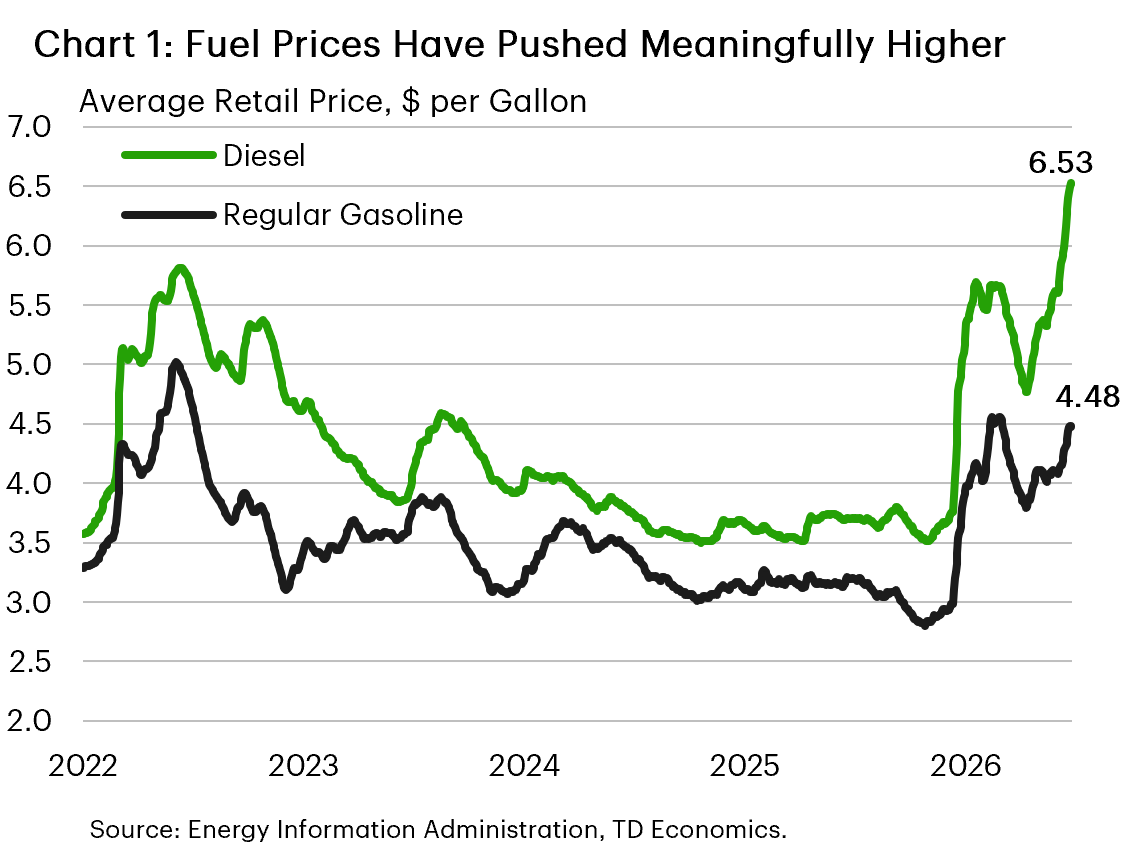
Despite the pullback in crude prices, refined-product markets remain tight. Retail diesel prices climbed above $6.50 per gallon while regular gasoline is hovering at $4.50 (Chart 1). The sharp rise in fuel costs prompted President Trump to propose a 90-day ban on diesel exports. Because the U.S. supplies roughly 20% of globally traded diesel, a ban would immediately redirect more supply to the domestic market, providing some near-term relief at the pump. However, the effects would vary considerably by region. The Gulf Coast, home to more than half of U.S. refining capacity, produces substantially more fuel than it consumes, while the East Coast relies partly on imports. An export ban would therefore strand excess supply on the Gulf Coast while tightening global markets. It could also create broader distortions because refineries jointly produce gasoline, diesel, and jet fuel. If surplus diesel forced refiners to reduce crude throughput, supplies of gasoline and jet fuel could also tighten, adding upward pressure to their prices.
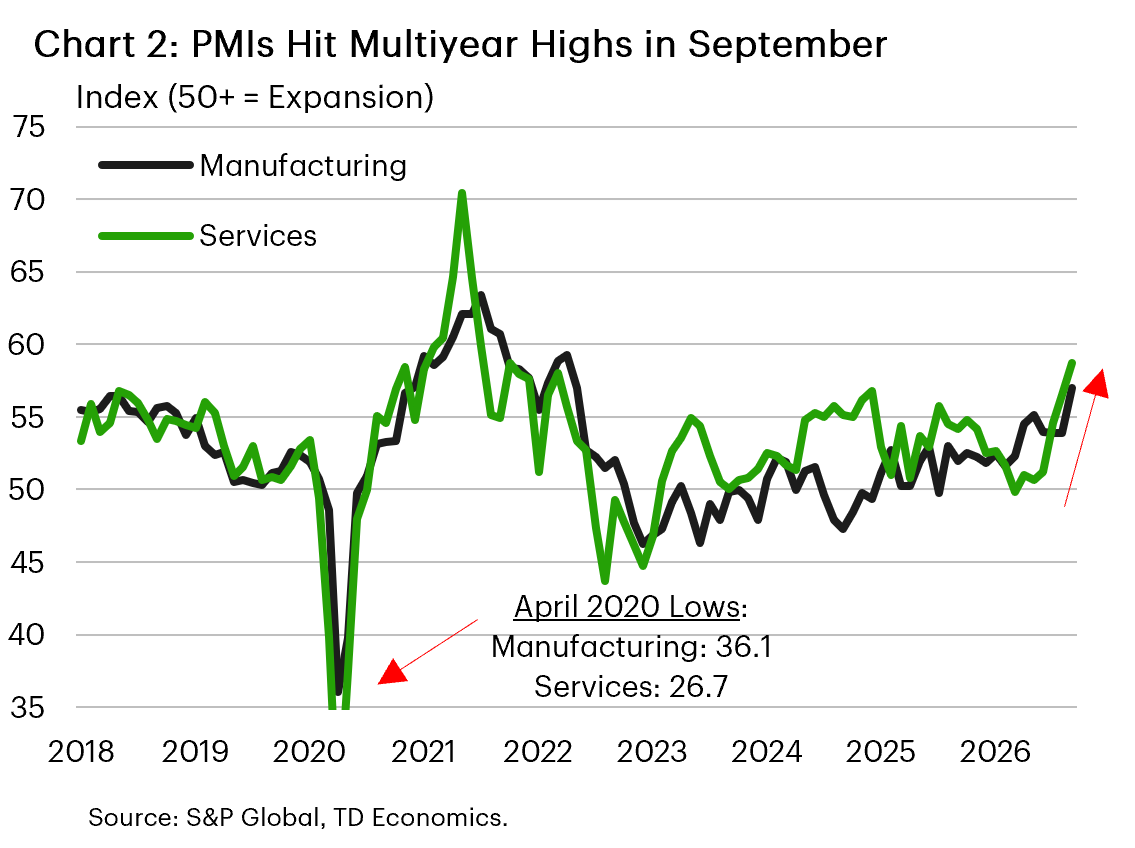
Simply put, there is no easy way to lower refined-product prices without a corresponding pullback in crude oil – and that appears unlikely in the near term. As a result, the second-round effects of higher energy costs may persist longer than previously expected. This has become a growing concern for Fed officials, particularly as strong aggregate demand also appears to be keeping inflation elevated. That concern was reinforced by S&P’s flash estimates of manufacturing and services PMIs for September, which showed activity expanding at its fastest pace in several years (Chart 2). The acceleration was driven largely by sharp gains in new orders and employment, while input costs also rose.
Fed officials had appeared increasingly divided earlier in the year, but this week’s remarks conveyed far greater unity, consistent with last week’s unanimous decision to raise rates. All nine officials who discussed the outlook struck a hawkish tone, and none expressed clear support for a pause. Next week’s August PCE inflation data and September employment report will be key in shaping the Fed’s next decision. Fed futures are currently pricing 66% odds of another hike in October.





