


Today’s themes:
- Dollar: gave back part of this week’s yield-driven rally, weaker against EUR, JPY, GBP, CHF, AUD and NZD (CAD the exception), but still on track for its first back-to-back weekly gain in more than three months as elevated Fed hike expectations and Treasury yields largely hold, a partial retracement, not a reversal.
- Yen: the clearest outperformer, rebounding as intervention risk moved back into focus, Trump raised Yen weakness with PM Takaichi at their September 22 meeting, Takaichi called an “undervalued yen” problematic, Minister Kiuchi said Abenomics-style reflation “is over,” and Japan conducted fresh rate checks, pulling USD/JPY back from near 160.
- AUD: firmer Friday but still down heavily on the week, not because markets expect a dovish RBA (a 25bp hike to 4.60% is essentially fully priced for Tuesday) but because traders reduced long exposure ahead of an event where the vote, tone and guidance carry more information than the decision itself.
Why it matters: These three moves share only the calendar day, not a common cause. Dollar, Yen and AUD are each responding to their own trigger, so resolving them independently is more useful than reaching for one unifying Dollar narrative. Next week brings a distinct test for each: Tuesday’s RBA vote and tone, whether verbal pressure keeps USD/JPY away from 160, and whether elevated Treasury yields can keep supporting Dollar after Friday’s give-back.
Dollar Gives Back Part of a Strong Week
Dollar weakened broadly on Friday, giving back part of this week’s yield-driven advance as traders adjusted positions into the weekend. The daily heat map showed USD lower against EUR, JPY, GBP, CHF, AUD and NZD, with CAD the main exception. That pullback comes after a powerful weekly move in which surging Treasury yields and rising expectations for further Fed tightening drove Dollar to multi-month highs. Dollar was still heading for its first back-to-back weekly gains in more than three months, with long-dated Treasury yields around multi-decade highs.
For now, Friday’s retreat looks more like a partial retracement than a reversal of the rates story. Expectations for another Fed hike remain elevated, while Treasury yields continue to hold much of their recent surge. That leaves the broader yield advantage underpinning Dollar intact even as some of the week’s accumulated gains are pared. The distinction matters: USD is genuinely weaker on the day, but there has been no corresponding collapse in the rate expectations that drove its advance.
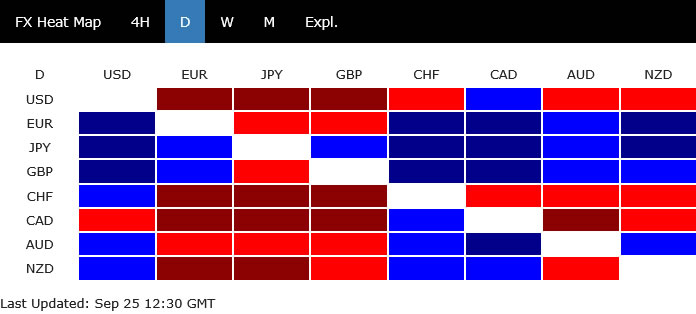
Friday’s Dollar Snapshot
- Heat map: USD lower against EUR, JPY, GBP, CHF, AUD and NZD; CAD the exception.
- Still on track for its first back-to-back weekly gain in more than three months.
- Long-dated Treasury yields: around multi-decade highs.
- Fed hike expectations remain elevated; no collapse in the rate expectations behind the week’s move.
Yen Rebounds as Intervention Risk Moves Back to the Foreground
Yen was the clearest outperformer, strengthening across the major-currency complex as a series of official signals increased the perceived risk of intervention. Japanese Finance Minister Satsuki Katayama disclosed on Friday that US President Donald Trump had raised concern about Yen weakness during his September 22 meeting with Japanese Prime Minister Sanae Takaichi in New York. Takaichi responded that, as a general principle, an “undervalued yen is problematic,” while emphasizing that monetary and fiscal policy were not discussed.
The message was reinforced from several directions. Economic Revitalization Minister Minoru Kiuchi, an ally of Takaichi’s reflationist camp, said the phase of Abenomics-style reflation policy “is over.” Japanese authorities also conducted fresh rate checks, a step closely watched because it can precede direct FX intervention. The combination of currency concern at the Trump-Takaichi meeting, tougher language from Tokyo and renewed rate checks raised the cost of maintaining short-Yen positions as USD/JPY backed away from the vicinity of 160.
That response is particularly notable after last week’s BoJ rate hike failed to provide lasting support for Yen. The central bank raised its policy rate to 1.25%, the highest in 31 years, but the divided decision and limited hawkish guidance left markets uncertain about the pace of further tightening, allowing Yen to weaken afterward. Friday’s rebound therefore reflects a different force: immediate intervention risk and growing official discomfort with currency weakness, rather than a fresh repricing of the BoJ policy path itself.
Intervention Signals This Week
- Trump raised Yen weakness with PM Takaichi at their September 22 New York meeting, disclosed by FinMin Katayama.
- Takaichi: an “undervalued yen is problematic” as a general principle; said monetary and fiscal policy were not discussed.
- Economic Revitalization Minister Kiuchi: the Abenomics-style reflation phase “is over.”
- Japan conducted fresh rate checks, a step that can precede direct FX intervention.
- USD/JPY backed away from the vicinity of 160.
- Context: last week’s BoJ hike to 1.25% (highest in 31 years) failed to give Yen lasting support due to a divided vote and limited hawkish guidance.
Aussie Stabilizes After a Week of Pre-RBA Position Reduction
Australian Dollar was firmer against USD on Friday, but that stabilization does little to erase its heavy weekly underperformance. The important distinction is that AUD is not being sold because markets have decided the RBA will deliver a dovish or divided decision. Rather, investors have been reducing long exposure ahead of Tuesday’s meeting because a 25bp hike to 4.60% is essentially fully priced while the vote, statement tone and guidance remain uncertain.
That creates an asymmetric event setup. The expected hike itself offers limited fresh upside, while a split vote or softer language around further tightening would contain genuinely new information. Conversely, a unanimous decision accompanied by firm guidance could remove some of the uncertainty that has encouraged traders to lighten AUD positions. For Friday’s wrap, the story is therefore one of stabilization after position reduction, rather than fresh Aussie weakness.
AUD’s Asymmetric Setup Ahead of Tuesday
- 25bp hike to 4.60%: essentially fully priced.
- Not priced: the vote split, statement tone and forward guidance.
- A split vote or softer tightening language would be genuinely new information.
- A unanimous decision with firm guidance could remove the uncertainty that drove position-lightening.
Three Moves, Three Different Drivers
Friday’s FX market is better understood as three distinct adjustments rather than one broad new Dollar trend. Dollar is retracing part of a yield-driven weekly rally. Yen is responding to escalating intervention signals. Aussie is stabilizing after traders reduced exposure ahead of an almost-certain but still information-rich RBA decision.
That leaves several clear tests for next week. Tuesday’s RBA vote and guidance will determine whether AUD’s pre-meeting caution was justified. For Yen, the question is whether verbal pressure and rate checks are enough to keep USD/JPY away from the 160 area or whether authorities need to escalate further. For Dollar, the key remains whether elevated Treasury yields can continue to support the broader weekly advance after Friday’s give-back.
Three Moves, Three Different Drivers
| Currency | Friday’s Move | Actual Driver |
|---|---|---|
| Dollar | Weaker across majors, CAD the exception | Partial retracement of this week’s yield-driven rally, not a reversal |
| Yen | Clear outperformer | Escalating intervention signals, not a fresh BoJ repricing |
| AUD | Firmer, but still down heavily on the week | Stabilization after pre-RBA position reduction, not a dovish RBA view |
Related Coverage
AUD & RBA Deep Dive
AUD/USD Tests 0.7000 as Markets Look Beyond an Almost Certain RBA Hike — more on why traders are lightening up on AUD despite the hike itself being priced.
US Data & Fed Watch
US Durable Goods Stall on Transport, but Core Capex Orders Accelerate — a headline-vs-underlying split that points to a stronger investment picture than the flat print suggests.
Fed Hawkishness Broadens as Paulson Backs “Modest Further Tightening” — the widening hawkish chorus behind this week’s Treasury yield surge.
Global Central Bank & Data Watch
Gold Survived the Yield Shock. Can It Survive Yields Staying Above 5%? — how the same yield surge behind Dollar’s weekly rally is testing Gold’s support.
BoE’s Bailey Says Persistent Energy Prices Could Force Higher Rates — another central bank facing the same energy-driven hike pressure as the Fed and RBA.
Germany GfK Consumer Climate Falls to -30.6 as Energy Costs Hit Income Expectations — the consumer-side cost of the same energy pressure showing up across central banks this week.
FAQ
Is Friday’s Dollar weakness a reversal of the week’s rally?
It looks more like a partial retracement. Fed hike expectations remain elevated and Treasury yields are still holding much of their surge, and Dollar is still on track for its first back-to-back weekly gain in more than three months.
Why did Yen rebound if last week’s BoJ hike didn’t help it?
Friday’s move reflects a different force: escalating official intervention signals, Trump raising Yen weakness with PM Takaichi, Takaichi calling an undervalued yen “problematic,” and fresh rate checks, rather than a new repricing of the BoJ’s policy path.
Why is AUD trading calmer if the RBA is basically certain to hike Tuesday?
The hike itself is fully priced and offers little fresh upside. What isn’t priced is the vote split, statement tone and guidance, so traders reduced long exposure ahead of the event rather than because they expect a dovish outcome.
Key Takeaways
- Dollar weakened against most majors Friday (CAD the exception), giving back part of this week’s yield-driven rally, but remains on track for its first back-to-back weekly gain in more than three months.
- Yen was the clearest outperformer as intervention risk resurfaced, Trump raised Yen weakness with PM Takaichi, Takaichi called an undervalued yen “problematic,” and Japan conducted fresh rate checks, pulling USD/JPY back from near 160.
- Last week’s BoJ hike to 1.25% (highest in 31 years) failed to give Yen lasting support due to a divided vote and limited hawkish guidance, making Friday’s rebound a different, intervention-driven story.
- AUD firmed Friday but remains down heavily on the week, reflecting position reduction ahead of Tuesday’s RBA decision rather than expectations of a dovish outcome, since a 25bp hike to 4.60% is already essentially fully priced.
- These are three independent adjustments rather than one Dollar trend: next week’s tests are Tuesday’s RBA vote and tone, whether verbal pressure keeps USD/JPY away from 160, and whether elevated Treasury yields can keep supporting Dollar after Friday’s give-back.
What to Watch Next
Tuesday’s RBA vote and guidance, for whether AUD’s pre-meeting caution was justified. Whether verbal pressure and rate checks are enough to keep USD/JPY away from the 160 area or whether Japanese authorities need to escalate further. And whether elevated Treasury yields can continue supporting Dollar’s broader weekly advance after Friday’s give-back.





