

Live Comments
UK GDP Beats June Forecast with 0.4% M/M Growth as Services Keep Economy Moving
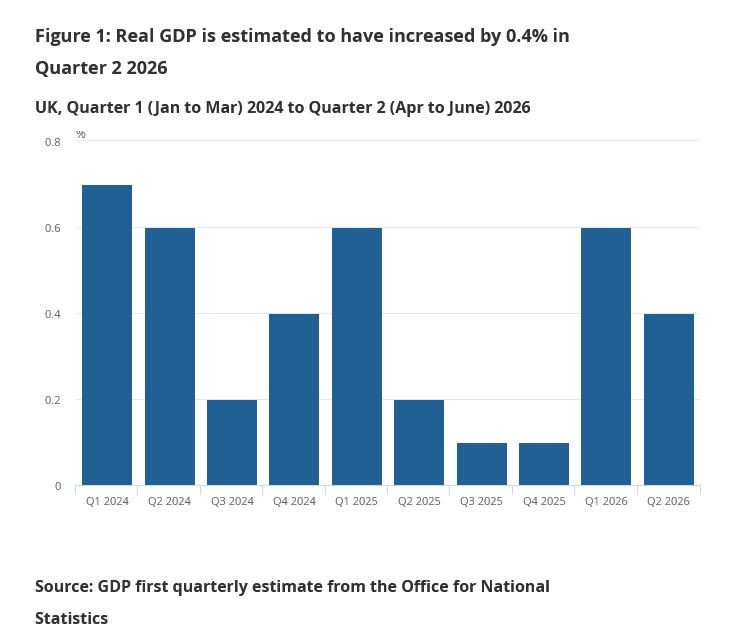
UK growth slowed in Q2, but economy finished quarter considerably better than June forecasts had suggested. GDP expanded 0.4% q/q after 0.6% growth in Q1, matching expectations, while annual growth accelerated from 0.9% to 1.2%, beating 1.1% consensus. GDP per head also increased 0.4% q/q, leaving it 1.0% higher than a year earlier. Services remained engine of expansion, growing 0.5% q/q over quarter, alongside a 0.3% rise in construction, while production stagnated.
More encouraging signal came from June. GDP rebounded from 0.0% to 0.3% m/m, versus expectations for a 0.1% decline, reversing some concern that growth was fading sharply after strong start to year. But improvement was concentrated in services, which rose 0.4%, while production contracted -0.2% and construction slipped -0.1%. Manufacturing weakened further from a revised -0.2% to -0.5%, showing that stronger headline GDP still masks considerable divergence across economy.
Overall, the report shows UK economy lost some momentum from Q1 but avoided sharper slowdown feared into quarter-end. Stronger June growth suggests a firmer handoff into Q3, although dependence on services and continuing weakness in manufacturing argue against describing recovery as broad based. For BoE, resilience in headline activity gives policymakers somewhat more room to stay focused on inflation, but GDP data alone are unlikely to materially change near-term policy stance.
Q2 GDP Summary
| Indicator | Actual | Expected | Previous |
|---|---|---|---|
| GDP q/q Q2 | 0.4% | 0.4% | 0.6% |
| GDP y/y Q2 | 1.2% | 1.1% | 0.9% |
| Services Output q/q Q2 | 0.5% | — | 0.8% |
| Production Output q/q Q2 | 0.0% | — | 0.2% |
| Construction Output q/q Q2 | 0.3% | — | — |
June GDP Summary
| Indicator | Actual | Expected | Previous |
|---|---|---|---|
| GDP q/q Q2 | 0.4% | 0.4% | 0.6% |
| GDP m/m Jun | 0.3% | -0.1% | 0.0% |
| Services Output m/m Jun | 0.4% | — | 0.1% |
| Production Output m/m Jun | -0.2% | 0.0% | -0.7% |
| Construction Output m/m Jun | -0.1% | — | -0.8% |
| Manufacturing Production m/m Jun | -0.5% | -0.3% | -0.2% |
Key Takeaways
- UK GDP slowed from 0.6% to 0.4% q/q in Q2, exactly matching expectations, while annual growth strengthened from 0.9% to 1.2%, beating 1.1% forecast.
- June GDP surprised clearly on upside, accelerating from 0.0% to 0.3% m/m against expectations for a -0.1% contraction.
- Services remained main growth engine, rising 0.5% q/q in Q2 and 0.4% m/m in June.
- Growth was uneven beneath headline, with production flat in Q2 and down -0.2% m/m in June, while manufacturing fell -0.5%.
- GDP per head rose 0.4% q/q and 1.0% y/y, adding a more constructive dimension to headline growth.
- Overall picture is of UK economy slowing rather than stalling, with stronger June activity providing a firmer handoff into Q3.
- For BoE, data modestly support patience by showing economy is holding up better than feared, though weak production prevents a broad-based growth signal.
RBA’s Kent Says Tightening Is Working, but Policy Restraint Remains Hard to Gauge
RBA Assistant Governor Christopher Kent said in a speech today that monetary policy is “somewhat restrictive” and that tightening delivered earlier this year is working through economy. He pointed to higher borrowing costs and mortgage payments, weaker established housing market, stronger Australian Dollar and slowing aggregate demand. Importantly, Kent stressed that this slowdown is deliberate, saying it is “intended and is needed to bring inflation back to target.” He added that estimates of nominal neutral rate, while imprecise, also support assessment that current policy stance is restrictive.
At same time, Kent cautioned that cash rate alone does not determine how restrictive financial conditions have become. Housing appears to have softened “by somewhat more than the recent increase in interest rates would imply,” potentially making conditions tighter than otherwise. But global forces are working in opposite direction. Resilient demand driven by AI-related investment and higher offshore yields linked to rising public debt could make Australian financial conditions “less restrictive than otherwise,” complicating Board’s assessment of how much restraint is actually being delivered.
Comments reinforce RBA’s current policy optionality rather than signaling tightening cycle is finished. Kent clearly acknowledged that higher rates are slowing demand as intended, but he stopped short of saying policy is sufficiently restrictive. Instead, Board will continue “carefully considering the wide range of factors that influence financial conditions and the restrictiveness of monetary policy” as it updates outlook. That fits this week’s hawkish hold: RBA sees tightening working, but still lacks enough certainty over effective restraint to rule out another hike if inflation risks re-emerge.
Key Takeaways
- RBA Assistant Governor Christopher Kent said monetary policy is “somewhat restrictive” and that tightening earlier this year is working through economy.
- Higher borrowing costs, mortgage payments, softer housing, stronger Australian Dollar and slower aggregate demand all point to tighter financial conditions.
- Kent stressed demand slowdown is “intended and is needed to bring inflation back to target,” suggesting RBA does not yet view weaker activity as excessive.
- Housing may be making conditions more restrictive than cash rate alone implies, after weakening more than recent rate increases would suggest.
- Resilient global demand from AI-related investment and higher offshore yields are pulling in opposite direction, potentially making Australian conditions “less restrictive than otherwise.”
- Remarks reinforce RBA’s policy optionality: tightening is working, but uncertainty over effective restraint means Board is not yet declaring tightening cycle complete.
Japan PPI Cools Slightly to 7.2% Y/Y, but Weak Yen Keeps Import Inflation Near 30%
Japan’s producer inflation eased slightly in July, but imported cost pressures remained elevated as weak Yen continued to amplify overseas price increases. Corporate Goods Price Index slowed from revised 7.3% to 7.2% y/y, undershooting 7.4% consensus. Monthly increase moderated from 0.5% to 0.1%.
Electricity was largest contributor to monthly increase, adding around 0.23 percentage point, while declines in energy-related and chemical prices provided some offset. Excluding extra summer electricity charges, index was unchanged from June, suggesting domestic pipeline inflation is no longer accelerating as sharply as earlier in year.
External pressure was much stronger. Yen-based import price inflation eased only slightly from 30.1% to 29.1% y/y, compared with 18.1% to 17.7% on contract-currency basis, highlighting how currency weakness continues to magnify imported inflation for Japanese businesses.
For BoJ, data offer only limited comfort. Softer headline PPI and flat underlying monthly reading reduce urgency for immediate action, but producer inflation at 7.2% and import costs close to 30% remain far too high to dismiss. With BoJ increasingly focused on preventing inflation from overshooting rather than simply generating price growth, persistent currency-driven import pressure keeps normalization case intact even as domestic producer inflation cools at margin.
Data Summary
| Indicator | Actual | Expected | Previous |
|---|---|---|---|
| PPI m/m | 0.1% | — | 0.5% |
| PPI y/y | 7.2% | 7.4% | 7.3% |
| Import Prices, Yen Basis y/y | 29.1% | — | 30.1% |
| Import Prices, Contract Currency Basis y/y | 17.7% | — | 18.1% |
| Export Prices, Yen Basis y/y | 18.9% | — | 20.9% |
| Export Prices, Contract Currency Basis y/y | 10.1% | — | 11.4% |
Key Takeaways
- Japan PPI eased from revised 7.3% to 7.2% y/y in July, undershooting 7.4% consensus, while monthly increase slowed from 0.5% to 0.1%.
- Excluding extra summer electricity charges, producer prices were unchanged m/m, pointing to moderation in underlying domestic pipeline pressure.
- Electricity was largest positive contributor to July increase, adding around 0.23 percentage point, partly offset by declines in energy-related and chemical prices.
- Yen-based import inflation eased only from 30.1% to 29.1%, remaining far above 17.7% increase measured in contract currencies.
- Wide gap between yen- and contract-currency import prices shows Yen weakness is still materially amplifying imported cost pressure.
- Data offer BoJ some comfort on domestic producer-price momentum, but persistently high import inflation keeps broader normalization case intact.