

Live Comments
Australia Westpac Consumer Sentiment Rebounds After RBA Hold, but Pessimism Persists
Australian consumer sentiment improved in August, with Westpac–Melbourne Institute Consumer Sentiment Index rising 83.9 to 88.9, a 6.0% monthly gain. Improvement was concentrated among mortgage holders and emerged almost entirely after RBA’s August 11 decision to keep rates unchanged. Current financial assessments led rebound, with family finances versus a year ago jumping 71.1 to 80.0, while time to buy a dwelling rose 85.4 to 95.7. Even so, headline index remains below neutral 100 and 9.7% weaker than a year earlier.
Forward-looking measures were less convincing. Family finances over next 12 months edged up 96.5 to 98.2, while expectations for economic conditions over next year rose 78.3 to 82.8. Unemployment Expectations Index deteriorated 129.9 to 135.7, moving above its long-run average, while House Price Expectations fell 118.0 to 110.8. Consumers also continue to anticipate tighter borrowing conditions: 59% expect mortgage rates to rise further, although RBA hold reduced uncertainty and lifted share expecting rates to stay unchanged or fall.
For RBA, survey shows August hold provided immediate relief without restoring confidence. Household pessimism, rising unemployment concerns and relatively subdued forward expectations suggest three hikes this year are still working through economy. Westpac argues Board is unlikely to have enough new evidence by September 28–29 meeting to conclude upside inflation risks have materialised, particularly with only one monthly inflation print ahead and labor market easing more than RBA had previously forecast. That keeps September tilted toward another hold even as Board retains explicit option to hike again.
Data Summary
| Component | Current | Previous | Trend |
|---|---|---|---|
| Consumer Sentiment Index | 88.9 | 83.9 | Improved 6.0% m/m |
| Family finances vs a year ago | 80.0 | 71.1 | Strong improvement |
| Family finances next 12 months | 98.2 | 96.5 | Modest improvement |
| Economic conditions next 12 months | 82.8 | 78.3 | Improved |
| Economic conditions next 5 years | 89.8 | 87.1 | Improved |
| Time to buy a major household item | 93.8 | 86.8 | Improved strongly |
| Time to buy a dwelling | 95.7 | 85.4 | Improved strongly |
| Unemployment Expectations Index | 135.7 | 129.9 | Job concerns increased |
| House Price Expectations Index | 110.8 | 118.0 | Weakened |
| Interest Rate Expectations Index | 158.8 | 162.6 | Eased slightly |
Key Takeaways
- Australian consumer sentiment rebounded 6.0% in August, with headline index rising from 83.9 to 88.9.
- Improvement was concentrated among mortgage holders and emerged almost entirely after RBA’s August 11 hold decision.
- Despite rebound, sentiment remains firmly pessimistic, below neutral 100 and 9.7% lower than a year ago.
- Current financial conditions improved more sharply than forward-looking expectations, suggesting consumers felt immediate relief without becoming substantially more confident about outlook.
- Family finances versus a year ago jumped from 71.1 to 80.0, while time to buy a dwelling rose from 85.4 to 95.7.
- Labor-market anxiety increased, with Unemployment Expectations Index rising from 129.9 to 135.7, above its long-run average.
- House Price Expectations Index fell from 118.0 to 110.8, pointing to weaker housing-market confidence.
- 59% of respondents still expect mortgage rates to rise further, although RBA hold reduced uncertainty and increased share expecting rates to stay unchanged or decline.
- Survey supports case for RBA patience in September: households are responding to restrictive policy, while rising unemployment concerns argue against assuming economy can absorb another hike easily.
Canada CPI Accelerates to 3% as Energy Shock Meets Firmer Core Inflation
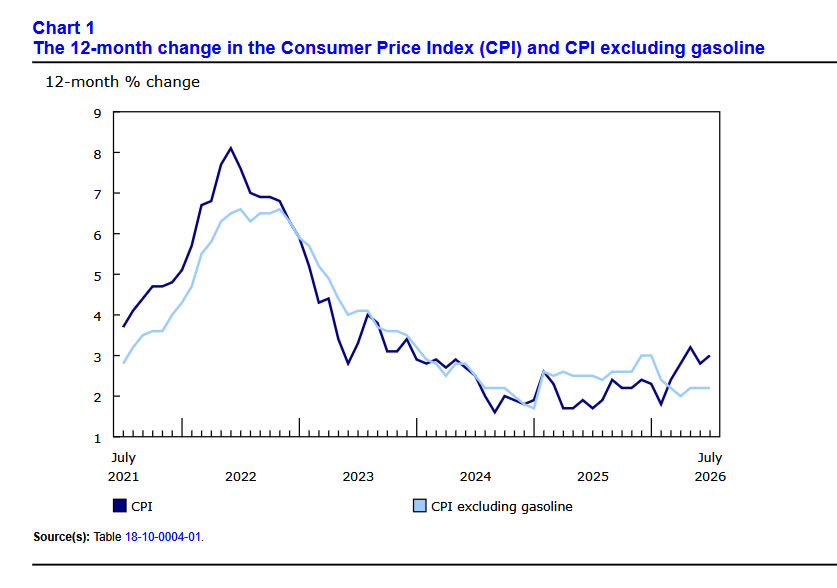
Canada inflation accelerated more than expected in July, with headline CPI rising from 2.8% to 3.0% y/y, above 2.9% consensus. Monthly CPI swung from -0.4% m/m to +0.5%, also stronger than 0.4% expected.
Gasoline was major driver, with annual price growth accelerating from 20.5% to 25.7% as Middle East conflict, Strait of Hormuz blockade and partial closure of Red Sea shipping routes pushed energy costs higher. Travel tours also contributed, while slower grocery inflation provided some offset.
Importantly, July report was not purely an energy story. CPI excluding gasoline held at 2.2% y/y for third consecutive month, while BoC core gauges all edged higher. Median CPI rose from 1.9% to 2.0%, matching expectations; Trimmed CPI increased from 1.8% to 1.9%, above 1.8% forecast; and Common CPI climbed from 2.6% to 2.7%, compared with 2.5% expected. That combination suggests underlying inflation pressure firmed even as gasoline accounted for much of headline acceleration.
Energy-driven headline inflation alone could potentially be looked through by the BoC, but simultaneous acceleration across core measures makes report harder to dismiss as temporary oil noise. Key question now is whether higher energy costs begin feeding more broadly into underlying prices, or whether softer domestic demand keeps second-round effects contained and allows BoC to maintain extended hold.
Data Summary
| Indicator | Actual | Expected | Previous |
|---|---|---|---|
| CPI y/y | 3.0% | 2.9% | 2.8% |
| CPI m/m | 0.5% | 0.4% | -0.4% |
| CPI ex-Gasoline y/y | 2.2% | — | 2.2% |
| CPI Median y/y | 2.0% | 2.0% | 1.9% |
| CPI Trimmed y/y | 1.9% | 1.8% | 1.8% |
| CPI Common y/y | 2.7% | 2.5% | 2.6% |
| Gasoline y/y | 25.7% | — | 20.5% |
Key Takeaways
- Canada headline CPI accelerated from 2.8% to 3.0% y/y, above 2.9% consensus, while monthly CPI rebounded from -0.4% to +0.5%.
- Gasoline was major driver, with annual price growth accelerating from 20.5% to 25.7% amid Middle East conflict, Strait of Hormuz blockade and partial closure of Red Sea shipping routes.
- Travel tours also contributed to faster headline inflation, while slower growth in grocery prices provided some offset.
- Inflation was not purely an energy story. CPI excluding gasoline held at 2.2% for third straight month.
- BoC’s core gauges all firmed: Median rose from 1.9% to 2.0%, Trimmed from 1.8% to 1.9%, and Common from 2.6% to 2.7%.
- Trimmed and Common CPI both exceeded expectations, making July report more hawkish than headline gasoline surge alone would suggest.
China’s Supply-Demand Divide Widens as Investment Slumps and Retail Sales Stall
China’s July activity data reinforced widening split between resilient production and weak domestic demand, with all three major readings undershooting expectations. Industrial production slowed from 5.3% to 4.5% y/y, below 4.8% consensus. Manufacturing nevertheless continued to provide support, particularly equipment manufacturing and high-tech manufacturing, which grew 9.7% and 13.8% y/y respectively over first seven months.
Consumption disappointed more clearly. Retail sales growth slowed from 1.0% to just 0.6% y/y in July, well below expectations for 1.6%. Sales rose only 0.06% m/m, while consumer-goods retail sales increased just 1.2% over first seven months. Services consumption performed better, with retail sales of services up 5.0%, but overall household spending remains too weak to provide a convincing domestic growth engine.
Investment delivered biggest downside surprise. Fixed-asset investment deteriorated from -5.7% to -6.7% y/y year-to-date, weaker than -6.0% expected. Real-estate development investment plunged -19.2%, but weakness extended well beyond property: infrastructure investment fell -3.6%, manufacturing investment declined -1.7%, and private investment dropped -9.4%. High-tech investment, up 5.0%, remained one of few pockets of strength.
Taken together, simultaneous misses in production, consumption and investment sharpen China’s central macro imbalance rather than simply pointing to a broad slowdown. Supply-side activity is still holding up better than domestic demand, while investment weakness is spreading beyond property. NBS itself acknowledged that imbalance between strong supply and weak demand remains acute, keeping pressure on policymakers to support household spending and private-sector activity more forcefully.
Data Summary
| Indicator | Actual | Expected | Previous |
|---|---|---|---|
| Industrial Production y/y | 4.5% | 4.8% | 5.3% |
| Equipment Manufacturing YTD y/y | 9.7% | — | — |
| High-Tech Manufacturing YTD y/y | 13.8% | — | — |
| Manufacturing PMI | 49.2 | — | — |
| Retail Sales y/y | 0.6% | 1.6% | 1.0% |
| Retail Sales m/m | 0.06% | — | — |
| Consumer Goods Retail Sales YTD y/y | 1.2% | — | — |
| Services Retail Sales YTD y/y | 5.0% | — | — |
| Fixed Asset Investment YTD y/y | -6.7% | -6.0% | -5.7% |
| FAI ex-Real Estate YTD y/y | -3.7% | — | — |
| Real Estate Development Investment YTD y/y | -19.2% | — | — |
| Infrastructure Investment YTD y/y | -3.6% | — | — |
| Manufacturing Investment YTD y/y | -1.7% | — | — |
| Private Investment YTD y/y | -9.4% | — | — |
| High-Tech Industry Investment YTD y/y | 5.0% | — | — |
Key Takeaways
- All three major activity indicators missed expectations, reinforcing evidence that China’s July momentum weakened more than markets anticipated.
- Industrial production slowed from 5.3% to 4.5% y/y, but still held up better than domestic-demand indicators.
- Retail sales growth weakened from 1.0% to just 0.6% y/y, far below 1.6% consensus, highlighting persistent consumer caution.
- Fixed asset investment deteriorated from -5.7% to -6.7% y/y YTD, versus -6.0% expected, with weakness extending beyond property into infrastructure, manufacturing and private investment.
- Real-estate development investment fell -19.2% y/y in first seven months, while private investment declined -9.4%, underscoring continued weakness in traditional domestic growth engines.
- High-tech manufacturing and investment remained relative bright spots, but they were not enough to offset broader demand weakness.
- Overall, July data strengthen “strong supply, weak demand” narrative explicitly acknowledged by NBS, keeping pressure on Beijing to do more to support consumption and private-sector investment.