

Live Comments
RBA’s Hawkish Warning Gets Clearer: Disinflation Stalls, Rates Rise Again
RBA Deputy Governor Andrew Hauser sharpened central bank’s tightening warning on Wednesday, saying another rate increase would follow if inflation stops improving. Speaking at an event in Queensland, Hauser said: “If those upside risks to inflation crystallise and we don't see inflation coming down, we will have to raise interest rates again and we will do so.” The message reinforces RBA’s August decision to retain explicit tightening optionality even after holding cash rate at 4.35%, following 75bps of increases since February.
Hauser identified three upside risks in particular: Middle East conflict, global AI boom and weak productivity growth. Middle East risk has become increasingly relevant as oil prices climb again, potentially feeding energy and transport costs into inflation. AI investment presents a different challenge by supporting demand and competing for resources, while poor productivity limits economy’s ability to grow without generating additional price pressure. Taken together, these risks leave RBA unwilling to assume recent disinflation will continue automatically.
At the same time, Hauser acknowledged that tighter monetary policy is already slowing economy. RBA has seen “a bit of a slowdown in consumption and employment growth,” although he added that policymakers “need to see more still.” He rejected a more severe characterization of current conditions: “That is not a slump. It is not a depression... but it's a lot slower than Australia has known in the past and it's a lot slower than recently.” Recent softer inflation readings and weaker housing conditions therefore matter, but RBA does not yet appear convinced demand has cooled enough to neutralise upside risks.
Markets are reflecting that uncertainty, pricing around a 60% chance of another increase to 4.60% by December as renewed oil strength brings imported inflation risks back into focus. Hauser’s remarks do not make another hike inevitable, but they clarify RBA’s reaction function: continued disinflation allows policy to stay on hold; stalled inflation combined with materialisation of oil, AI or productivity risks would bring tightening back. That leaves upcoming inflation and labor-market data as the evidence needed to decide which side of that conditional warning becomes relevant.
Key Takeaways
- RBA Deputy Governor Andrew Hauser made tightening bias more explicit, saying rates “will have to” rise again if upside inflation risks materialise and disinflation stalls.
- Hauser identified Middle East conflict, global AI boom and weak productivity as three key upside risks to inflation.
- He acknowledged consumption and employment growth have slowed, but said RBA “needs to see more still,” indicating current cooling is not yet sufficient to remove inflation concern.
- Hauser rejected a recessionary interpretation, saying economy is “not a slump” or depression, but is growing much more slowly than Australia has been used to.
- Markets are pricing roughly 60% probability of another hike to 4.60% by December, reflecting renewed concern that oil and other inflation risks could keep RBA tightening option alive.
- Core message is conditional but hawkish: continued disinflation supports a hold; stalled disinflation alongside stronger upside risks would bring another hike back into play.
Australia Annual Wage Growth Slows to 3.2% as Private-Sector Pay Moderates
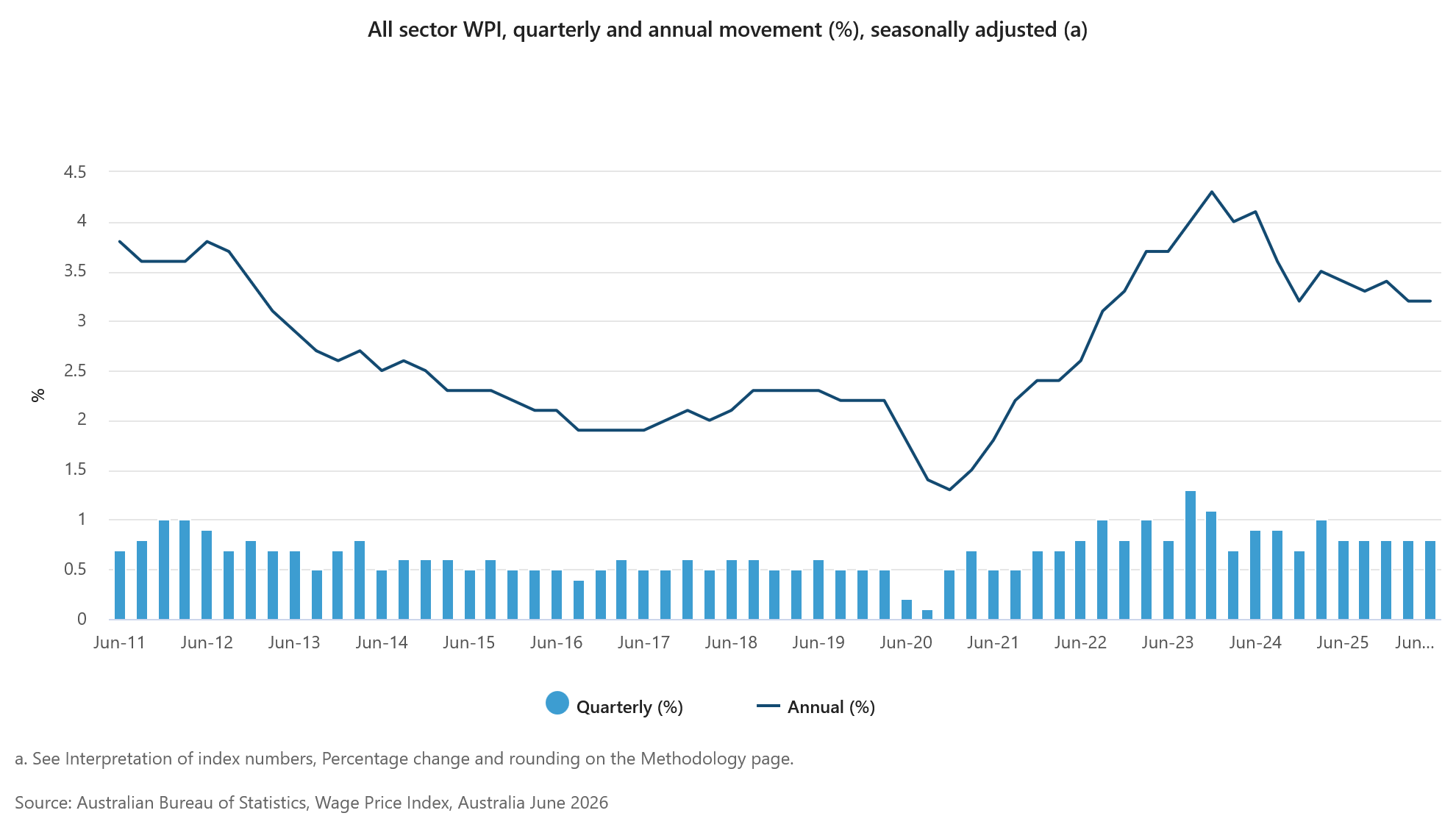
Australia’s wage growth held steady on a quarterly basis but continued to cool over the year, offering some reassurance that labor-cost pressures are not reaccelerating. Wage Price Index rose 0.8% q/q in Q2, matching expectations and extending the same quarterly pace for a fifth consecutive quarter. Annual wage growth slowed from 3.4% a year earlier to 3.2%, remaining well below the 4.3% peak reached in late 2023.
Moderation was clearer in private sector. Private wages rose 0.7% q/q, while annual growth eased from 3.2% in Q1 to 3.1%, and from 3.4% in Q2 2025. Public-sector wages were firmer at 0.9% q/q and 3.4% y/y, with annual growth unchanged from Q1 but down from 3.7% a year earlier. Public-sector pay has now outpaced private-sector growth for six consecutive quarters, driven in Q2 by state government public-service increases and scheduled Commonwealth agreement rises.
The distribution of wage increases also points toward gradual cooling. 79% of jobs recorded wage rises of less than 4% over the past year, up from 75% a year earlier and highest share since Q2 2022. ABS said decline in larger pay rises has contributed to slower overall wage growth. In original terms, Public administration and safety recorded a 1.1% quarterly increase, while Health care and social assistance rose 0.5%.
For RBA, report does not eliminate inflation concerns, but it offers little evidence that wages are becoming a fresh source of upside pressure. Board has deliberately kept another rate hike on table if inflation risks materialize, yet slowing annual wage growth and softer private-sector pay reduce urgency from labor-cost side. With public-sector wages still comparatively firm, RBA is unlikely to dismiss wage pressures entirely, but upcoming inflation and employment data should carry greater weight in determining whether retained tightening bias needs to be used.
Data Summary
| Indicator | Actual | Expected | Previous |
|---|---|---|---|
| Wage Price Index q/q | 0.8% | 0.8% | 0.8% |
| Wage Price Index y/y | 3.2% | — | 3.3% |
| Private Sector Wages q/q | 0.7% | — | 0.8% |
| Private Sector Wages y/y | 3.1% | — | 3.2% |
| Public Sector Wages q/q | 0.9% | — | 0.8% |
| Public Sector Wages y/y | 3.4% | — | 3.4% |
| Jobs with wage rises below 4% | 79% | — | 75%* |
| Public Administration & Safety q/q | 1.1% | — | — |
| Health Care & Social Assistance q/q | 0.5% | — | — |
*Compared with Q2 2025.
Key Takeaways
- Australia Wage Price Index rose 0.8% q/q for a fifth consecutive quarter, matching expectations.
- Annual wage growth eased to 3.2%, down from 3.4% a year earlier and well below late-2023 peak of 4.3%.
- Private-sector wages softened further, with annual growth easing from 3.2% to 3.1%.
- Public-sector wages remained firmer at 3.4% y/y, outpacing private-sector growth for a sixth straight quarter.
- State government wage rises and scheduled Commonwealth pay increases were key supports to public-sector growth.
- 79% of jobs recorded wage rises below 4%, up from 75% a year earlier, showing larger pay increases are becoming less common.
- For RBA, data do not point to renewed wage acceleration. That reduces urgency for another hike from labor-cost side, even as Board keeps tightening option open if broader inflation risks strengthen.
New Zealand Input PPI Rises 2.9% in Q2, Output Prices Up 1.6%
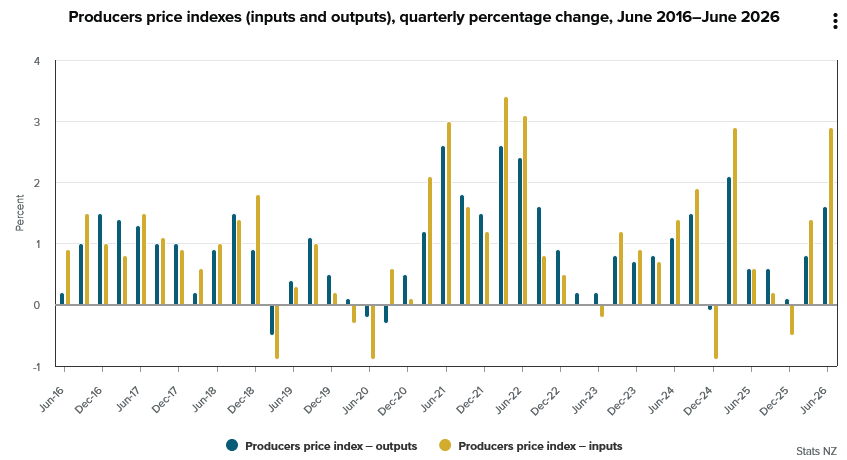
New Zealand producer price pressures accelerated sharply in Q2, with input PPI rising 2.9% q/q from 1.4% in Q1, more than double 1.3% consensus. Output PPI also strengthened, rising 1.6% from 0.8%, twice 0.8% expected. Stats NZ said producers faced higher costs for inputs including fuel, power and raw materials.
The gap between input and output prices was particularly notable. Producers’ costs rose almost twice as fast as prices received for their goods and services, pointing to potential pressure on margins if firms are unable to pass those increases through. Consumer prices rose 1.5% q/q over the same period, slightly below output PPI and well below input-cost growth.
Cost pressures were broader across the economy. Farm Expenses Price Index rose 3.8% q/q, while Capital Goods Price Index increased 1.8%. Overall, Q2 data show a clear reacceleration in upstream inflation, with key question now whether businesses continue absorbing higher costs or increasingly pass them into final prices.
Data Summary
| Indicator | Actual | Expected | Previous |
|---|---|---|---|
| PPI Input q/q | 2.9% | 1.3% | 1.4% |
| PPI Output q/q | 1.6% | 0.8% | 0.8% |
| CPI q/q | 1.5% | — | 0.9% |
Key Takeaways
- New Zealand producer cost pressures accelerated sharply in Q2, with PPI Input rising from 1.4% to 2.9% q/q, more than double 1.3% consensus.
- PPI Output increased from 0.8% to 1.6%, also twice 0.8% expected.
- Input costs rose substantially faster than output prices, suggesting businesses either absorbed part of increase through margins or still have costs to pass through.
- Stats NZ highlighted higher fuel, power and raw-material prices as important contributors to input-cost increase.
- Producer input inflation at 2.9% was nearly twice Q2 CPI increase of 1.5%, highlighting strength of upstream cost pressures.
- Broader cost measures were also firm, with Farm Expenses Price Index up 3.8% and Capital Goods Price Index up 1.8%.
- Overall, Q2 data show a clear reacceleration in production costs, with future inflation impact depending on how much businesses pass through to customers.