

Live Comments
US PMI Composite Hits 52-Month High as Services Drive August Acceleration
US private-sector growth accelerated sharply in August, with PMI Composite Output rising from 54.5 to 56.0, its highest in 52 months. PMI Services Business Activity climbed from 54.6 to 56.8, a 20-month high, becoming main driver of expansion. PMI Manufacturing eased from 53.9 to 53.2, while PMI Manufacturing Output dropped from 53.9 to 51.9, a 13-month low.
S&P Global said Q3 survey data are now consistent with annualized growth approaching 3.0%, up from 1.5% in Q2. Employment also strengthened as business confidence improved. Manufacturing, however, lost momentum as precautionary inventory building faded and supply delays constrained production. Those delays remained among most severe seen over past four years, with Middle East disruption and energy prices still key concerns.
Inflation pressure eased somewhat but remained elevated, leaving Fed with a mixed but still firm backdrop. Stronger services activity and renewed hiring point to resilient demand, while weaker factory output shows expansion is becoming more dependent on consumers and financial services. With price pressures still vulnerable to another energy shock, August PMI does little to strengthen case for an easier policy stance.
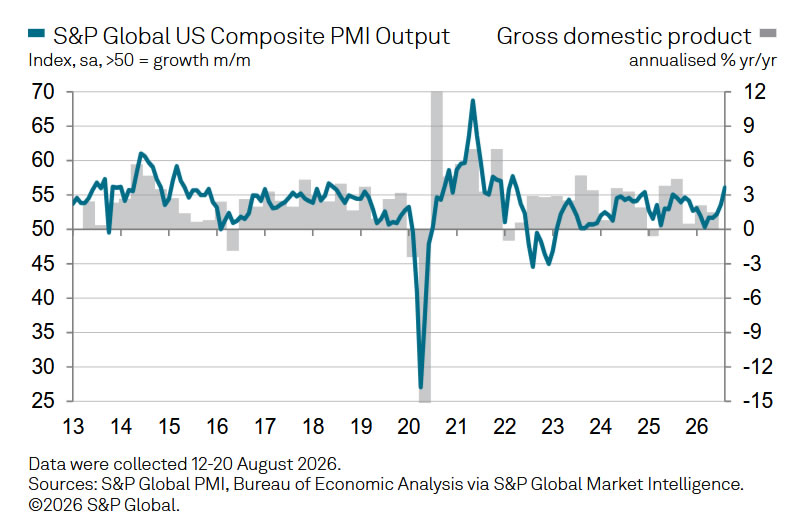
Data Summary
| Component | Current | Previous | Trend |
|---|---|---|---|
| PMI Composite Output | 56.0 | 54.5 | 52-month high |
| PMI Services Business Activity | 56.8 | 54.6 | 20-month high |
| PMI Manufacturing | 53.2 | 53.9 | 5-month low |
| PMI Manufacturing Output | 51.9 | 53.9 | 13-month low |
| Q3 GDP Signal | ~3.0% annualized | 1.5% Q2 | Stronger |
| Employment | — | — | Growth revived |
| Business Confidence | — | — | Improved |
| Input / Price Pressures | — | — | Easing but still elevated |
| Supply Delays | — | — | Among worst in four years |
Key Takeaways
- US PMI Composite Output rose from 54.5 to 56.0 in August, reaching its strongest level in more than four years.
- PMI Services Business Activity accelerated from 54.6 to 56.8, a 20-month high and clear driver of overall growth.
- PMI Manufacturing eased from 53.9 to 53.2, while PMI Manufacturing Output fell more sharply from 53.9 to 51.9.
- S&P Global said Q3 survey data point to annualized GDP growth approaching 3.0%, up from 1.5% in Q2.
- Employment growth revived as business confidence improved.
- Manufacturing lost momentum as precautionary stock building faded and supply delays constrained production.
- Supply-chain disruption remained severe, with Middle East conflict and energy prices still key risks.
- Price pressures eased but stayed elevated, leaving inflation vulnerable to another energy shock.
- For Fed, data point to resilient demand and stronger services activity, limiting scope for a rapid shift toward easier policy.
Canada Retail Sales Rise 0.6% as Core Spending Strengthens, but July Estimate Warns of Pullback
Canada retail sales rose 0.6% m/m in June to CAD 74.3bn, beating expectations for 0.4% and following a revised 1.1% gain in May. Sales increased in seven of nine subsectors. More importantly, core retail sales excluding gasoline and motor vehicles rose 1.2%, extending their advance for a second month. In volume terms, total retail sales increased 1.5%, showing that June’s improvement reflected a meaningful rise in real spending.
General merchandise retailers led core growth with a 2.7% increase. Clothing, footwear, jewelry and related retailers gained 3.1%. Motor vehicle and parts dealers rose 1.0% for a third consecutive month, driven by new-car sales. Food and beverage retailers slipped 0.4%. Gasoline-station receipts fell 4.1%, but volumes increased 4.2%, highlighting the impact of lower fuel prices on nominal sales.
The broader picture is less straightforward heading into Q3. Retail sales rose 2.2% in Q2, though volumes increased a more modest 0.4%. Statistics Canada’s advance estimate points to a -0.8% decline in July, suggesting June’s strength may not have carried forward. The early estimate is based on responses from only 56.5% of surveyed companies and is subject to revision, but it nevertheless tempers the strong June report and points to a potentially softer start to Q3.
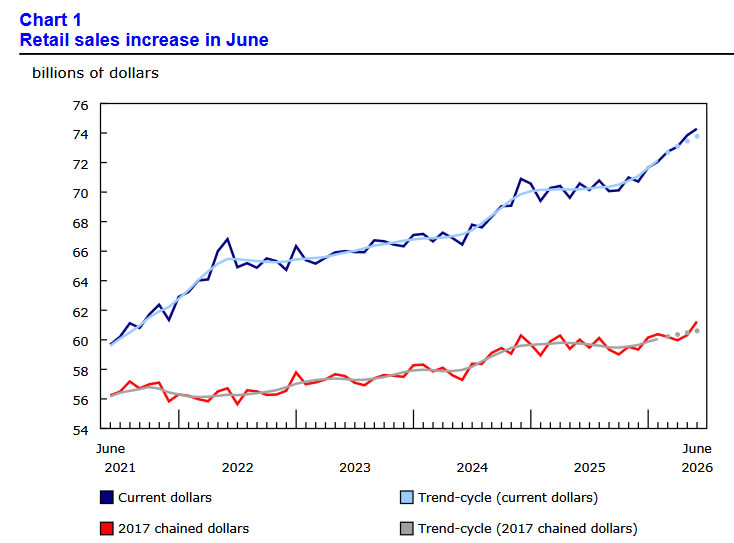
Data Summary
| Indicator | Actual | Expected | Previous |
|---|---|---|---|
| Retail Sales m/m | 0.6% | 0.4% | 1.1% |
| Retail Sales ex Autos m/m | 0.5% | 0.2% | 1.2% |
| Core Retail Sales m/m* | 1.2% | — | — |
| Retail Sales Volume m/m | 1.5% | — | — |
| Retail Sales q/q | 2.2% | — | — |
| Retail Sales Volume q/q | 0.4% | — | — |
| July Advance Retail Sales Estimate m/m | -0.8% | — | 0.6% |
*Core retail sales exclude gasoline stations and fuel vendors, and motor vehicle and parts dealers.
Key Takeaways
- Canada retail sales rose 0.6% m/m in June, beating expectations for 0.4%, after May was revised higher to 1.1%.
- Retail sales excluding autos increased 0.5%, also beating the 0.2% forecast.
- Core retail sales rose a stronger 1.2%, extending gains for a second consecutive month.
- Real spending was particularly firm, with retail sales volumes jumping 1.5% m/m.
- General merchandise sales rose 2.7%, while clothing and related categories gained 3.1%.
- Motor vehicle and parts sales increased 1.0% for a third straight month.
- Gasoline-station receipts fell 4.1%, but volumes rose 4.2%, showing lower prices rather than weaker fuel demand drove the nominal decline.
- Retail sales increased 2.2% in Q2, but volumes rose a more moderate 0.4%.
- Statistics Canada’s advance estimate points to a 0.8% decline in July, warning that June strength may not have carried into Q3.
- July estimate is highly provisional, based on responses from 56.5% of surveyed companies, versus an average final response rate of 87.3%.
UK PMI Services Strengthen in August, but Manufacturing Momentum Fades
UK private-sector growth strengthened modestly in August, with PMI Composite Output rising from 52.2 to 52.5, a four-month high. PMI Services Business Activity improved from 52.1 to 52.8, reaching a six-month high and providing the main lift. Manufacturing moved the other way. PMI Manufacturing eased from 51.9 to 51.5, while PMI Manufacturing Output fell from 52.9 to 51.2, both five-month lows.
S&P Global said sunny weather and technology investment supported activity, while manufacturing lost some momentum as precautionary stock building faded. Business confidence improved to its strongest since Middle East war began, and job losses moderated. But cost pressures remained elevated, driven by energy prices, supply-chain disruption and high staffing costs. S&P Global estimated the survey was consistent with around 0.3% q/q GDP growth in Q3.
For BoE, August PMI points to resilient growth but an uncomfortable inflation backdrop. Stronger services activity reduces urgency to support economy, while persistent cost pressure argues against an early dovish turn. S&P Global said Bank is likely to retain a hawkish bias but stay cautious, holding off on further hikes until growth and inflation signals become clearer.
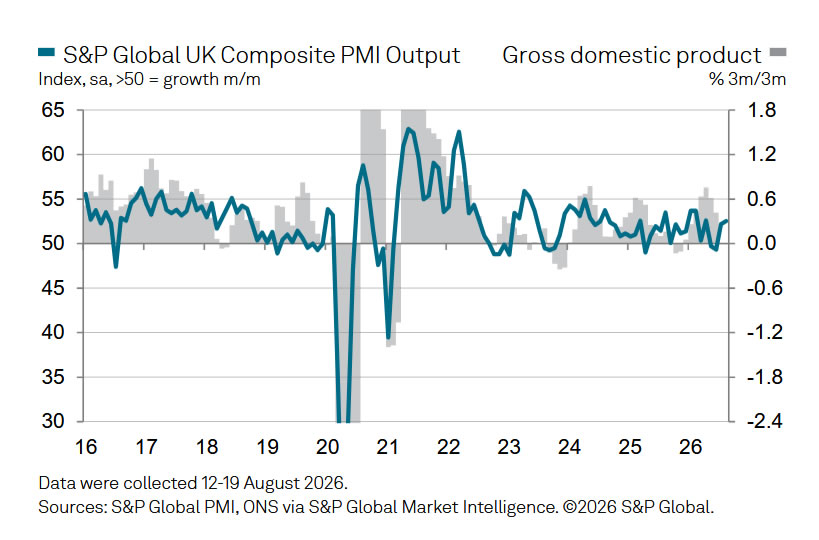
Data Summary
| Component | Current | Previous | Trend |
|---|---|---|---|
| PMI Composite Output | 52.5 | 52.2 | 4-month high |
| PMI Services Business Activity | 52.8 | 52.1 | 6-month high |
| PMI Manufacturing | 51.5 | 51.9 | 5-month low |
| PMI Manufacturing Output | 51.2 | 52.9 | 5-month low |
Key Takeaways
- UK PMI Composite Output rose from 52.2 to 52.5 in August, reaching a four-month high.
- PMI Services Business Activity strengthened from 52.1 to 52.8, a six-month high and main driver of faster overall growth.
- Manufacturing lost momentum. PMI Manufacturing fell from 51.9 to 51.5, while PMI Manufacturing Output dropped from 52.9 to 51.2.
- S&P Global said sunny weather and technology investment supported activity. Earlier precautionary stock building in manufacturing started to fade.
- Business confidence improved to its strongest level since Middle East war began, while job losses became less severe.
- Cost pressures remained high due to energy prices, Middle East-related supply disruption and staffing costs.
- Survey was consistent with around 0.3% q/q GDP growth in Q3.
- For BoE, resilient growth and elevated costs support a hawkish bias, but softer manufacturing and lingering uncertainty argue for patience before another hike.