ECB’s Nagel: Should avoid rushing monetary policy normalization

    German ECB Governing Council member Joachim Nagel in an interview with Platow Brief, highlighted persistent services inflation and a “high level of uncertainty,” referencing concerns about global trade dynamics as Donald Trump prepares to return to the White House next week.

    “We should therefore not rush into anything on the path to monetary policy normalization,” Nagel stated.

    Meanwhile, he defended the ECB’s discussions of a more aggressive 50-basis-point rate cut during its December meeting, noting that such debates are a normal part of policy deliberations.

    ECB’s Elderson: Rate setting is a question of speed and magnitude

      ECB Executive Board member Frank Elderson emphasized the delicate balance the central bank must strike in setting interest rates during an interview with Het Financieele Dagblad.

      He warned, “If we lower the interest rate too quickly, dialling down services inflation sufficiently could become complicated.” At the same time, he acknowledged the risks of maintaining rates too high for too long, which could lead to undershooting ECB’s inflation target.

      “The markets don’t think we’ve finished easing now that we’re at 3% and I don’t think we have, either,” he added. “Setting interest rates is ultimately a question of how fast and how much.”

      Eurozone CPI finalized at 2.4% in Dec, core CPI at 2.7%

        Eurozone inflation was finalized at to 2.4% yoy in December, up from November’s 2.2% yoy. Core CPI, which excludes energy, food, alcohol, and tobacco, held steady at 2.7% yoy. Services made the largest contribution to the annual headline inflation rate (+1.78 percentage points), followed by food, alcohol, and tobacco (+0.51 pp), non-energy industrial goods (+0.13 pp), and energy (+0.01 pp).

        In the broader EU, inflation was finalized at 2.7% yoy, up from 2.5% yoy in November. Ireland recorded the lowest annual inflation rate at 1.0%, followed by Italy at 1.4%, with Luxembourg, Finland, and Sweden at 1.6% each. On the other end, Romania (5.5%), Hungary (4.8%), and Croatia (4.5%) posted the highest inflation rates.

        Across the EU, annual inflation rose in 19 member states, remained unchanged in one, and fell in seven compared to the previous month.

        Full Eurozone CPI final release here.

        UK retail sales fall -0.3% mom in Dec, down -0.8% qoq in Q4

          UK retail sales volumes declined by -0.3% mom in December, significantly missing expectations for 0.4% mom increase. The drop was primarily driven by reduced supermarket sales, partially offset by a rebound in non-food stores such as clothing retailers, which saw recovery after recent declines.

          On a quarterly basis, sales volumes in Q4 fell -0.8% qoq compared with Q3, highlighting a slowdown in consumer activity. However, year-on-year, Q4 sales volumes rose 1.9% compared to the same period in 2023.

          Full UK retail sales release here.

          China’s Q4 GDP growth surpasses expectations, full-year growth hits 5% target

            China’s economy ended 2024 on a strong note, with GDP expanding by 5.4% yoy in Q4, beating market expectations of 5.0%. This marked a significant acceleration from 4.6% in Q3, 4.7% in Q2, and 5.3% in Q1. The robust Q4 performance pushed full-year GDP growth to 5.0%, aligning with the government’s target of “around 5%.”

            December’s economic indicators also showed positive momentum. Industrial production surged 6.2% yoy, exceeding the forecast of 5.4%. Retail sales grew by 3.7% yoy, marginally beating expectations of 3.5%. However, fixed asset investment lagged, rising only 3.2% year-to-date, just below the 3.3% forecast.

            Despite the upbeat data, concerns remain. Statistics Bureau spokesperson Fu Linghui acknowledged lingering weakness in consumer spending and cautioned that in 2025, the “unfavorable impact of external factors may deepen.”

            BNZ PMI at 45.9: NZ manufacturing completes 2024 fully in contraction

              New Zealand’s BNZ Performance of Manufacturing Index rose marginally in December, increasing from 45.2 to 45.9. While this marks a slight improvement, the sector remains in a prolonged contraction, far below the long-term average of 52.5 since the survey’s inception. December also marked the 22nd consecutive month of contraction, a record-breaking trend for the PMI.

              Catherine Beard, Director of Advocacy at BusinessNZ, noted that 2024 was unprecedented, as it was the first year in the survey’s history with all 12 months in contraction. By comparison, the next closest period was 2008 during the Global Financial Crisis, which saw nine months of contraction.

              Breaking down the December data, production dropped further, slipping from 42.3 to 41.9. Employment showed modest improvement, rising from 46.9 to 47.6, while new orders also edged up from 44.5 to 46.5. However, finished stocks fell significantly, declining from 49.2 to 45.9, and deliveries dipped slightly below the neutral 50 mark, moving from 50.0 to 49.8.

              Full NZ BNZ PMI release here.

              Fed’s Waller suggests rate cuts possible in H1 if inflation trend holds

                Fed Governor Christopher Waller expressed optimism about the US inflation outlook during an interview with CNBC, signaling that rate cuts may be on the table sooner than previously anticipated.

                Waller highlighted the positive inflation data released yesterday, describing it as “very good.” He suggested that, if this trend continues, “it’s reasonable to think rate cuts could happen in the first half of the year.”

                Waller noted that Fed’s median estimate of the neutral policy rate indicates the potential for three or four rate cuts in 2025, contingent on the evolution of economic data.

                However, he tempered this with caution, stating, “If the data doesn’t cooperate, then you’re going to be back to two, maybe even one if we just get a lot of sticky inflation.”

                On the labor market, Waller described conditions as stable rather than overheated. He pointed out that indicators like hiring rates, quit rates, and wage growth remain restrained, which aligns with Fed’s restrictive policy stance.

                US initial jobless claims falls to 217k vs exp 210k

                  US initial jobless claims rose 14k to 217k in the week ending January 11, above expectation of 210k. Four-week moving average of initial claims fell -750 to 213k.

                  Continuing claims fell -18k to 1859k in the week ending January 4. Four-week moving average of continuing claims fell -1k to 1867k.

                  Full US jobless claims release here.

                  US retail sales rise 0.4% mom in Dec, ex-auto sales up 0.4% mom

                    US retail sales rose 0.4% mom to USD 729.2B in December, below expectation of 0.5% mom. Ex-auto sales rose 0.4% mom to USD 586.3B, below expectation of 0.5% mom. Ex-gasoline sales rose 0.4% mom to USD 676.8B. Ex-auto & gasoline sales rose 0.4% mom to USD 533.9B.

                    Total sales for the October through December period were up 3.7% from the same period a year ago.

                    Full US retail sales release here.

                    ECB Minutes: Gradual easing essential to monitor disinflation check points

                      ECB’s December 11–12 meeting minutes noted that while the 25 bps rate cut decided at the meeting was widely supported, some members argued for a more aggressive 50 bps reduction.

                      Some policymakers contended that a larger rate cut would have better addressed Eurozone’s weakening economic projections, with one noting that “successive projection exercises have shown increasing downside risks to growth.”

                      However, the majority concurred that a smaller, measured cut aligned with the “controlled pace of easing” and provided a “sense of the direction” of the path of interest rates.

                      The minutes emphasize while projections were conditional on a further rate cut in January, the meeting underscored that “data dependency precluded any foregone conclusions.”

                      The minutes also stated that the “measured pace of interest rate cuts” was essential to ensure that ECB could “pass critical checkpoints to verify disinflation remains on track.” Furthermore, it was highlighted that optionality must be preserved to address risks that could derail inflation stabilization, including geopolitical tensions, global trade disruptions, and energy price volatility.

                      Nevertheless, “if the baseline projection for inflation is confirmed over the next few months and quarters,” the minutes noted, a “gradual dialing back of policy restrictiveness” would be appropriate.

                      Full ECB meeting accounts here.

                      Eurozone goods exports fall -1.6% yoy in Nov, imports down -1.0% yoy

                        Eurozone goods exports fell -1.6% yoy to EUR 248.3B in November. Good imports fell -1.0% yoy to EUR 231.9B. Trade balanced showed a EUR 16.4B surplus. Intra-Eurozone trade fell -7.0% yoy to EUR 214.8B.

                        In seasonally adjusted term, goods exports rose 3.2% mom to EUR 240.6B.Goods imports rose 0.7% mom to EUR 227.8B. Trade balance widened from October’s EUR 7.0B to EUR 12.9B, larger than expectation of EUR 7.2B. Intra-Eurozone trade fell -1.7% mom to EUR 210.4B.

                        Full Eurozone trade balance release here.

                        UK GDP grows only 0.1% mom in Nov, with mixed sector performance

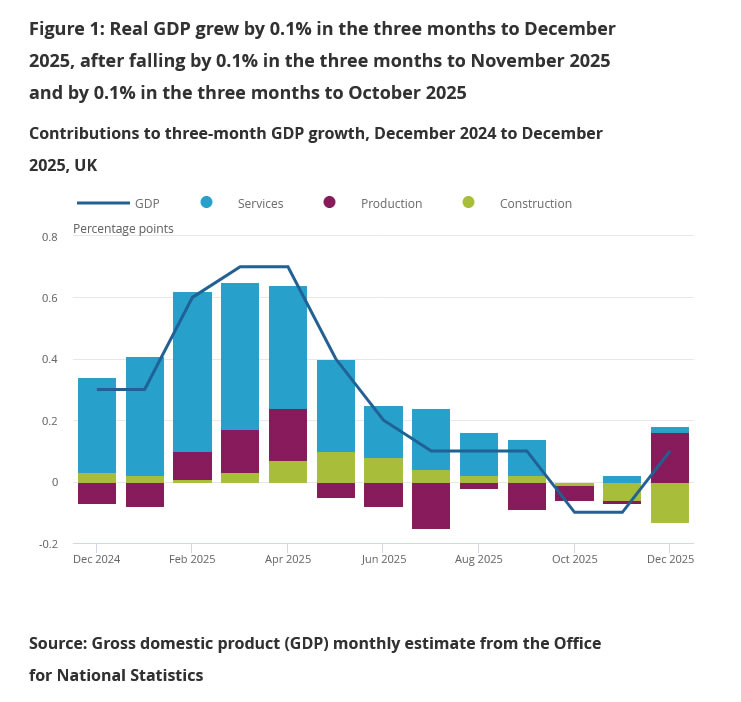
                          UK’s economy posted modest growth in November, with GDP increasing by 0.1% mom, but slightly missing market expectations of 0.2%. Nevertheless, this marked a positive turnaround from the -0.1% mom contraction in October.

                          Sectoral performance was mixed, with services, the largest contributor to the economy, inching up by 0.1% mom, while production fell by -0.4% mom. Construction activity, however, provided a brighter spot, rising 0.4% mom during the month.

                          Despite November’s modest gains, the broader economic picture remains subdued. Over the three months to November 2024, real GDP showed no growth compared to the three months to August. Services, which account for a significant portion of the UK’s output, stagnated over this period. Production output contracted by -0.7%, offsetting the 0.2% growth seen in construction.

                          Full UK monthly GDP release here.

                          Australia’s employment grows 56.3k in Dec, showing continuous resilience

                            Australia’s labor market displayed resilience in December as employment surged by 56.3k, significantly exceeding expectations of a 15.0k increase. Number of unemployed people also rose by 10.3k, contributing to a slight uptick in the unemployment rate from 3.9% to 4.0%, in line with forecasts.

                            Participation rate climbed to a record high of 67.1%, up from 67.0%, reflecting an expanding labor force. Additionally, employment-to-population ratio rose by 0.1 percentage point to a new peak of 64.5%, showcasing the labor market’s capacity to absorb more workers. Monthly hours worked increased by 0.5% mom, equivalent to 10 million additional hours.

                            This data supports the view that the labor market’s earlier signs of easing have stabilized in the second half of 2024. Robust employment growth, consistent levels of average hours worked, and unchanged or lower levels of labor underutilization compared to a year ago affirm the ongoing strength of the job market.

                            Full Australia employment release here.

                            BoJ’s Ueda reiterates rate hike debate for next week’s policy meeting

                              BoJ Governor Kazuo Ueda indicated today, for the second time this week, that the central bank will “debate whether to raise interest rates” at its upcoming January 23-24 policy meeting. This marks the second time in this week that Ueda has emphasized

                              Ueda’s comments come as BoJ prepares its new quarterly economic report, which will serve as the basis for its policy decision. While the Governor has not committed to a specific outcome, the repeated message signals that a rate hike is a plausible scenario, barring any significant market shocks tied to the January 20 inauguration of U.S. President-elect Donald Trump.

                              Market sentiment, nevertheless, remains divided on the timing of the anticipated hike. A recent poll conducted between January 8-15 shows that 59 out of 61 economists expect BoJ to raise rates to 0.50% by the end of March. Yet, only 20 foresee the move occurring at this month’s meeting.

                              Japan’s PPI holds steady at 3.8% as import prices turn positive

                                Japan’s PPI held steady at 3.8% yoy in December, meeting market expectations and maintaining the previous month’s pace. Key drivers included a sharp 31.8% yoy rise in agricultural goods prices, fueled by soaring rice costs.

                                Energy costs also contributed significantly, with electric power, gas, and water prices climbing 12.9% year-on-year. This uptick comes as the government phases out subsidies designed to mitigate rising utility and gasoline prices.

                                Yen-based import prices turned positive, rising 1.0% yoy after three months of declines. While modest, this reversal underscores the lingering effects of Yen depreciation, which was recorded at -0.1% mom.

                                Full Japan PPI release here.

                                Fed’s Williams highlights uncertainty tied to fiscal, trade, and regulatory Policies

                                  New York Fed President John Williams said today that monetary policy remains “well-positioned” to balance Fed’s dual mandate of stable prices and maximum employment. He noted that the process of disinflation is expected to persist, though achieving the 2% target may take time, with a return to the goal likely “in the coming years.” The pace and direction of monetary policy, however, remain highly data-dependent

                                  Williams highlighted significant uncertainties clouding the economic outlook, including risks related to fiscal policies, trade dynamics, immigration changes, and regulatory shifts.

                                  Therefore, “our decisions on future monetary policy actions will continue to be based on the totality of the data, the evolution of the economic outlook, and the risks to achieving our dual mandate goals,” he added.

                                  Separately, Richmond Fed President Thomas Barkin commented on the December CPI report released today, acknowledging that it reinforces the narrative of inflation gradually declining toward Fed’s target. Barkin also downplayed the potential impact of rising 10-year Treasury yields on the Fed’s monetary policy stance.


                                  US CPI jumps to 2.9% in Dec, core ticks down to 3.2%

                                    US CPI rose by 0.4% mom in December, surpassing expectations of 0.3% mom and marking an acceleration from the prior month’s 0.3% mom increase. Meanwhile, core CPI, which excludes the more volatile food and energy components, rose by a more subdued 0.2% mom, in line with market expectations but down from the 0.3% mom recorded in November.

                                    Energy prices were the primary driver, rising 2.6% mom on the month and accounting for over 40% of the headline increase. Food prices also contributed to inflationary pressure, advancing by 0.3% mom.

                                    On an annual basis, headline inflation climbed to 2.9% yoy, meeting consensus forecasts and up from November’s 2.7% yoy. Core inflation, however, slowed to 3.2% yoy, slightly below expectations of 3.3% yoy, indicating some easing in underlying price pressures. Notably, energy prices declined by -0.5% yoy, while food prices remained elevated at 2.5% yoy.

                                    Full US CPI release here.

                                    Eurozone industrial production rises 0.2% mom in Nov, EU up 0.1% mom

                                      Eurozone industrial production edged up by 0.2% mom in November, falling short of 0.3% mom consensus forecast. While the overall increase suggests resilience in the industrial sector, the performance was uneven across categories. Production rose by 1.5% for durable consumer goods and 1.1% for energy, highlighting strong demand in these areas. Intermediate and capital goods also posted gains of 0.5% each, while non-durable consumer goods saw a marginal uptick of 0.1%.

                                      Across the broader EU, industrial production grew by just 0.1% on the month. The highest monthly increases were recorded in Belgium (+8.7%), Malta (+7.1%) and Lithuania (+4.3%). The largest decreases were observed in Ireland (-5.8%), Luxembourg (-3.9%) and Portugal (-3.4%).

                                      Full Eurozone industrial production release here.

                                      ECB’s Guindos and Villeroy affirm progress on disinflation

                                        ECB Vice President Luis de Guindos highlighted today that disinflation in the Eurozone is “well on track,” reinforcing optimism about the region’s progress toward price stability. While December’s inflation rose to 2.4%, Guindos noted that this increase was anticipated and aligned with ECB’s projections. Domestic inflation remains elevated, but recent easing signals have provided some relief.

                                        Guindos cautioned, however, that risks remain high. “The high level of uncertainty calls for prudence,” he said, referencing global trade frictions that could fragment the global economy further. He also warned about the fiscal policy challenges to weigh on borrowing costs and renewed geopolitical tensions to destabilize energy markets.

                                        Despite weak near-term economic outlook, Guindos expressed cautious optimism, stating, “The conditions are in place for growth to strengthen over the projection horizon, although less than was forecast in previous rounds.”

                                        Meanwhile, French ECB Governing Council member François Villeroy de Galhau echoed a positive sentiment, emphasizing progress against inflation.

                                        “We have practically won the battle against inflation,” he said, projecting that it “makes sense for interest rates to reach 2% by the summer.” However, Villeroy also highlighted risks to France’s 2025 growth forecast of 0.9%, acknowledging that while downside risks persist, a recession remains unlikely.

                                        UK CPI slows to 2.5% in Dec, services inflation down to 4.4%

                                          UK CPI slowed from 2.6% yoy to 2.5% yoy in December, below expectation of 2.7% yoy. Core CPI slowed from 3.5% yoy to 3.2% yoy, below expectation of 3.4% yoy.

                                          CPI goods annual rate rose from 0.4% yoy to 0.7% yoy, while CPI services annual rate fell from 5.0% yoy to 4.4% yoy.

                                          On a monthly basis, CPI rose by 0.3% mom, below expectation of 0.4% mom.

                                          Full UK CPI release here.