

Live Comments
BoJ’s Himino Says Rates Should Keep Rising as Weak Yen Feeds Inflation
BoJ Deputy Governor Ryozo Himino said on Thursday, at a meeting with local leaders in Saitama that policy rates should continue to rise as underlying inflation approaches 2% and financial conditions remain accommodative. Himino said “the Bank should continue to raise the policy interest rate and adjust the degree of monetary accommodation,”. He also stressed that June’s increase to 1% was “an adjustment in the degree of monetary accommodation, not a tightening.” He warned that policymakers now need to pay greater attention to upside inflation risks as the economy moves closer to sustained 2% inflation.
Exchange rates featured prominently in that assessment. Himino stressed that “monetary policy does not target exchange rates, but exchange rates have an impact on economic activity and prices,” adding that pass-through from currency moves to prices “seems to be getting stronger.” Weak Yen can support exporters and inbound tourism, but it also raises import costs, consumer prices and pressure on household real incomes. More importantly for policy, stronger pass-through means persistent Yen depreciation can lift underlying inflation through expectations even if BoJ does not target exchange rate itself.
Himino argued that timely normalization would reduce risk of having to tighten more abruptly later, saying “raising rates in a timely manner will help avoid inflation acceleration and abrupt rate hikes in the future.” His message therefore reinforces a hawkish BoJ bias: further hikes are likely if inflation continues to firm, while Yen weakness matters increasingly through its inflation transmission rather than as a standalone policy objective. Timing will remain data-dependent, but Himino’s framing suggests debate has shifted from whether BoJ should normalize further to how quickly it should do so.
Key Takeaways
- BoJ Deputy Governor Ryozo Himino said “the Bank should continue to raise the policy interest rate and adjust the degree of monetary accommodation.”
- He stressed that June’s increase to 1% was “an adjustment in the degree of monetary accommodation, not a tightening,” implying policy still remains accommodative.
- Himino said “monetary policy does not target exchange rates,” but acknowledged exchange rates affect both economic activity and prices.
- He added that exchange-rate pass-through “seems to be getting stronger,” making weak Yen more relevant to inflation and BoJ’s reaction function.
- Himino warned that timely rate increases can help avoid “inflation acceleration and abrupt rate hikes in the future.”
- His comments reinforce a hawkish normalization bias, with weak Yen adding to inflation pressure even though BoJ is not explicitly targeting currency.
Australian Household Spending Jumps Again, Adding to RBA’s Inflation Dilemma
Australian Household Spending Jumps Again, Adding to RBA’s Inflation Dilemma
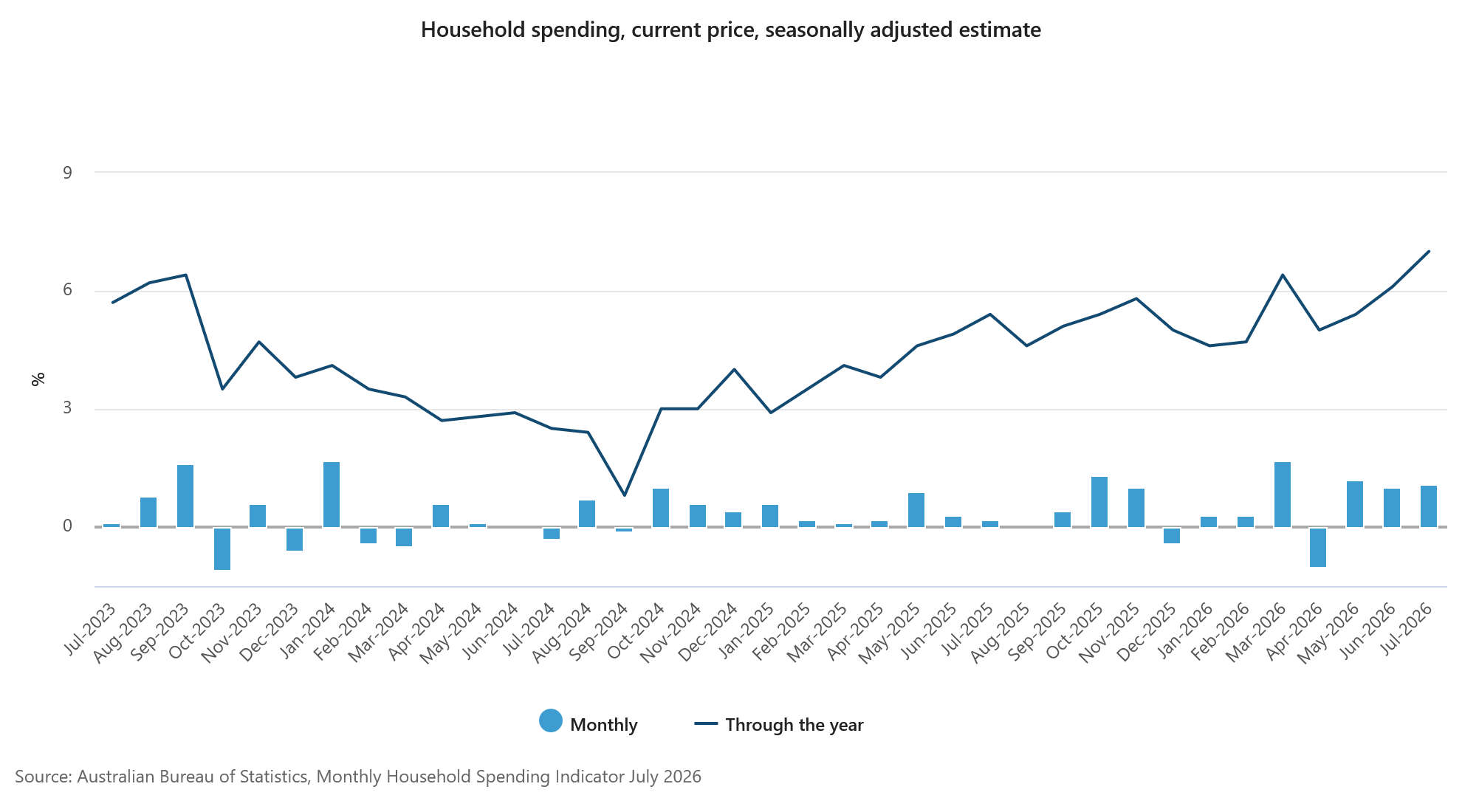
Australian household spending rose 1.1% m/m in July, well above 0.3% consensus, after gains of 1.2% in May and 1.0% in June. Through year, spending growth accelerated from 6.1% to 7.0%, strongest annual pace since June 2023. ABS said July increase was led by recreation and culture, food, hotels, cafes and restaurants, and health.
Details showed demand strength extended beyond one category. Recreation and culture spending rose 1.5%, health increased 1.2%, hotels, cafes and restaurants gained 1.1%, and food spending rose 1.0%. Price effects were important, however. ABS noted higher prices contributed to food and hospitality spending, while nominal fuel spending rose 2.2% even as experimental volume estimates showed fuel consumption falling 4.7% after a 7.9% increase in June.
That distinction matters for RBA. July household-spending data are measured in current prices, so part of headline strength reflects inflation rather than stronger real demand. But three consecutive solid monthly gains, alongside resilience in discretionary services, make it harder to argue that restrictive policy is already producing a broad collapse in household activity. That is particularly relevant after July CPI showed Trimmed Mean inflation holding at 3.6% y/y and accelerating to 0.5% m/m.
For RBA, report therefore adds another modestly hawkish piece of evidence ahead of Sept. 28–29 meeting. August minutes showed Board considered pre-emptive tightening and judged economy was still operating with excess demand, while July CPI has already kept September live. Strong nominal household spending does not by itself make another hike necessary, especially given price effects and softer labour data, but it strengthens case that domestic demand is still resilient enough for RBA to remain focused on upside inflation risks.
Data Summary
| Indicator | Actual | Expected | Previous |
|---|---|---|---|
| Household Spending m/m | +1.1% | +0.3% | +1.0% |
| Household Spending y/y | +7.0% | — | +6.1% |
Details
| Indicator | Actual |
|---|---|
| Recreation and Culture m/m | +1.5% |
| Health m/m | +1.2% |
| Hotels, Cafes and Restaurants m/m | +1.1% |
| Food m/m | +1.0% |
| Nominal Fuel Spending m/m | +2.2% |
| Experimental Fuel Volume m/m | -4.7% |
Key Takeaways
- Australian household spending rose 1.1% m/m in July, far above 0.3% consensus, after a 1.0% increase in June.
- Spending has now risen strongly for three consecutive months: 1.2% in May, 1.0% in June and 1.1% in July.
- Annual spending growth accelerated from 6.1% to 7.0%, highest since June 2023.
- Gains were broad, led by recreation and culture, health, hospitality and food.
- Price effects contributed materially to July strength. Fuel spending rose 2.2% in nominal terms, while experimental volume data showed fuel consumption falling 4.7%.
- Report therefore points to resilient household demand, but not all headline growth represents stronger real consumption.
- For RBA, data lean hawkish at margin after sticky July CPI. Strong spending makes it harder to argue restrictive policy is already causing a broad demand slowdown.
- Combined with August minutes and 3.6% trimmed mean inflation, July spending keeps September tightening debate live.
US PCE Inflation Holds at 3.7%, Core Stays at 3.3%
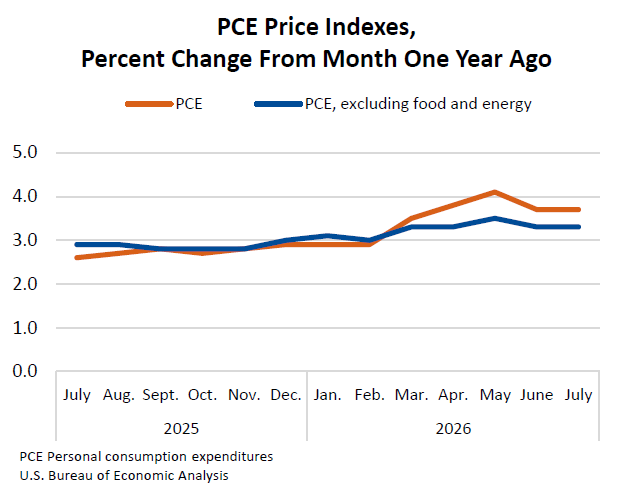
US inflation stayed sticky in July while household income and spending both came in stronger than expected. Headline PCE Price Index rose 0.2% m/m, up from -0.1% in June and above 0.1% consensus, while annual rate held at 3.7%, slightly above 3.6% expected. Core PCE increased 0.2% m/m, up from 0.1%, while annual core inflation was unchanged at 3.3%, both exactly in line with expectations.
Household data were firmer. Personal income growth accelerated from 0.2% to 0.4% m/m, twice 0.2% consensus, while personal spending slowed from 0.3% to 0.2% but still beat 0.1% expected. Combination suggests consumers retained some spending power even as inflation continued to run well above Fed’s 2% objective.
For Fed, report offers little evidence that underlying inflation is breaking higher, with core readings matching forecasts, but neither does it provide much additional disinflation comfort. Slightly hotter headline inflation and stronger income and spending point to resilient demand alongside persistent price pressure. That keeps focus on whether upcoming data reinforce case for maintaining current policy stance or revive debate over further tightening.
Data Summary
| Indicator | Actual | Expected | Previous |
|---|---|---|---|
| Personal Income m/m | +0.4% | +0.2% | +0.2% |
| Personal Spending m/m | +0.2% | +0.1% | +0.3% |
| PCE Price Index m/m | +0.2% | +0.1% | -0.1% |
| PCE Price Index y/y | 3.7% | 3.6% | 3.7% |
| Core PCE Price Index m/m | +0.2% | +0.2% | +0.1% |
| Core PCE Price Index y/y | 3.3% | 3.3% | 3.3% |
Key Takeaways
- Headline PCE inflation accelerated from -0.1% to +0.2% m/m, slightly above 0.1% consensus.
- Annual headline PCE held at 3.7%, also a touch firmer than 3.6% expected.
- Core PCE rose from 0.1% to 0.2% m/m, while annual core inflation stayed at 3.3%. Both matched forecasts.
- Personal income growth strengthened from 0.2% to 0.4% m/m, doubling consensus.
- Personal spending slowed from 0.3% to 0.2%, but still beat expectations for 0.1%.
- Overall report points to persistent inflation alongside resilient household demand, rather than a fresh core inflation shock.
- For Fed, core inflation offered little reason for immediate hawkish repricing, but stronger income, spending and slightly firmer headline prices also provided limited disinflation relief.