


TL;DR: Three of Australia’s Big Four banks now expect another RBA hike this year, after minutes, CPI, and household spending data all pointed the same direction this week — pushing AUD/JPY toward 115 while BoJ hawkishness offers Yen little new to trade.
Australia’s Rate Story Has Changed Fast
The most important shift behind AUD this week is not simply that markets have become more hawkish—it is how quickly professional forecasts have changed. Three of Australia’s Big Four banks now expect another RBA hike before year-end, a genuine reversal from the much more cautious consensus entering the week. NAB has taken the most aggressive position, forecasting a September hike to 4.60% on the view that July inflation ran hotter than RBA itself had anticipated. CBA changed its call on Thursday to a November hike to 4.60%, saying the broad-based upside CPI surprise “has crossed the threshold needed to trigger further tightening,” while acknowledging a material risk that Board could act as early as September.
ANZ has also moved to a November hike, with Australian economics head Adam Boyton saying inflation risks are “closer to crystallising.” That language is particularly significant because it echoes RBA’s own August minutes, which said pre-emptive tightening could become appropriate if upside risks began to crystallise. Westpac is now the lone Big Four holdout, maintaining its call for rates to stay at 4.35% through year-end. Its argument is that July CPI was “noisy rather than a genuine signal of reacceleration,” with softer labour-market and wage data still providing enough offset to keep RBA on hold.
The shift extends beyond domestic banks. Goldman Sachs has joined the November-hike camp, while Citi’s Josh Williamson expects cash rate to reach 4.60% this year and sees risks tilted toward still more tightening. UBS’s Stephen Wu also favors November over September, but his distinction is important: an immediate September hike would suggest RBA believes it is “behind the curve,” potentially raising risk that one additional move would not be enough. That turns timing into a signal about the scale of tightening cycle, rather than merely which meeting delivers the next 25bp.
Markets have repriced in parallel. September hike odds jumped from roughly 17% before CPI to as high as 50%, while around 30bp of additional tightening is now priced by February 2027. In other words, this week has moved the debate from whether RBA is finished to whether next hike comes in September or November—and whether that move is an isolated insurance hike or beginning of a broader response to persistent inflation. That rapid shift in both bank forecasts and market pricing is the core fundamental reason AUD has outperformed.
- NAB: Most aggressive call — September hike to 4.60%, on the view July inflation ran hotter than the RBA itself expected.
- CBA: Flipped Thursday to a November hike to 4.60%, saying the CPI surprise “has crossed the threshold needed to trigger further tightening,” with a real risk of September instead.
- ANZ: Also moved to November, with Adam Boyton citing inflation risks “closer to crystallising” — language mirroring the RBA’s own pre-emptive-tightening minutes.
- Westpac: Lone holdout at 4.35% through year-end, calling July CPI “noisy rather than a genuine signal of reacceleration.”
- Goldman Sachs: Joined the November-hike camp.
- Citi: Josh Williamson sees 4.60% this year, with risks skewed toward more tightening still.
- UBS: Stephen Wu favors November over September — an early September move would signal the RBA sees itself “behind the curve,” raising the odds one hike won’t be enough.
Three Releases Have All Pointed the Same Way
What makes this week unusual is that forecast shift is not resting on one hot CPI print. Tuesday’s RBA minutes showed policymakers had already debated pre-emptive tightening and specifically said monthly inflation and labour-market reports would help determine whether upside risks were crystallising before Sept. 28–29 meeting.
Then came July CPI. Headline rate slowed from 3.8% to 3.5%, but beat 3.2% consensus. Trimmed Mean CPI held at 3.6%, above 3.5% expected, while monthly pace accelerated to 0.5%. Services inflation also picked up from 3.5% to 3.7%, making underlying composition less reassuring than headline decline suggested.
Thursday added a demand-side confirmation. Household spending rose 1.1% m/m, lifting annual growth to 7.0%, with discretionary spending accelerating to 7.8% and services spending to 6.8%. Price effects contributed to nominal strength, but broader message is still that households are not retrenching sharply.
Minutes supplied reaction function, CPI supplied inflation risk, and spending weakened argument that domestic demand is cooling quickly enough to make another hike unnecessary.
BoJ Hawkishness Was Already Known
Deputy Governor Ryozo Himino’s speech should have been Yen-positive on substance. He said the Bank should “continue to raise the policy interest rate” and warned of the possibility that underlying inflation exceeds 2%.
Yet little of that represented fresh guidance. He gave no new timing signal and largely reiterated BoJ’s existing normalization framework. Markets therefore treated speech as confirmation rather than a reason to reprice Japan aggressively. That leaves AUD/JPY driven by the side where expectations are actually changing: Australia.
ActionForex’s Technical View on AUD/JPY: Break 115, and 120 Becomes the Next Test
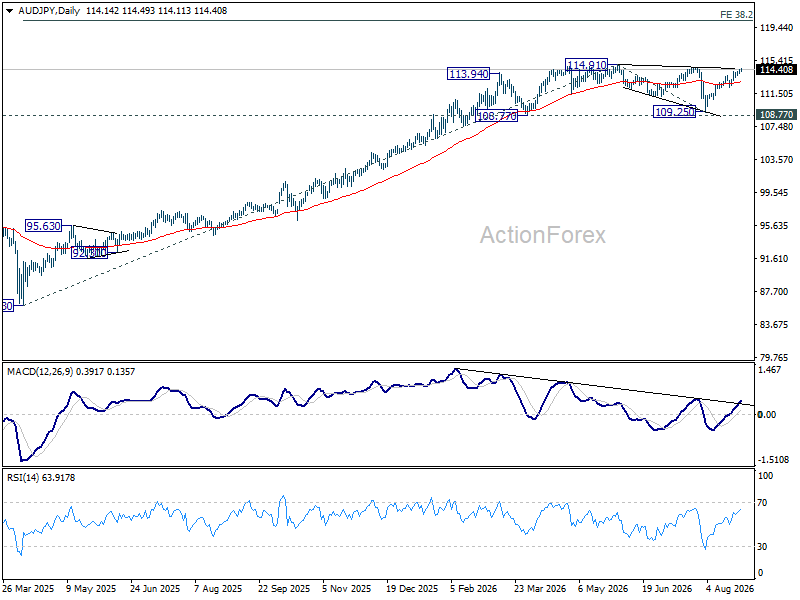
AUD/JPY is now closing in on 114.91, with daily MACD breaking its descending trendline and reinforcing view that correction from that high completed with three wave to 109.25.
A firm break of 114.91 would resume broader rise from 86.03 and target t 38.2% projection of 86.03 to 114.91 from 109.25 at 120.28. Psychological 120 level would therefore become next major medium-term test.
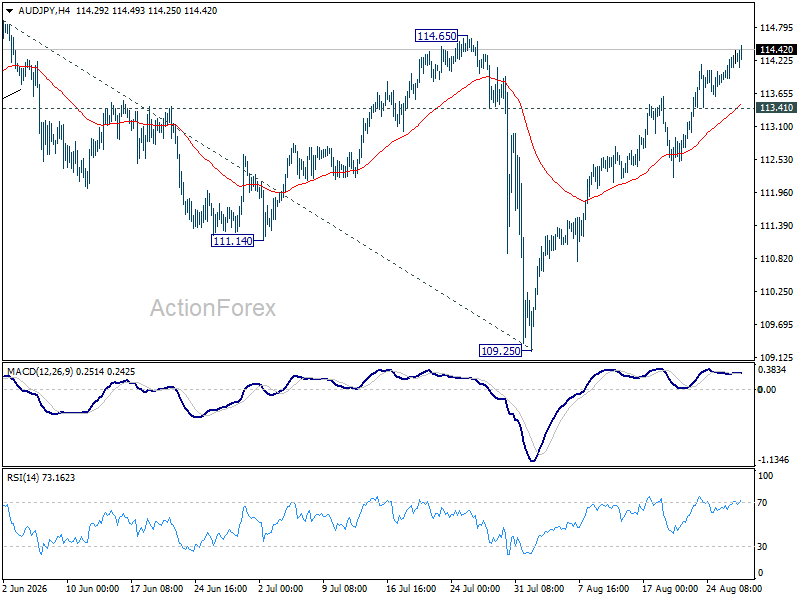
Near-term conditions are stretched, however, with 4H RSI above 70. A break below 113.41 would point to temporary consolidation, although outlook should stay bullish while 55-day EMA near 112.78 holds.
This week’s AUD/JPY rally is ultimately about a change in information rather than simply relative central-bank rhetoric. BoJ still intends to normalize, but markets knew that already. Australia has delivered three consecutive reasons to reconsider where RBA rates are headed—and three of Big Four banks have now done exactly that.
Key Takeaways
- Three of Australia’s Big Four banks (NAB, CBA, ANZ) now expect another RBA hike this year, with September odds rising from 17% to as high as 50% in a week.
- The shift rests on three separate confirmations, not one print: RBA minutes on pre-emptive tightening, a sticky trimmed-mean CPI, and strong household spending data.
- BoJ Deputy Governor Himino’s hawkish comments offered no new timing signal, meaning AUD/JPY is being driven almost entirely by the Australian side of the story.
- AUD/JPY is testing 114.91 resistance; a firm break would open a run toward the psychologically important 120.28 level.
- Near-term momentum is stretched (4H RSI above 70), but the bullish structure holds above the 112.78 EMA, with a break below 113.41 pointing to only temporary consolidation.





