

Live Comments
US Jobless Claims Fall to 203K as Layoffs Stay Contained
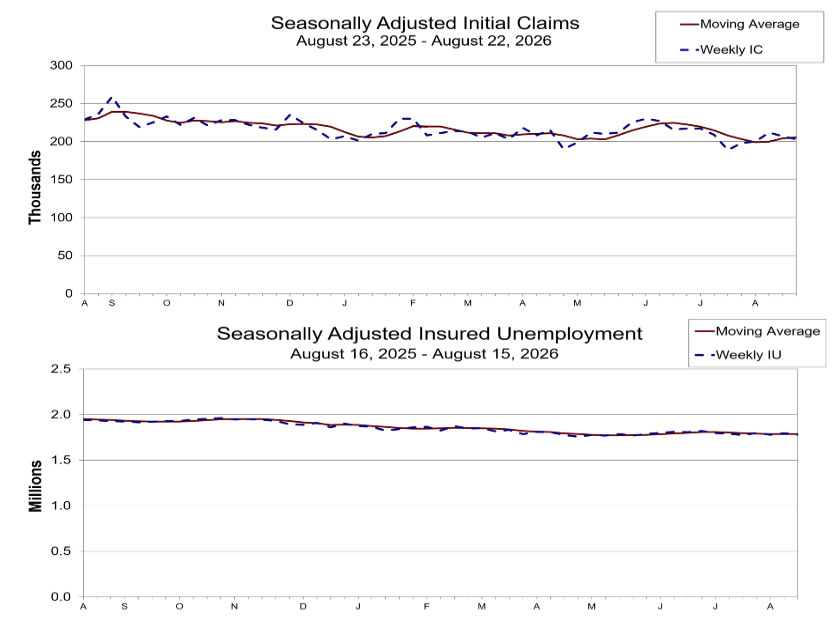
US initial jobless claims fell from a revised 207K to 203K in week ending Aug. 22, beating consensus of 209K. The latest reading keeps claims near historically low levels and suggests employers remain reluctant to shed workers despite broader signs of cooling in labor demand.
Continuing claims also improved, falling from a revised 1.796M to 1.778M in week ending Aug. 15. However, four-week average of initial claims edged up from a revised 204.25K to 205.5K, indicating underlying trend is a little firmer than latest weekly decline alone suggests rather than showing a renewed acceleration in labor-market strength.
Data Summary
| Indicator | Previous | Latest | Consensus |
|---|---|---|---|
| Initial Jobless Claims | 207K | 203K | 209K |
| 4-Week Avg. Initial Claims | 204.25K | 205.50K | — |
| Continuing Claims | 1.796M | 1.778M | — |
| 4-Week Avg. Continuing Claims | 1.78825M | 1.78850M | — |
| Insured Unemployment Rate | 1.2% | 1.2% | — |
Key Takeaways
- US Initial Jobless Claims fell from a revised 207K to 203K, beating 209K consensus.
- Continuing Claims also improved, declining from a revised 1.796M to 1.778M.
- Four-week average of Initial Claims rose slightly from 204.25K to 205.50K, tempering strength of weekly headline.
- Insured unemployment rate was unchanged at 1.2%.
- Overall, claims data suggest layoffs remain contained even as broader labor-market momentum has cooled.
ECB Minutes: Hawks Push for More Tightening as July Pause Leaves Door Open
ECB’s unanimous decision to hold rates in July concealed a distinctly hawkish debate, according to accounts of Governing Council’s July 22–23 meeting in Frankfurt. While all members ultimately backed pause, some said they “would not have opposed raising rates” immediately, arguing incoming data still supported further tightening and that “option value of waiting was therefore small.” Their concern was that delaying action could prolong above-target inflation, disturb expectations and ultimately force ECB into more aggressive tightening later.
Hawks also questioned whether current policy was restrictive enough. They argued rates needed to move into mildly restrictive territory, pointing to resilient economic activity and accelerating credit growth as evidence monetary policy was no longer meaningfully restraining demand. More importantly, they did not want ECB to wait for second-round effects to become obvious: once wages or underlying inflation responded more forcefully to energy shock, policy risked falling behind curve.
Case for holding was nevertheless substantial. June inflation had fallen from 3.2% to 2.8%, underlying pressures had eased, wage growth was moderating and longer-term inflation expectations remained anchored near 2%. Majority therefore judged conditions fragile rather than acute and saw value in waiting for September projections, Q2 GDP, further inflation data and fresh wage evidence. ECB also noted current inflation shock was still largely supply-driven, meaning another hike would not directly address its original energy cause.
But pause was clearly not intended to signal end of tightening cycle. Members stressed “another rate hike would likely be necessary” unless inflation outlook improved significantly, while keeping September explicitly data-dependent. Accounts also revived idea of pre-emptive tightening if economy started moving toward a more adverse inflation scenario. Bottom line is hawkish: July was a tactical pause for information, not a declaration that rates had peaked. September remains genuinely live, with burden now on incoming data to give ECB reason not to tighten again.
Key Takeaways
- ECB’s unanimous July hold masked a meaningfully hawkish internal debate, with some policymakers saying they “would not have opposed raising rates.”
- Hawkish members argued “option value of waiting was therefore small”, warning delayed action could allow inflation pressures to broaden and ultimately require stronger tightening.
- Several policymakers questioned whether current rates were sufficiently restrictive and favored acting before second-round effects became entrenched.
- Majority still preferred to wait for September projections, Q2 GDP, inflation and wage data, given softer headline inflation and still-anchored expectations.
- Governing Council stressed “another rate hike would likely be necessary” unless inflation outlook improved significantly.
- ECB was also “not pre-committed” to September, keeping decision explicitly data-dependent.
- Overall message is that July was a tactical pause rather than clear end of hiking cycle, leaving September firmly live.
Germany GfK Consumer Confidence Improves to -26.6 as Income Expectations Rebound Sharply
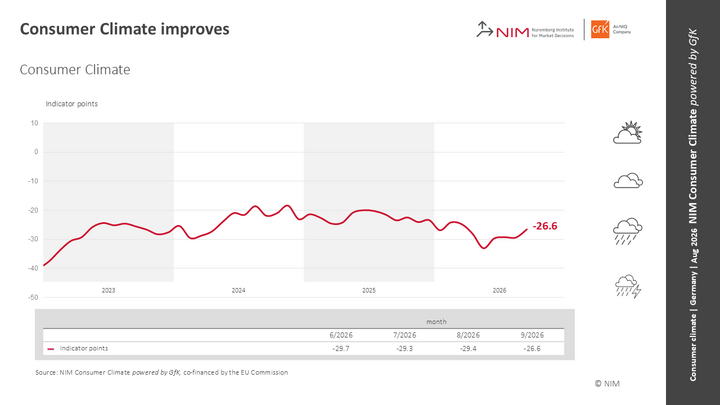
Germany’s GfK/NIM Consumer Climate improved from a revised -29.4 to -26.6 for September, comfortably beating consensus of -29.2. Improvement was driven by a sharp recovery in income expectations, which surged from -14.5 to +1.7, while economic expectations also strengthened from -6.3 to -3.9. Willingness to save eased from 17.0 to 15.5, providing another modest lift to overall sentiment.
Improvement was less convincing on actual spending intentions. Willingness to buy was almost unchanged, edging from -9.9 to -9.8, showing that stronger income expectations have not yet translated into greater readiness to spend. Price expectations also rose from -2.1 to +0.2, while willingness to save remained elevated despite its decline.
Overall, September reading points to a clearer recovery in German consumer confidence, but not yet a decisive consumption rebound. Households are becoming markedly more optimistic about income and somewhat more positive on economy, while purchase intentions remain stuck near depressed levels. That leaves consumer recovery dependent on whether improving confidence eventually converts into stronger spending.
Data Summary
| Component | Current | Previous | Trend |
|---|---|---|---|
| Consumer Climate, Sep | -26.6 | -29.4 revised | Improving |
| Economic Expectations | -3.9 | -6.3 | Improving |
| Price Expectations | +0.2 | -2.1 | Higher |
| Income Expectations | +1.7 | -14.5 | Sharply improving |
| Willingness to Buy | -9.8 | -9.9 | Broadly unchanged |
| Willingness to Save | 15.5 | 17.0 | Lower |
Key Takeaways
- Germany’s GfK/NIM Consumer Climate improved from a revised -29.4 to -26.6 for September, beating -29.2 consensus.
- Income Expectations surged from -14.5 to +1.7, providing the clearest sign of improving household sentiment.
- Economic Expectations also strengthened from -6.3 to -3.9, extending recent improvement.
- Willingness to Buy barely moved from -9.9 to -9.8, showing better confidence has not yet translated into stronger spending intentions.
- Willingness to Save fell from 17.0 to 15.5 but remained elevated.
- Price Expectations rose from -2.1 to +0.2, adding a note of caution.
- Overall, German consumers are becoming less pessimistic, but recovery in confidence is still running ahead of actual willingness to spend.