


- Oil prices are in a “tug-of-war” between short-term geopolitical risk (US-Iran tensions) and a long-term global supply surplus.
- A bullish spike for WTI is possible if tensions escalate, potentially breaking above $65.
- A massive 4 mb/d supply glut forecasted for 2026 acts as a ceiling, with a bearish correction below $62.40 exposing $55.00.
The crude oil market is characterized by a delicate balancing act between escalating geopolitical risk premiums and a looming global supply surplus at present.
Prices for both West Texas Intermediate (WTI) and Brent crude have remained steady near six-month highs, even as the market faces conflicting signals from diplomatic channels and maritime warnings.
The global benchmarks are trading in a tight, consolidated range as investors weigh the potential for supply disruptions against a bearish long-term fundamental outlook
What is moving oil prices at the moment?
The market’s current “coiling” behavior where prices trade in a narrowing range and is being driven by three primary factors:
The US-Iran Geopolitical Risk Premium: The most immediate driver is the “tug-of-war” between Washington and Tehran. While indirect nuclear talks in Oman have been described as a “good start,” significant friction remains.
The US Department of Transportation recently issued a maritime advisory for American-flagged vessels to stay clear of Iranian territorial waters in the Strait of Hormuz. Because nearly 20% of global oil consumption passes through this strait, any threat of interception or military escalation keeps a “fear premium” embedded in the price.
The “India-Russia” Factor and Sanctions: Markets are closely monitoring a potential shift in global trade flows. Recent US-India trade discussions have reportedly been linked to New Delhi freezing or reducing its imports of Russian crude. As India is a top buyer of Russian oil, any significant disruption to this flow would force a massive reshuffling of global supply, likely tightening the market and pushing prices higher in the short term.
Long-term Supply Surplus vs. Short-term Tensions: Acting as a ceiling on prices is the fundamental reality of 2026: a massive supply glut. The International Energy Agency (IEA) and the EIA have forecast that global production driven by OPEC+ output hikes and record production from the US, Canada, and Brazil is outstripping demand. The IEA estimates a surplus of nearly 4 million barrels per day (mb/d) this year, which is preventing geopolitical spikes from turning into a sustained bull run.
Forward Outlook – bulls or bears to prevail?
Market analysts suggest that crude is at a technical crossroads. Here is the outlook for the coming weeks:
- The Bullish Breakout Scenario: If US-Iran tensions escalate further or if Iranian forces intercept a tanker in the Strait of Hormuz, Oil prices could be in for a spike. For WTI, a clean close above $65 could open the door for a run toward $66.60.
- The Bearish Correction Scenario: If diplomacy in Oman yields a concrete breakthrough or if the focus shifts back to the global supply surplus, prices could retreat sharply.
Technical support for WTI sits at $62.40 (200-day MA), with a break below that level potentially exposing a decline toward $55.00 the lower bound of the long-term trending channel.
- Long-term Forecast: Most major agencies, including the EIA, maintain a bearish outlook for the remainder of 2026. However, thus far the geopolitical situation continues to cast a shadow over oil markets.
Brent Crude Oil Daily Chart, February 9, 2026
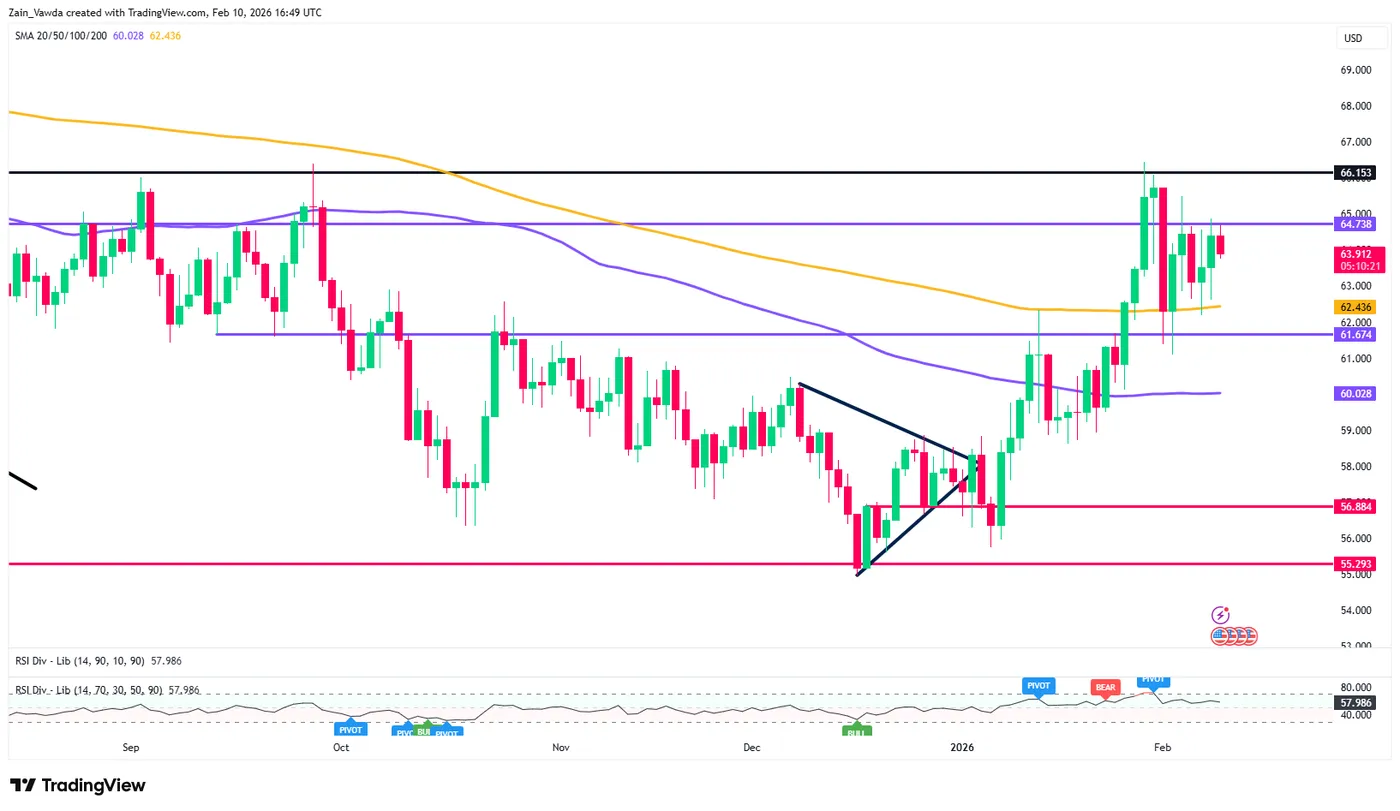
Source: TradingView (click to enlarge)

 and a long-term global supply surplus.)