


Key takeaways
- US futures edged lower in the early Asian session: Donald Trump rejected Iran’s latest peace response, dampening hopes for a formal US-Iran agreement and keeping geopolitical risk premiums elevated.
- Stronger-than-expected US April jobs data: Reinforced the “higher for longer” interest rate narrative, reducing expectations for Federal Reserve rate cuts in 2026 and supporting elevated Treasury yields.
- The AI-driven equity rally remains intact globally: Supported by semiconductor momentum, expanding hyperscaler AI capex, and new industrial AI initiatives involving Apple, Intel, and Jeff Bezos.
- Chart of the day: Nasdaq 100’s bullish impulsive up move looks overstretched, raising the risk of a minor corrective decline below the 29,505/615 key short-term resistance zone. Intermediate supports stand at 28,835 and 28,460/280.
Top macro headlines
- Trump rejects Iran peace response: US President Donald Trump described Iran’s response to Washington’s latest peace proposal as “unacceptable” over the weekend. The setback clouds the near-term prospects for a formalized agreement and keeps a floor under geopolitical risk premiums even as direct military engagements remain limited.
- US jobs report defies expectations: A stronger-than-expected April employment report (115K versus 62K consensus) reinforced the view that the Federal Reserve may avoid cutting rates in 2026 as labor market resilience and sticky inflation keep policy restrictive.
- US-Iran ceasefire holds after latest test: Reuters reported that despite exchanges of fire late last week in the most serious test of the ceasefire so far, both sides signaled a desire to avoid escalation and tensions later stabilized.
- Apple & Intel AI chip pact: The AI hardware supercycle continues to dominate market leadership after reports emerged that Apple has reached a preliminary agreement with Intel on chip production initiatives.
- Yuan hits three-year highs ahead of Trump-Xi summit: China’s yuan strengthened to fresh three-year highs against the dollar ahead of the highly anticipated Trump-Xi summit scheduled for May 14–15 in Beijing.
- Bezos expands into industrial AI: Reuters Breakingviews highlighted that Amazon founder Jeff Bezos is raising $10 billion to help build AI models focused on industrial production and physical-world applications, signaling the next phase of AI capital expenditure expansion.
Key macro themes
- The “No Rate Cuts” reality: The combination of stronger labor data and persistent inflation pressures has reinforced the “higher for longer” narrative. Markets are increasingly pricing out the likelihood of Federal Reserve easing for the remainder of 2026.
- Complex geopolitics: Equity investors continue to navigate a difficult balance between a fragile ceasefire and stalled diplomacy. While the absence of a major escalation prevents oil from exploding higher, Trump’s rejection of Iran’s latest proposal means energy and defense sectors are likely to retain a geopolitical premium.
- AI Capex broadens beyond Silicon Valley: The AI boom continues to widen across sectors. Morgan Stanley expects top-tier hyperscaler AI capex to exceed $1.1 trillion next year, while capital increasingly flows into industrial and real-world AI applications.
Global market impact (last 48 hours)
Equities: Wall Street ended Friday on a firm footing, with semiconductor giants such as AMD and Micron continuing to lead gains as the AI trade remained the dominant market driver. However, in Monday’s early Asian session, S&P 500 and Nasdaq 100 E-mini futures slipped around 0.2% after Trump rejected Iran’s peace proposal.
Fixed Income: The stronger jobs report continues to pressure the bond market. The US 30-year Treasury yield remains supported around 4.90%, near its 50-day moving average, highlighting persistent inflation concerns and elevated long-term yield expectations.
FX: The Japanese Yen remains highly volatile following Japan’s suspected $67 billion intervention campaign over the past two weeks. Meanwhile, the Chinese Yuan continues to act as a regional anchor near three-year highs.
Commodities: Gold remains capped below its 50-day moving average near $4,775, while ongoing bullion purchases from China’s PBOC for an 18th consecutive month continue to provide structural support. Crude oil fluctuates around the $100 level as traders monitor Middle East developments.
Asia Pacific impact
- Stock markets: Asian technology shares remain the core engine behind the global equity rally. South Korea’s KOSPI recently crossed the historic 7,000 level as Samsung’s market capitalization surpassed $1 trillion amid surging memory-chip demand. Mixed performances were seen across the region, with the KOSPI up 4% and Nikkei 225 gaining 0.5%, while the Hang Seng Index fell 0.9% and ASX 200 slipped 0.8% during Monday’s Asian session.
- Currencies: The PBOC’s management of the Yuan continues to stabilize regional FX markets ahead of the Trump-Xi summit, while the Yen’s sharp swings near the 155 level keep carry-trade investors cautious.
- Economic outlook: The region continues to benefit from the AI-driven export boom, particularly in Taiwan and South Korea, while simultaneously facing structural pressure from elevated energy import costs.
Top 3 events to watch today
- China Inflation Rate & PPI (Apr) – 9:30 am SGT (consensus: CPI 0.8% y/y, PPI 1.5% y/y)
Impact: USD/CNH, Hang Seng, China A50, AUD/USD - US Existing Home Sales (Apr) – 10:00 pm SGT (consensus: 4.05M, previous: 3.98M)
Impact: US stock indices, USD - Geopolitical updates on the US-Iran peace proposal
Impact: All asset classes
Chart of the day – Nasdaq 100 due for a minor corrective decline
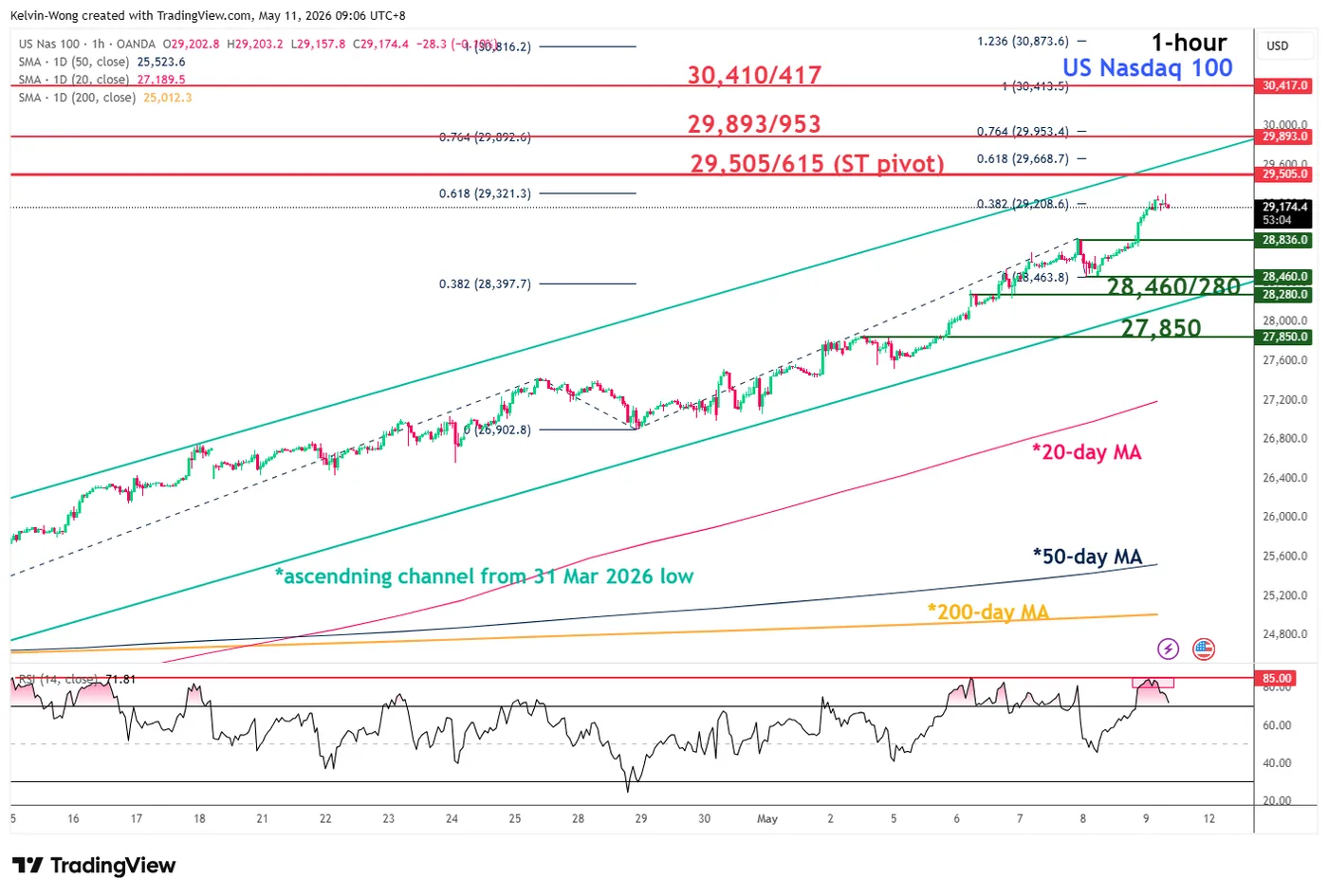
Fig. 1: Nasdaq 100 CFD index minor trend as of 11 May 2026 (Source: TradingView).
The US Nasdaq 100 CFD index, a proxy for Nasdaq 100 E-mini futures, has experienced a steep bullish impulsive rally since 30 April 2026. However, two key technical developments now suggest the index may face the risk of a near-term corrective pullback.
Friday’s rally pushed the Nasdaq 100 toward the upper boundary of its medium-term ascending channel in place since the 30 March 2026 low. At the same time, the hourly RSI momentum indicator has started to reverse lower after reaching extremely overbought territory near the 85 level.
Watch the 29,505/615 key short-term pivotal resistance zone. A break below the 28,835 downside trigger may expose the next intermediate support area at 28,460/280, which also coincides with the lower boundary of the ascending channel from the 30 March 2026 low.
On the other hand, a sustained break and hourly close above 29,615 would invalidate the minor bearish scenario and instead reinforce continuation of the bullish impulsive uptrend toward the next resistance levels at 29,893/953 and 30,410/417.





