


At its meeting on 18 December, the European Central Bank (ECB) left all key interest rates unchanged, maintaining the deposit facility rate at 2.0%. The decision was widely anticipated, offering no fresh catalyst for meaningful euro movement. While headline inflation for the eurozone remained close to target at 2.15% in November, the ECB’s updated projections saw a slight upward revision for the coming years, primarily driven by persistent price growth in the services sector.
Concurrently, the ECB improved its GDP growth forecast for 2025–2027. However, with the decision fully priced in, it provided neither additional support nor pressure to the single currency.
The primary driver for EUR/USD now stems from US monetary policy. The recent Federal Reserve rate cut from 4.00% to 3.75% has narrowed the yield differential between the dollar and the euro. This reduces the dollar’s interest rate advantage and makes euro-denominated assets relatively more attractive, providing a moderate tailwind for the euro.
Looking ahead, medium-term dynamics will hinge on relative expectations for central bank policy. Should markets continue to price in a more aggressive easing cycle from the Fed compared to the ECB, the euro is likely to find further support. Conversely, any signs that the ECB is preparing to proactively ease policy in response to eurozone economic weakness would limit the euro’s upside potential.
Technical Analysis: EUR/USD
H4 Chart:
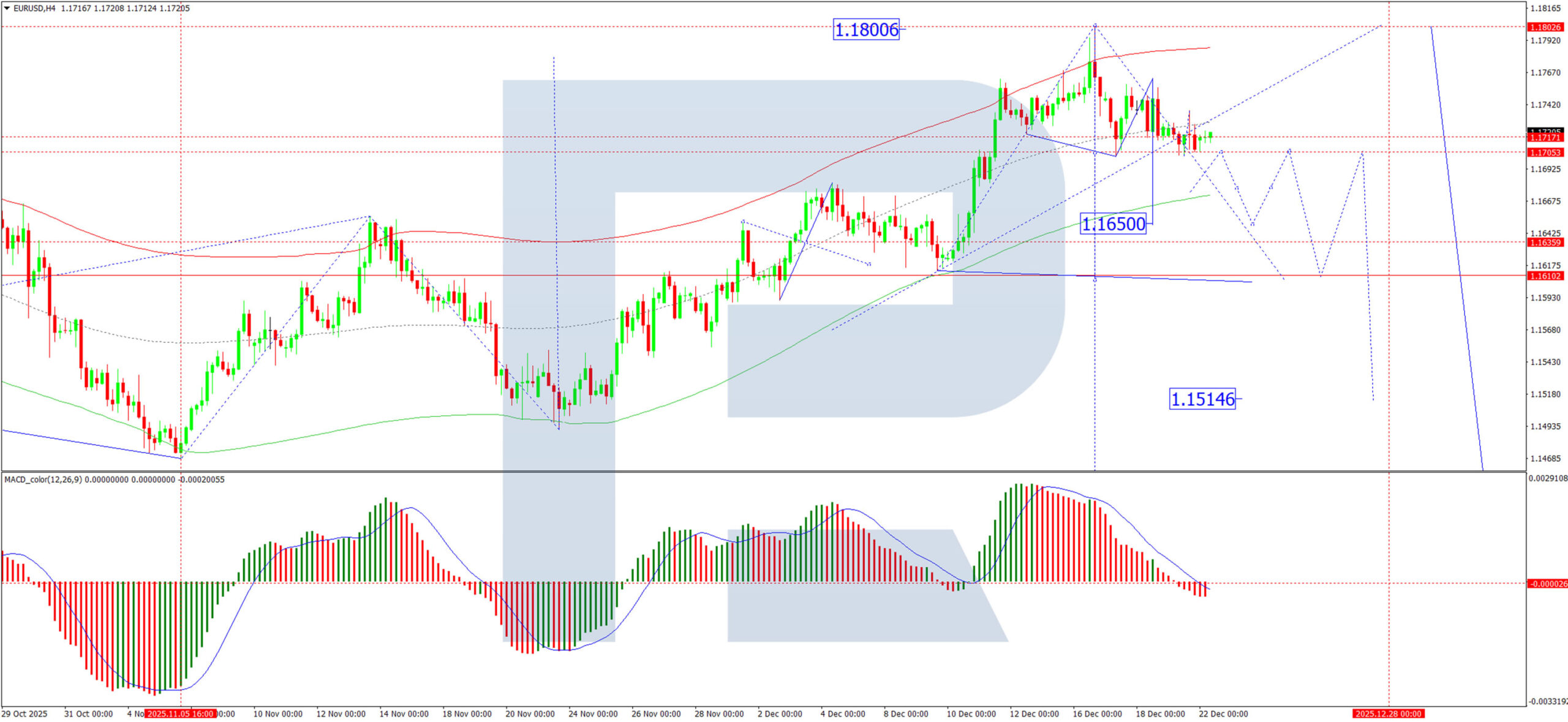
On the H4 chart, the pair is consolidating near the breakdown level of the previous growth channel’s lower boundary. We anticipate a downside breakout from this range and a resumption of the third decline wave, with an initial target at 1.1650.
The MACD indicator technically confirms this bearish outlook. Its signal line is below zero and pointing decisively downward, reflecting sustained bearish momentum and potential for further downside.
H1 Chart:
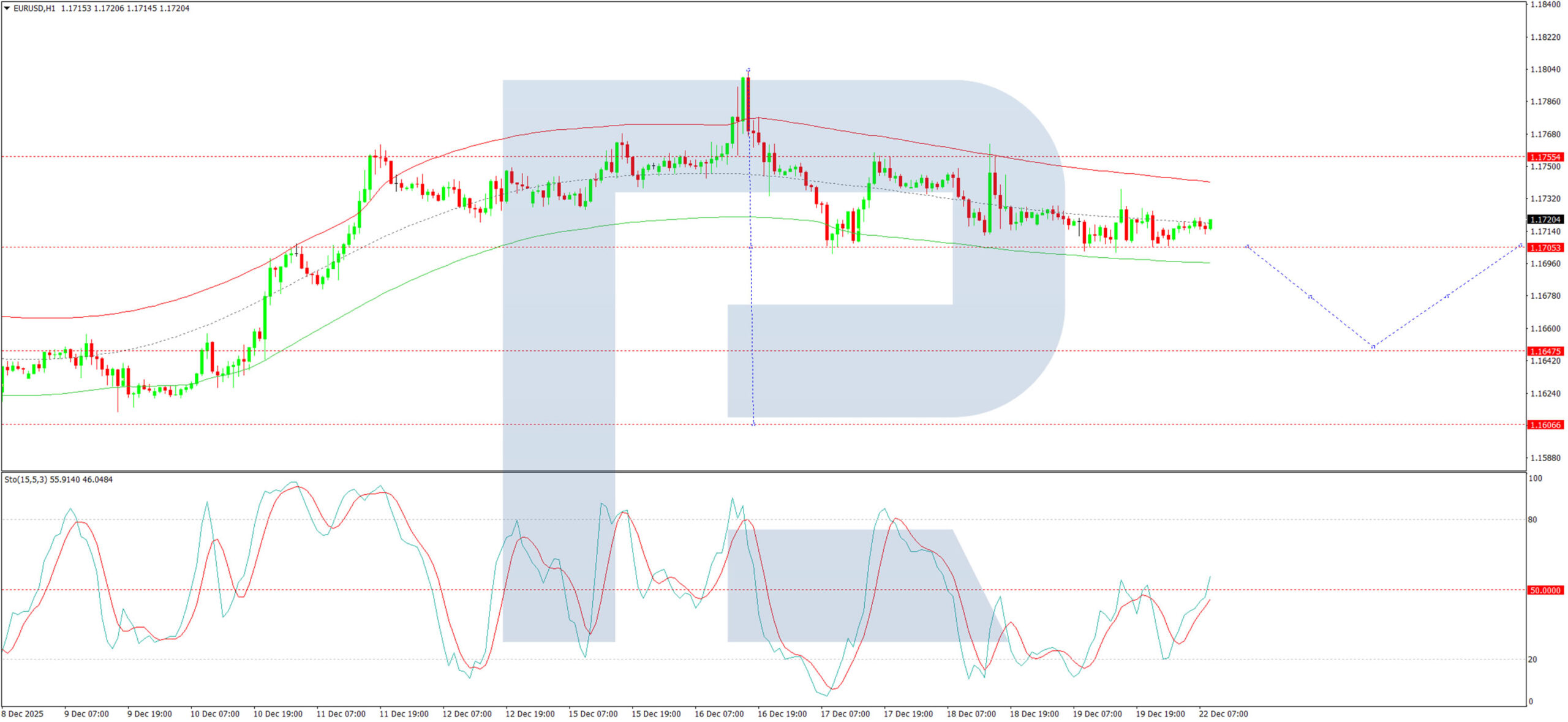
On the H1 chart, the market completed another decline wave to 1.1702, followed by a correction to 1.1737. A new downward impulse towards 1.1650 is currently forming. A sustained break below this level would signal the potential for an extended third wave, targeting the 1.1645 area as a local objective.
This scenario is supported by the Stochastic oscillator, with its signal line below the 50 level and trending firmly downwards.
Conclusion
The euro’s trajectory remains more sensitive to shifting US policy expectations than to the ECB’s predictable stance. While the narrowed interest rate differential offers near-term support, the technical structure appears bearish. A decisive break below the current consolidation range could trigger a renewed move towards the 1.1650–1.1645 support zone.

 left all key interest rates unchanged, maintaining the deposit facility rate at 2.0%. The decision was widely anticipated, offering no fresh catalyst for meaningful euro movement. While headline inflation for the eurozone remained close to target at 2.15% in November, the ECB's updated projections saw a slight upward revision for the coming years, primarily driven by persistent price growth in the services sector.)