


EUR/USD on Thursday stabilised at 1.1792 after a sharp decline the day before. The US dollar was supported by strong US macro data and unexpectedly tough signals from the Fed.
The minutes of the previous meeting showed that disagreements remain within the Federal Reserve regarding the future path of rates. This suggests that it may not be easy for the new chair to implement a rate cut. Some members had previously explicitly admitted the possibility of a rate hike if inflation remains above target.
The market has slightly reduced expectations for policy easing this year, but still prices in two 25-basis-point cuts before the end of the year.
Additional support for the dollar was provided by industrial production data. It grew at the highest rate in almost a year. Orders for core capital goods exceeded forecasts, and the number of new home mortgages reached a five-month high.
PMI indices and GDP data are due next, which may provide additional guidance on the path of interest rates.
Technical Analysis
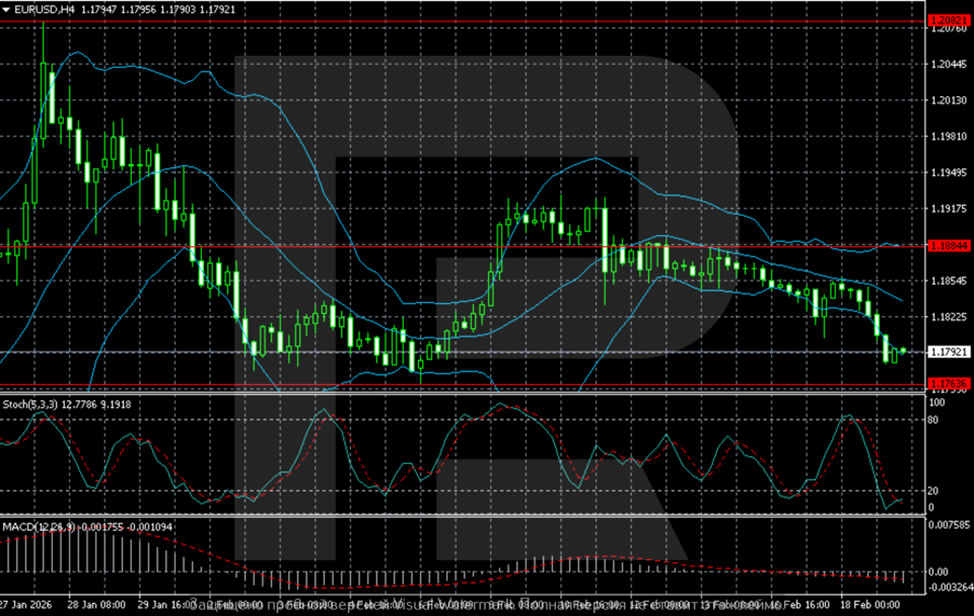
On the H4 chart, EUR/USD stays close to 1.1790–1.1800 after breaking support at 1.1885 and accelerating the decline. The price has firmed below the Bollinger Bands’ midline; the bands have widened, indicating bearish momentum. The MACD is in negative territory; the histogram is deepening further, reinforcing downward momentum. The Stochastic oscillator has rebounded from oversold. Against this background, a brief correction is possible, but the structure remains weak. The nearest support is at 1.1765, and resistance is at 1.1885.
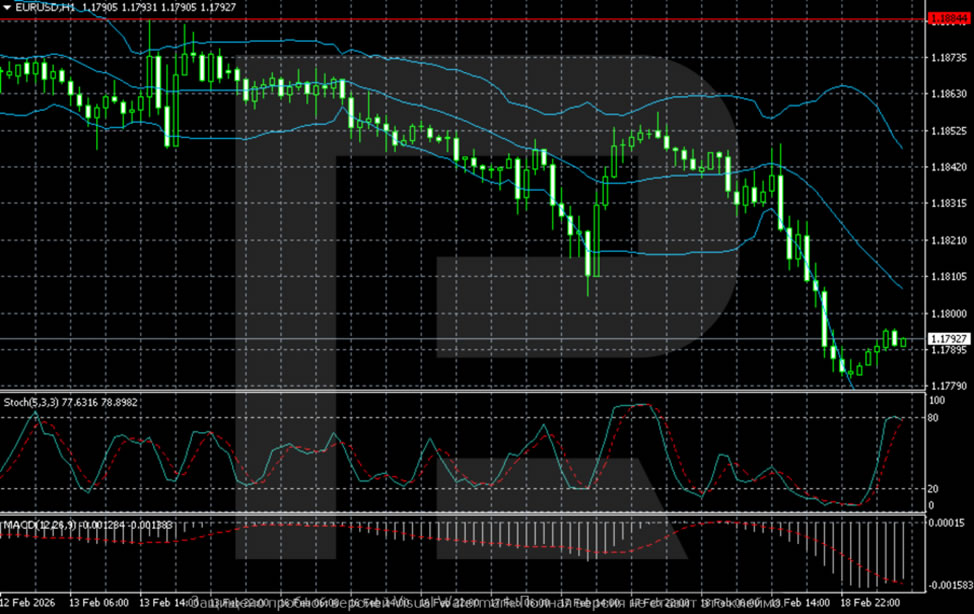
On the lower H1 time frame, a sharp downward move is visible, followed by local stabilisation. The price is forming a small bounce off 1.1780 but remains below the Bollinger Bands’ middle line. The MACD remains negative, although the pressure is gradually decreasing. The Stochastic oscillator is in the overbought zone, suggesting that any corrective rebound could fade in the 1.1820–1.1840 area.
The overall picture points to a short-term rebound within a broader bearish move.
Conclusion
In summary, EUR/USD remains under decisive pressure following hawkish Fed signals and resilient US economic data. The technical breakdown below key support has confirmed a bearish shift, with momentum indicators favouring further downside despite oversold conditions. The current stabilisation appears corrective rather than reversal, with any bounce likely capped near 1.1820–1.1840. Upcoming US PMI and GDP releases will shape the near-term direction. A break below 1.1765 would open the door to deeper losses towards 1.1700, while a sustained move above 1.1885 is needed to alleviate bearish pressure.

