


- USD/CAD stays rangebound with a downside bias.
- Momentum indicators’ prolonged flatlining mirrors consolidation.
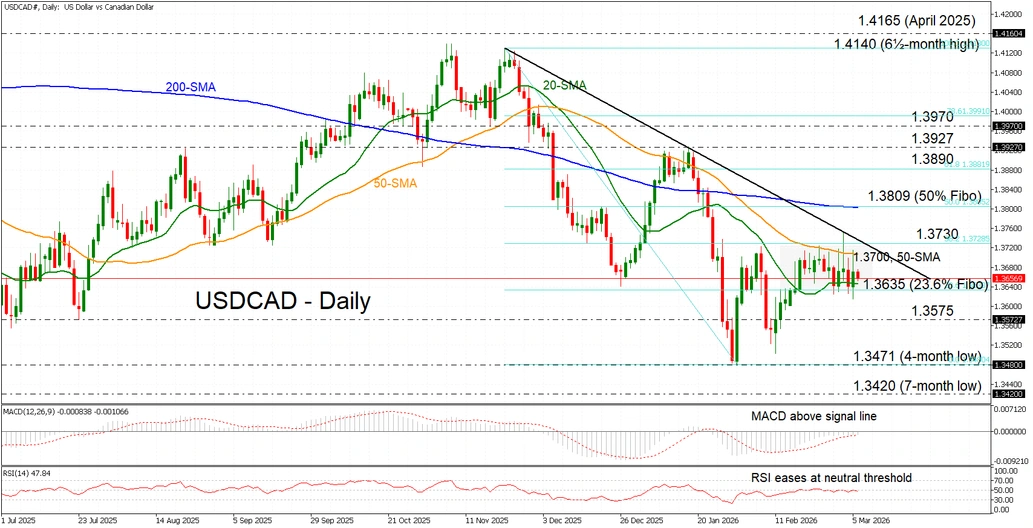
USD/CAD remains on the defensive, continuing to trade within the range established since mid‑February, with price action capped between the 20‑day and 50‑day simple moving averages (SMAs) inside the tight 1.3645-1.3700 band. The Canadian dollar is still under pressure against a firmer US dollar, though it remains relatively bid amid rising oil prices linked to the ongoing Middle East conflict.
The momentum indicators reinforce the multi‑week muted tone, with the RSI flatlining near the neutral 50 mark and the MACD compressing around its zero and red signal lines, pointing to limited upside in the near term.
Price action is currently drifting lower within its range after repeated rejections at the short‑term downtrend line. Initial support is located at the 20‑day SMA at 1.3645, sitting just above the 23.6% Fibonacci retracement of the November-January decline at 1.3635. A break below these levels would expose support at 1.3575 and then the four‑month low near 1.3471, last touched in late January.
On the upside, a decisive break above the 50‑day SMA and the 38.2% Fibonacci retracement at 1.3730 – where the short‑term downtrend line also intersects – would shift the bias higher. Such a move would open the path toward the 200‑day SMA near the 50% Fibonacci level at 1.3809, which recently formed a ‘death cross’ with the 50‑day SMA, adding further technical weight against sustained upside.
Overall, USD/CAD is losing momentum as it edges toward the lower bound of its multi‑week consolidation, with the earlier rebound from four‑month lows stalling. While the broader downtrend remains intact, downside risks may be limited if the pair continues to hold above the 20‑day SMA.





 inside the tight 1.3645-1.3700 band. The Canadian dollar is still under pressure against a firmer US dollar, though it remains relatively bid amid rising oil prices linked to the ongoing Middle East conflict.)