EUR/USD kicked off Monday with an attempt to stabilise around 1.1587. Federal Reserve Chair Kevin Warsh returned support to the dollar with a hawkish performance at Jackson Hole. The key test now will be Friday’s US labour market report, which will show whether the case for another rate hike has sufficient backing from the economy. The US dollar has already recovered to a two-week high.
Warsh also stated that with inflation not slowing sufficiently, the regulator may need to tighten policy again. Markets now estimate the probability of a rate hike in September at approximately 57%, up from around 35% before his speech. The yield on two-year US Treasury notes climbed to 4.33%, further enhancing the appeal of dollar-denominated assets.
The main event of the week will be Friday’s August Nonfarm Payrolls report. Expectations point to an increase in employment of around 50,000, following an unexpected decline of 23,000 in July. Unemployment is projected at approximately 4.1%. Strong payrolls, combined with steady wage growth and a stable average working week, would support Warsh’s hawkish stance and may increase pressure on EUR/USD below 1.16. Weak data, on the other hand, would cast doubt on a September rate hike, lower yields, and help the euro recover.
Until Friday, markets will also monitor intermediate signals. US jobs data is due on Tuesday, followed later by private sector employment figures, jobless claims, and revised productivity statistics.
In Europe, eurozone inflation will be the main event, with expectations pointing to an acceleration to around 3.3%. A strong reading would reinforce expectations of an ECB rate hike in September and could partially offset the dollar’s support from the Fed.
Technical Analysis
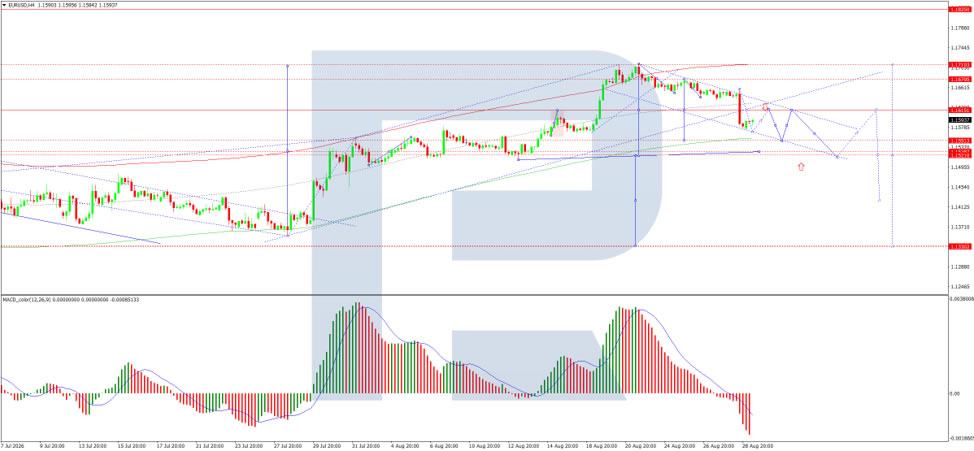
On the H4 chart of EUR/USD, the market made a downward wave to 1.1567 today. A consolidation range is currently forming above this level, with a potential growth leg to 1.1597 not ruled out. Further decline to 1.1555 is expected. Technically, this scenario is confirmed by the MACD indicator-its signal line is below zero and pointing strictly downwards, reflecting continued bearish momentum with the potential for the downward trend to persist.
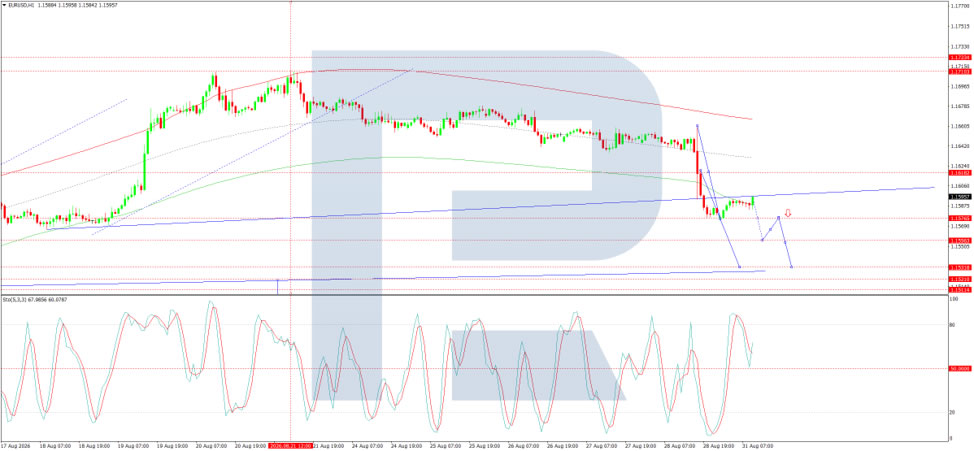
On the H1 chart, the market completed the next downward wave to 1.1576. A consolidation range is forming above this level. A growth leg to 1.1597 is expected, followed by the beginning of a decline to 1.1533, with the prospect of the wave continuing to 1.1511. Technically, this scenario is confirmed by the Stochastic oscillator-its signal line is below the 80 level and pointing strictly downwards to 20.
Conclusion
EUR/USD has retreated to near two-week lows following Fed Chair Warsh’s hawkish Jackson Hole speech, which significantly raised market expectations for a September rate hike. The probability of a move has surged from 35% to 57%, supported by rising Treasury yields and a stronger dollar. Markets now look to Friday’s US payrolls report as the key test for whether the economy can withstand further tightening, with a strong reading likely to push EUR/USD below 1.16. Meanwhile, eurozone inflation data will be closely watched, with a strong print potentially reinforcing ECB tightening expectations and offering some support to the euro. Technically, the pair remains bearish, with further downside towards 1.1533 and 1.1511 likely in the near term.