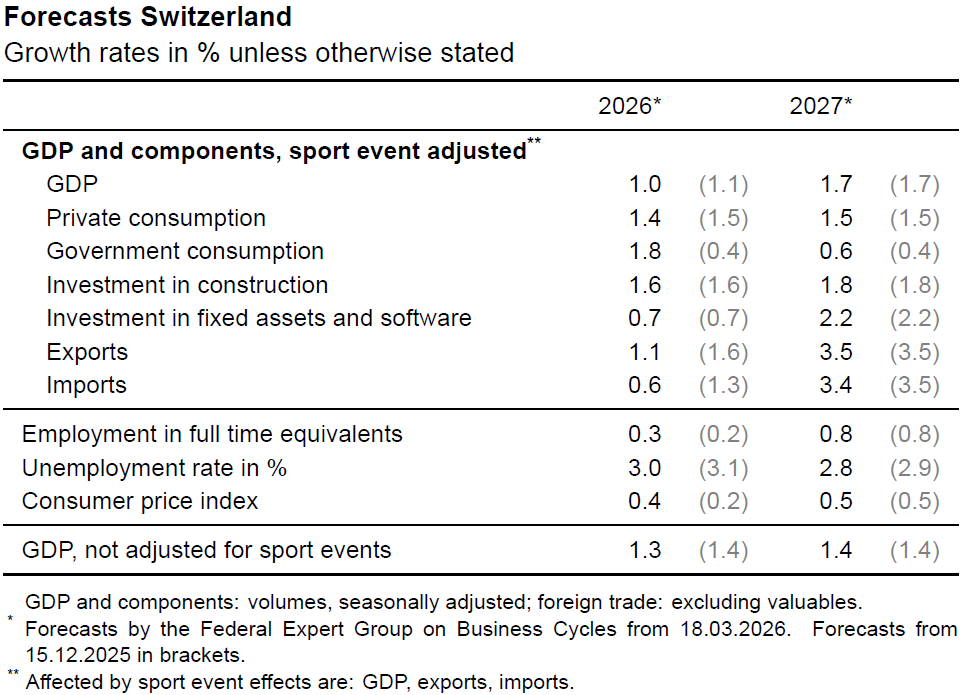
Switzerland’s economic outlook has been revised slightly lower as the fallout from the Middle East conflict continues to ripple through global markets. The Federal Government Expert Group on Business Cycles now expects GDP growth of 1.0% in 2026, down from the previous 1.1% forecast, reflecting below-average expansion. Growth is still projected to recover to 1.7% in 2027, but the near-term outlook has clearly softened amid rising uncertainty.
The key driver behind the downgrade is the sharp increase in energy prices since late February. Higher oil prices are not only lifting inflation expectations globally but also weighing on consumption and business sentiment. In Switzerland, inflation is now expected to come in slightly higher at 0.4% in 2026, compared to the earlier estimate of 0.2%.
At the same time, Switzerland’s export sector continues to face headwinds from subdued global demand and the strength of the Swiss Franc. These factors are dampening investment activity and limiting growth momentum in exposed industries.
Looking ahead, conditions are expected to improve gradually in 2027 as global demand recovers, particularly in Europe, with Germany’s stabilization likely to provide some support. However, the near-term outlook remains constrained by external risks and currency strength.