


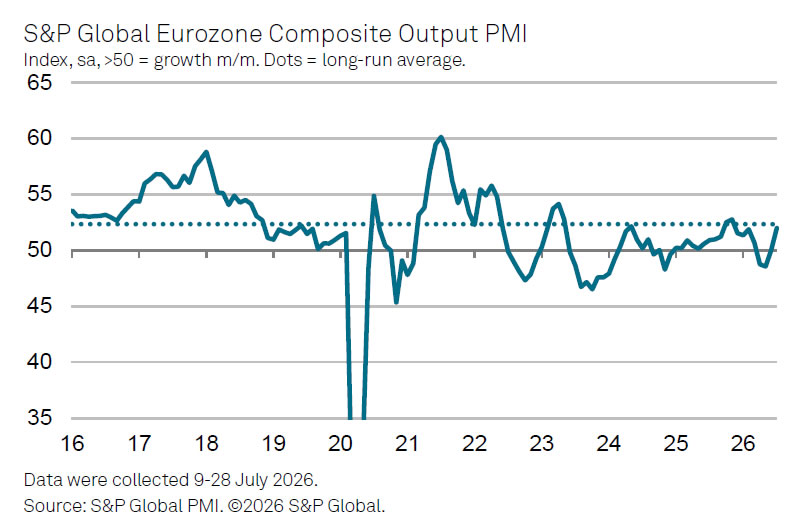
The Eurozone economy gathered momentum at the start of the third quarter, with business activity expanding at its fastest pace in eight months as the services sector returned to growth. The final S&P Global Composite PMI rose to 52.0 in July from 50.0 in June, while the Services PMI climbed to 51.7 from 49.4, its highest level in five months. The survey pointed to the strongest increases in output and new orders since November, suggesting demand is recovering despite continued geopolitical uncertainty.
The improvement was broad-based across the region. Germany led the recovery, with its Composite PMI returning to expansion territory at 51.3 after three months of contraction, supported by a near-stabilization in services activity. France remained a laggard, but conditions improved noticeably as both services and overall private-sector activity moved closer to the 50 threshold, indicating the downturn is steadily easing. The divergence between the Eurozone’s two largest economies therefore narrowed further during July.
The survey also offered encouraging news on inflation. Business optimism rose to its highest level since January as demand strengthened and input cost inflation slowed to its weakest pace since February. That combination points to a healthier growth environment without a renewed surge in price pressures. According to S&P Global, the PMI is consistent with around 0.3% quarterly GDP growth, reflecting a recovery that is becoming increasingly broad-based.
However, the outlook remains closely tied to developments in the Middle East. Much of July’s improvement followed the temporary easing in oil prices and geopolitical tensions during June. With the conflict having intensified again since then, risks to both growth and inflation have resurfaced. While the moderation in PMI price gauges could give the ECB room to delay further policy tightening until the inflation outlook becomes clearer, policymakers are unlikely to become complacent given the renewed uncertainty surrounding energy markets.
Data Summary
| Component | July 2026 | June 2026 | Trend |
|---|---|---|---|
| Eurozone Composite PMI | 52.0 | 50.0 | ▲ 8-month high |
| Eurozone Services PMI | 51.7 | 49.4 | ▲ 5-month high |
| Output | Expanded | Expanded | Strongest since November |
| New Orders | Expanded | Expanded | Strongest since November |
| Business Optimism | Highest since January | Improved | ▲ Stronger confidence |
| Input Cost Inflation | Slowed | Faster | ▼ Slowest since February |
Major Economies
| Economy | Services PMI | June | Composite PMI | June | Assessment |
|---|---|---|---|---|---|
| Germany | 49.8 | 48.6 | 51.3 | 49.5 | Composite returned to expansion |
| France | 49.6 | 46.8 | 49.4 | 47.2 | Contraction eased markedly |
Key Takeaways
- The Eurozone Composite PMI climbed to 52.0, its highest level in eight months, while the Services PMI returned to expansion at 51.7, the strongest reading in five months.
- Output and new orders recorded their fastest growth since November, pointing to improving demand at the start of the third quarter.
- Germany led the recovery, with its Composite PMI returning above 50 for the first time since March, while France remained in contraction but showed a notable improvement.
- Business confidence strengthened to its highest level since January, supported by improving demand and easing cost pressures.
- Input cost inflation slowed to its weakest pace since February, providing some relief after months of elevated price pressures.
- S&P Global estimates the survey is consistent with around 0.3% q/q GDP growth, although renewed Middle East tensions and higher oil prices have reintroduced downside risks to growth and upside risks to inflation.





