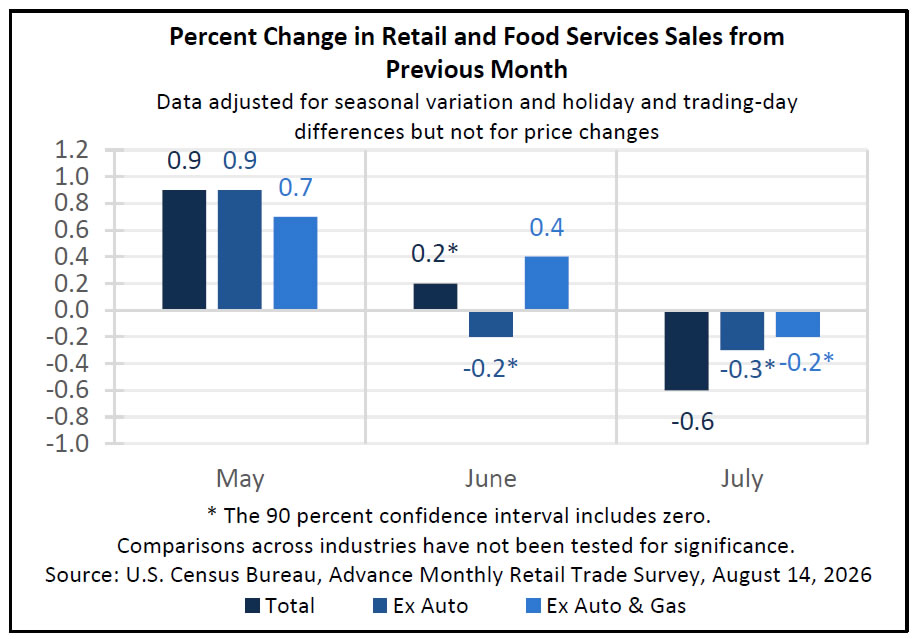
US retail sales weakened sharply in July, adding to evidence that domestic demand lost momentum at start of Q3. Headline sales slowed from 0.2% to -0.6% m/m, well below expectations for 0.2% growth. Sales excluding autos deteriorated from -0.2% to -0.3%, also missing 0.2% forecast. Even excluding both autos and gasoline, sales fell -0.2%, suggesting weakness extended beyond volatile categories. Retail sales excluding food services were softer still at -0.8%.
Monthly weakness contrasts with still-solid annual growth. Total retail and food-services sales were 5.0% higher y/y, while sales over May-July were 6.3% above same period a year earlier. Ex-auto sales rose 5.8% y/y and ex-auto-and-gasoline sales increased 4.8%. That argues against describing July as a collapse in consumption, but it does point to a clear loss of near-term momentum after May’s strong gains and modest June growth.
For Fed, July retail sales reinforce case for keeping rates unchanged in September. Weak payrolls already raised concern over labor market, while this week’s CPI and PPI reduced urgency to tighten again. Softer consumer spending now adds evidence that higher rates are restraining demand. One month is not enough to establish a sustained downturn, but another weak August reading would strengthen argument that Fed should remain patient rather than revive tightening.
Data Summary
| Indicator | Actual | Expected | Previous |
|---|---|---|---|
| Retail Sales m/m | -0.6% | 0.2% | 0.2% |
| Retail Sales ex Autos m/m | -0.3% | 0.2% | -0.2% |
| Retail Sales ex Autos & Gas m/m | -0.2% | — | 0.4% |
| Retail Sales ex Gasoline m/m | -0.6% | — | 0.8% |
| Retail Sales ex Food Services m/m | -0.8% | — | 0.2% |
Key Takeaways
- US retail sales swung from 0.2% growth to -0.6% m/m in July, sharply missing expectations for another 0.2% increase.
- Weakness extended beyond autos. Sales excluding autos deteriorated from -0.2% to -0.3%, while sales excluding both autos and gasoline fell 0.2%.
- Retail sales excluding food services dropped 0.8% m/m, reinforcing evidence of broad monthly softness.
- Annual spending remains much firmer, with total retail and food-services sales 5.0% higher y/y and May–July sales up 6.3% from same period in 2025.
- Data therefore point to loss of near-term consumer momentum rather than outright collapse in spending.
- Retail sales are nominal and not adjusted for price changes, so strong annual growth does not necessarily imply equally strong real consumption.
- Combined with weak July payrolls and benign CPI/PPI, report further strengthens September Fed hold case.