


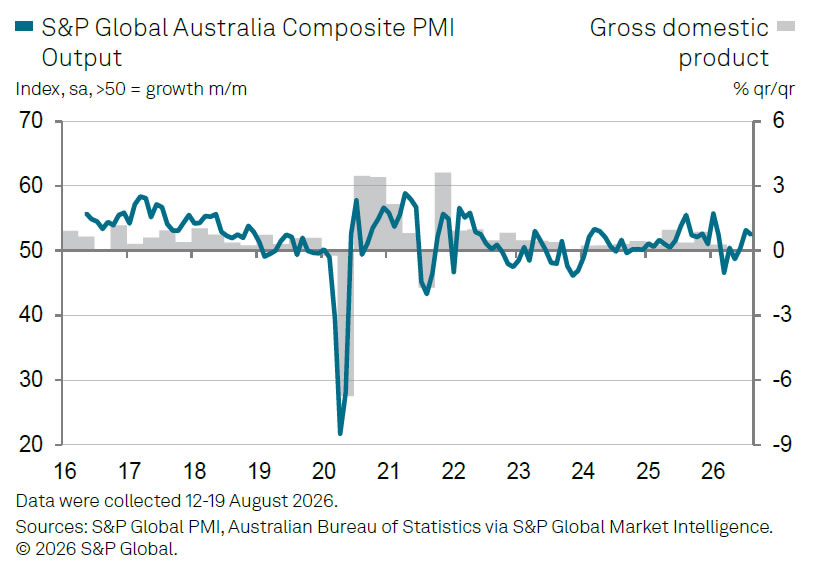
Australia private-sector activity continued to expand in August, although momentum eased slightly. PMI Composite Output fell from 53.2 to 52.5, while PMI Services Business Activity eased from 53.6 to 52.9. PMI Manufacturing held at 52.0, but PMI Manufacturing Output slipped from 50.3 to 49.7, indicating a marginal contraction in factory production even as broader manufacturing conditions stayed expansionary.
The details were mixed but still constructive. S&P Global said order books improved again, with manufacturing recording its strongest increase in new work since the start of the year. Employment also rose modestly, while business confidence strengthened to a six-month high. Services remained the main source of growth, though both activity and new business expanded at a softer pace than in July. Manufacturing output, meanwhile, was held back by supply-chain disruption and rising cost pressures.
Inflation signals were less comfortable. Input-cost inflation accelerated in August, ending the steady easing seen since April, while firms cut the pace of output-price increases to the slowest since the start of the year in an effort to support demand. S&P Global said businesses continued absorbing a large share of higher costs, pointing to ongoing margin pressure. Overall, August PMI still signals modest expansion, but with softer services momentum, weaker factory output and a less favorable cost environment.
Data Summary
| Component | Current | Previous | Trend |
|---|---|---|---|
| PMI Composite Output | 52.5 | 53.2 | Growth slowed |
| PMI Services Business Activity | 52.9 | 53.6 | Expansion eased |
| PMI Manufacturing | 52.0 | 52.0 | Stable expansion |
| PMI Manufacturing Output | 49.7 | 50.3 | Slipped into contraction |
Key Takeaways
- Australia PMI Composite Output eased from 53.2 to 52.5 in August, signaling continued private-sector expansion but at a slightly slower pace.
- PMI Services Business Activity fell from 53.6 to 52.9, keeping services in growth while momentum softened.
- PMI Manufacturing held at 52.0, but PMI Manufacturing Output slipped from 50.3 to 49.7, indicating a marginal contraction in factory production.
- Demand remained relatively resilient, with order books improving and manufacturing recording its strongest inflow of new work since the start of the year.
- Employment continued to rise modestly, while business sentiment improved to a six-month high.
- Cost pressures became less favorable as input-price inflation accelerated, ending the easing trend seen since April.
- Firms nevertheless slowed increases in selling prices to the weakest pace since the start of the year, suggesting businesses are absorbing more of higher costs to protect demand.
- Overall, August PMI points to continued but slower growth, stronger order books and renewed margin pressure.





