


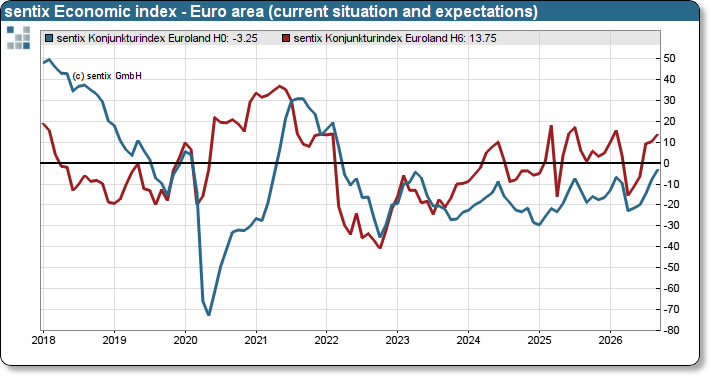
Eurozone investor confidence strengthened much more than expected in September, with the sentix Economic Index rising from 0.9 to 5.1, well above consensus of 2.1 and marking a fifth consecutive monthly improvement. The headline reached its highest level since February 2022. The advance was broad-based: the current situation index improved from -8.0 to -3.3, its strongest reading since March 2022, while expectations rose from 10.3 to 13.8. sentix consequently classified the Eurozone economy as being in an “upturn.”
The composition suggests that improving sentiment is no longer being driven solely by hopes for the future. Current conditions are catching up with expectations, pointing to a more constructive assessment of activity even though the current-situation index remains slightly negative. There was also a less favorable inflation signal: sentix said investors’ inflation expectations continued to rise moderately, which it viewed as an increasing headwind for bond markets. That leaves the survey showing firmer economic confidence alongside continued concern over price pressures rather than an unambiguously benign recovery.
Germany provided the most striking improvement. Its sentix overall index jumped from -11.9 to -2.8, a 9.1-point increase and the strongest reading since July 2025. The current situation surged from -28.3 to -16.8, while expectations strengthened from 6.0 to 12.3. But the optimism contrasts sharply with Monday’s hard data: German industrial production fell from 0.0% to -1.1% m/m in July, missing expectations for a 0.4% increase. The survey therefore suggests investors are becoming considerably more confident about Germany before that improvement has been consistently confirmed in actual industrial activity.
Taken together, the releases paint a more constructive Eurozone picture but stop short of confirming a broad-based German recovery. Sentiment is strengthening, current-condition assessments are improving and Germany is finally contributing to the Eurozone upswing rather than holding it back. Yet the industrial-production disappointment shows that the gap between confidence and hard activity remains substantial. The next test is whether the improvement now visible in surveys can translate into sustained gains in German output rather than remaining primarily an expectations-led turn.
Data Summary
| Indicator | Actual | Expected | Previous |
|---|---|---|---|
| Eurozone Sentix Economic Index | 5.1 | 2.1 | 0.9 |
| Eurozone Current Situation | -3.3 | — | -8.0 |
| Eurozone Expectations | 13.8 | — | 10.3 |
| Germany Sentix Economic Index | -2.8 | — | -11.9 |
| Germany Current Situation | -16.8 | — | -28.3 |
| Germany Expectations | 12.3 | — | 6.0 |
| Germany Industrial Production m/m | -1.1% | +0.4% | 0.0% |
The Eurozone Sentix headline rose for a fifth consecutive month to its highest level since February 2022. Germany’s headline reached its strongest level since July 2025.
Key Takeaways
- Eurozone Sentix rose from 0.9 to 5.1, well above the 2.1 consensus, with improvement in both current conditions and expectations.
- The current situation index improved from -8.0 to -3.3, while expectations rose from 10.3 to 13.8, showing that the improvement is becoming broader than an expectations-only rebound.
- Germany delivered the sharper turn, with its headline index jumping from -11.9 to -2.8. Current conditions improved from -28.3 to -16.8 and expectations from 6.0 to 12.3.
- However, Germany’s sentiment recovery is running ahead of hard activity: July industrial production fell from 0.0% to -1.1% m/m, versus expectations for +0.4%.
- The combined message is constructive for the Eurozone, but Germany still needs hard-data confirmation before the rebound can be described as an established recovery.





