TL;DR: Thursday’s ECB hike to 2.50% is almost fully priced, but economists overwhelmingly expect it to be the last move while markets price roughly two more hikes within a year — and EUR/GBP is testing a major resistance cluster at 0.8610–0.8617 at exactly the moment that disagreement needs resolving.
The Hike Is Almost Certain. What Comes After It Is Not.
Calling Thursday’s ECB meeting a non-event because a 25bp hike is already almost fully priced misses the part of the meeting that actually matters.
There’s little disagreement over the immediate decision. Markets assign roughly a 95% probability to a rate increase from 2.25% to 2.50%, while all 65 economists in the latest Reuters poll expect the same move. But beyond September, the consensus breaks apart sharply.
Economists overwhelmingly think Thursday will mark the end of the tightening campaign. Rates markets do not. Some 91% of economists expect the deposit rate to finish 2026 at 2.50%, while 78% see it still there through the middle of 2027. OIS pricing, by contrast, implies around 72bp of cumulative tightening over the coming 12 months — roughly three hikes in total, including the one expected this week.
That leaves close to two additional moves embedded in the curve beyond Thursday. So the real question isn’t whether the ECB hikes. The hike is priced. The rate path is not. And EUR/GBP has arrived at a particularly awkward place for that disagreement to be resolved.
EUR/GBP Is Testing More Than Just Another Resistance Level
The pair has recovered from 0.8453 into a resistance zone where several independent technical methods converge.
On the daily chart, the broader cycle runs from the October 2024 base around 0.8221 through the rally to 0.8863, followed by a decline that developed through lower highs before stalling at 0.8453. That low wasn’t technically random. The 61.8% retracement of the entire 0.8221–0.8863 advance sits around 0.8466, almost exactly where the decline eventually found support. That strengthens the significance of 0.8453 as a potential medium-term turning point.
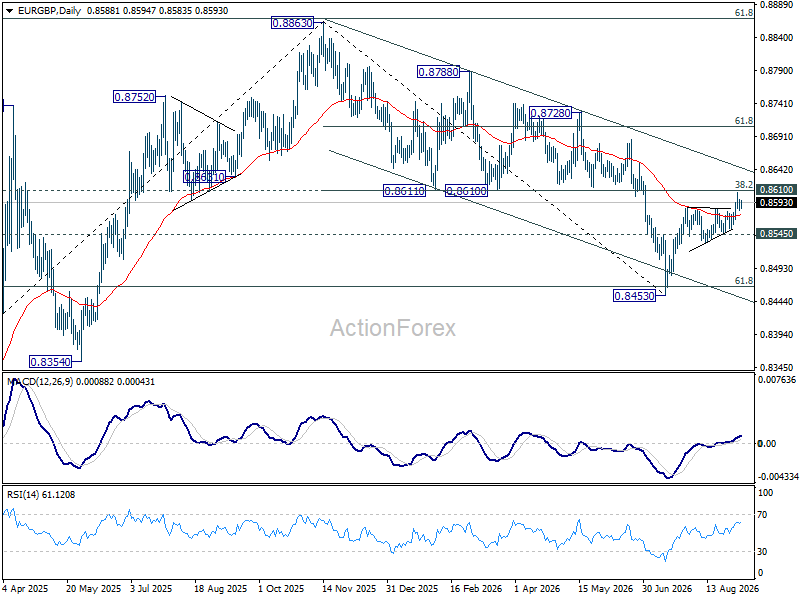
But proving a bottom exists is very different from proving a new uptrend has begun. EUR/GBP has now reached the 0.8610 area, and this is where the recovery faces its first serious test. Three separate forms of daily resistance converge there.
First is horizontal structure. EUR/GBP previously consolidated around 0.8610 on two occasions during the decline, giving the zone clear historical significance. Second is the 38.2% retracement of the 0.8863–0.8453 decline, which also comes in almost exactly at 0.8610.
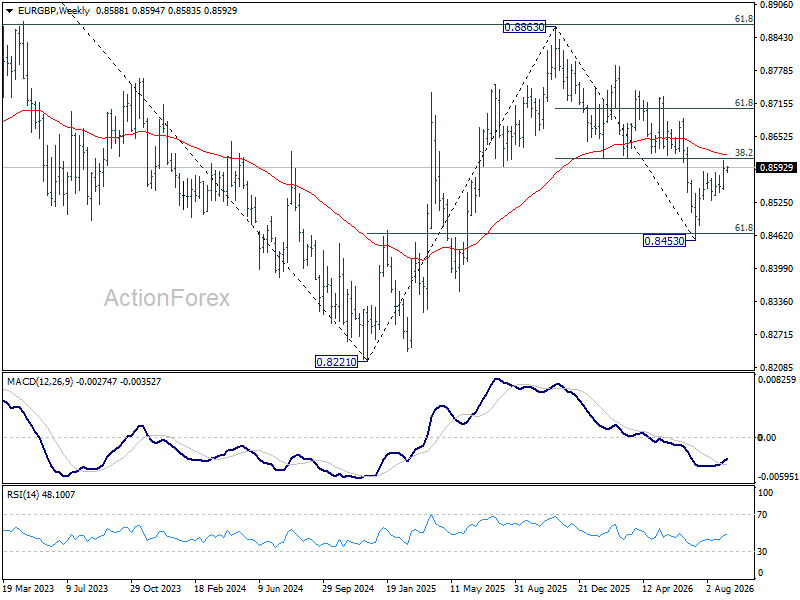
The weekly chart raises the bar further. The 55-week EMA currently sits around 0.8617, leaving EUR/GBP facing a broader resistance cluster between roughly 0.8610 and 0.8617. That matters because the pair isn’t simply approaching a level where one technical method happens to suggest resistance — several different structures are saying much the same thing. It will probably take real fundamental conviction to clear them.
Momentum Has Already Started to Hesitate
The higher-timeframe momentum picture is still constructive. Daily RSI is around 61, leaving considerable room before overbought territory, while daily MACD has crossed higher and is holding above zero. There’s no obvious daily exhaustion signal.
The four-hour chart, however, is beginning to tell a different story. EUR/GBP reached 0.8607 last week, effectively tagging the lower edge of the resistance cluster, but momentum failed to confirm the move. Four-hour MACD shows bearish divergence, as the latest price high wasn’t accompanied by a matching momentum peak. Four-hour RSI is only around the upper-50s.
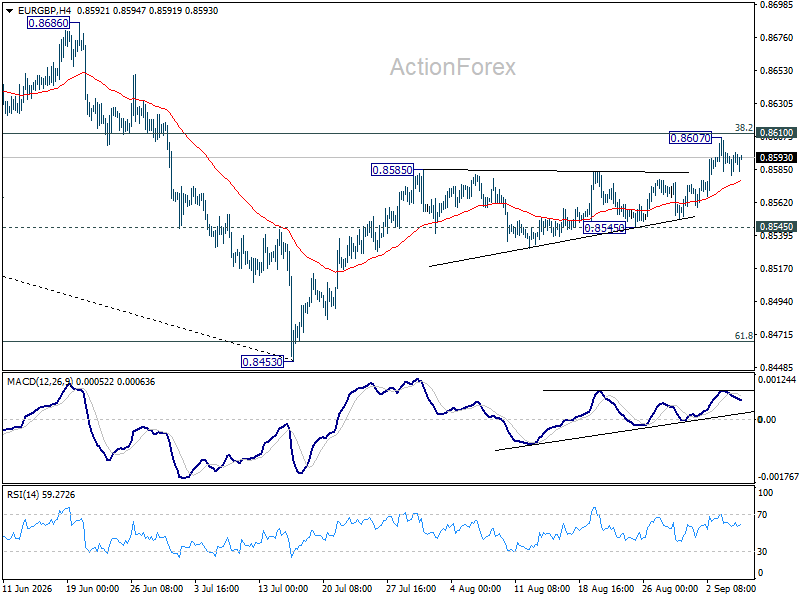
The rally hasn’t stalled because EUR/GBP is already deeply overbought. It has stalled because momentum is fading exactly where substantial resistance should be expected. That makes the current setup genuinely two-sided. A rejection would fit the existing structure. But there’s still enough higher-timeframe momentum for a sufficiently strong catalyst to force a breakout. Thursday’s ECB projections could provide that catalyst.
Economists and Markets Are Making Different Bets
The ECB announces its decision on Thursday, September 10, at 1215 GMT, followed by President Christine Lagarde’s press conference at 1245 GMT.
The expected hike itself is close to settled. The latest Reuters poll, conducted between August 31 and September 3, found all 65 economists expecting a 25bp increase to 2.50%. That conviction has risen steadily: 83% expected a September hike in the previous poll, compared with 72% before the July meeting, when the ECB ultimately held rates unchanged.
But the firm consensus around September masks a much bigger disagreement about what comes next. Economists largely see this as the second and final move of what would be the ECB’s shortest tightening campaign in 15 years. Markets are leaving the door much wider open.
OIS pricing late Sunday put Thursday’s hike probability at 94.8%, equivalent to around 23.7bp of tightening. Yet the curve discounts approximately 72.1bp over the next 12 months. October itself carries only around a 40% probability of another move, while December is somewhat higher at roughly 44%, consistent with the possibility that the ECB could skip October and wait for the next major projection round.
But the exact meeting doesn’t matter as much as the cumulative message. Investors are effectively saying September probably won’t be enough. Economists are saying it probably will. Thursday’s projections need to begin telling markets which side has the stronger case.
The June Forecasts Already Included the Iran Shock
This is why simply seeing higher inflation forecasts on Thursday wouldn’t automatically be hawkish. The ECB’s June projections were already constructed after the Iran war had become a major economic shock.
On June 11, the ECB raised the deposit rate from 2.00% to 2.25%, the main refinancing rate from 2.15% to 2.40%, and the marginal lending rate from 2.40% to 2.65%. The central bank explicitly tied the decision to the conflict and its effects on commodity markets.
Its June staff projections put headline inflation at 3.0% in 2026, 2.3% in 2027, and 2.0% in 2028. Core inflation excluding energy and food was projected at 2.5%, 2.5%, and 2.2%. GDP growth was seen at 0.8%, 1.2%, and 1.5% over the same three years.
Compared with March, the direction was already stagflationary: inflation forecasts moved higher while growth was revised lower, with the ECB linking both changes to the war’s effects on energy prices, real incomes, and confidence. So Thursday isn’t about whether the ECB has suddenly discovered an energy shock. It’s about whether that shock is proving more persistent or more broad-based than the ECB assumed in June.
Headline Inflation Says One Thing. Core Inflation Says Another.
The latest inflation data make that question unusually clean. Eurozone headline inflation accelerated from 2.9% in July to 3.3% in August, putting it above the ECB’s 3.0% full-year projection for 2026. But the increase was driven overwhelmingly by energy.
Underlying measures moved the other way. Core CPI eased from 2.5% to 2.4%, while services inflation slowed from 3.3% to 3.0%. That divergence is the heart of Thursday’s policy debate.
If headline inflation is rising because the conflict has pushed up energy prices, while core and services inflation continue to cool, the ECB is dealing primarily with a supply shock. Higher rates can’t produce more oil or reopen shipping routes. They matter only if those higher energy costs begin feeding into wages, services prices, and inflation expectations. So far, the latest data don’t clearly show that second-round process taking hold.
That’s why the economist consensus can simultaneously accept a September hike and reject the need for several more afterward. The ECB can respond to the immediate inflation risk without concluding that a prolonged tightening campaign is necessary.
The complication is that supply shocks don’t always stay clean. Persistent increases in visible fuel, diesel, and food costs can influence inflation expectations. If households and workers start building those costs into wage demands, and companies begin passing them into broader prices, the distinction between an energy shock and underlying inflation becomes much less comfortable. Thursday’s projections should show whether the ECB thinks Europe is moving closer to that point.
Three Forecast Tests Matter More Than the 25bp Hike
1. Headline Inflation: How Big Is the Revision?
A higher 2026 headline inflation forecast would hardly be surprising after August inflation reached 3.3%. The more important question is what kind of revision the ECB makes.
A modest increase confined mainly to 2026 could amount to little more than technical acknowledgement of higher energy prices already visible in the data. That wouldn’t, by itself, justify another two hikes after September. A larger revision extending meaningfully into 2027 would carry more significance, implying the ECB sees the inflation shock lasting longer than anticipated in June.
2. Core Inflation: The Real Hawkish Test
The core projections are much more important. In June, the ECB forecast core inflation at 2.5% in 2026, 2.5% in 2027, and 2.2% in 2028.
If that path is unchanged or revised slightly lower, the central bank would effectively be confirming that underlying inflation hasn’t materially deteriorated despite the increase in energy-driven headline CPI. That would strongly reinforce the “September and done” argument.
A meaningful upward revision would carry a completely different message. It would suggest policymakers see evidence — or at least a growing risk — that the supply shock is beginning to bleed into more persistent inflation dynamics. That’s the kind of surprise that could justify the extra tightening currently embedded in the market curve.
3. Growth: How Much Damage Is the Shock Doing?
The June growth projections provide the other side of the equation. The ECB expected GDP growth of 0.8% in 2026, 1.2% in 2027, and 1.5% in 2028.
Private-sector consensus remains broadly aligned with the first two numbers, suggesting no obvious reason for a large revision based purely on the growth data available so far. But the intensifying conflict creates clear downside channels through energy costs, weaker household purchasing power, and confidence.
If the ECB cuts growth further while raising inflation, Thursday becomes more complicated rather than simply more hawkish. Higher inflation alongside weaker growth strengthens the policy trade-off. That’s why markets need to look beyond the headline forecast revision and ask what exactly is driving it.
Scenario One: The ECB Confirms This Is Still Mainly a Supply Shock
The cleanest EUR-negative outcome would be straightforward. Headline inflation is revised modestly higher, but core inflation stays broadly unchanged or eases. Growth stays close to the June path or receives a moderate downgrade.
That would tell markets the ECB still sees much of the inflation deterioration as energy-driven rather than evidence of a broader inflation resurgence. It would also validate the dominant economist view that Thursday’s hike can be the last.
This is where the asymmetric market risk becomes important. September itself doesn’t need to be repriced lower — the 25bp increase can happen exactly as expected. The adjustment would come from the additional tightening priced beyond September. With around 72bp embedded over the next year, the curve has significant room to remove future hikes without challenging Thursday’s move at all.
That would be a genuinely EUR-negative outcome. For EUR/GBP, rejection from the 0.8610–0.8617 resistance cluster would then have both technical and fundamental backing. The more important bearish confirmation would come below 0.8545. A break there would strengthen the view that the rebound from 0.8453 was corrective rather than the start of a durable trend reversal, exposing 0.8453 again. A renewed break of that low would reopen the broader decline from 0.8863.
Scenario Two: The ECB Validates the Market’s Hawkish View
The bullish EUR scenario requires more than an energy-driven headline revision. Core inflation would need to move higher as well, or the projections and Lagarde’s communication would need to show the ECB is becoming more concerned about second-round inflation pressure.
The press conference could be just as important as the forecasts here. The ECB has repeatedly emphasized that it isn’t pre-committing to a particular rate path and will decide meeting by meeting. If that language stays essentially intact while Lagarde makes little effort to push back against the roughly two additional hikes markets are pricing beyond September, investors could interpret the meeting as tacit confirmation that the tightening cycle still has room to run.
That would give EUR/GBP the kind of Euro-specific catalyst needed to challenge the current technical ceiling. A decisive break through 0.8610–0.8617 would be the first important signal that the decline from 0.8863 completed at 0.8453. The next immediate objective would be the upper boundary of the descending daily channel around 0.8644. A sustained break there would make the recovery from 0.8453 look increasingly like a genuine reversal rather than another rebound within the broader decline.
Scenario Three: The ECB Solves Nothing
The third outcome may be the easiest to imagine and the hardest to trade. Headline inflation is revised higher. Growth is cut. Core inflation moves too little to settle whether the shock is genuinely spreading.
That would leave the ECB facing essentially the same two-sided problem it described in June: upside inflation risk and downside growth risk at the same time. In that environment, markets may struggle to decide whether the extra tightening already priced into the curve is justified.
EUR/GBP could reject again from 0.8610 without generating enough downside conviction to break 0.8545. And if that happens, the technical stalemate simply survives another day. Friday’s UK data could then become the tie-breaker.
Friday’s UK GDP Matters Most If the ECB Leaves a Draw
The ONS releases July monthly GDP on Friday, September 11, alongside the trade balance, industrial and manufacturing production, construction output, and the NIESR monthly GDP tracker.
The broader UK growth picture is modest rather than collapsing. GDP growth slowed from 0.6% q/q in Q1 to 0.4% in Q2, while the IMF forecasts 1.0% growth for 2026 and the OECD 0.9%.
That gives Friday’s releases clear Sterling relevance. But they shouldn’t displace Thursday’s ECB meeting as the central driver of this setup. If the ECB convincingly validates further tightening, EUR/GBP may already be testing or breaking resistance before the UK numbers arrive. If the ECB instead reinforces the “one and done” view, the Euro could already be retreating from resistance, leaving UK data as a secondary confirmation or counterweight. Friday becomes most important under the mixed scenario, where Thursday fails to provide enough conviction to resolve either side of the technical range.
ActionForex’s Technical View on EUR/GBP: The Market Has Already Drawn Its Own Line
EUR/GBP is approaching Thursday with an unusually clean combination of fundamental and technical uncertainty. The rate decision itself is almost known. The projections are not.
Economists overwhelmingly think 2.50% will mark the end of the ECB’s tightening campaign. Rates markets are effectively pricing another two moves beyond September. That disagreement is now meeting a technical structure that also demands resolution.
At 0.8610–0.8617, EUR/GBP faces horizontal resistance, a major Fibonacci retracement, the descending daily trendline, and the 55-week EMA. Four-hour momentum has already begun to fade around the zone, but the daily recovery hasn’t yet exhausted itself. The pair therefore needs conviction, not merely another expected rate hike.
If Thursday shows headline inflation is hotter but underlying inflation remains contained, the additional tightening embedded in the curve has room to unwind. Rejection from resistance would then gain a clear fundamental explanation, with 0.8545 becoming the critical downside trigger.
If the ECB lifts the core inflation path and leaves markets comfortable pricing further tightening, the Euro could finally gain enough support to break the resistance cluster. That would shift attention toward 0.8644 and strengthen the case that 0.8453 marked a more durable bottom.
And if the projections split the difference, Friday’s UK GDP may have to finish the job. Either way, dismissing Thursday because the hike is already priced misses the real trade.
The hike is priced. The rate path is not. And EUR/GBP is sitting exactly where that difference starts to matter.
Key Takeaways
- Thursday’s ECB hike to 2.50% is nearly certain, but economists (91% see 2.50% through year-end) and markets (72bp priced over 12 months) disagree sharply on what comes after it.
- Core inflation (2.4% in August) and services inflation (3.0%) are both cooling even as headline inflation rises to 3.3% on energy, making the core forecast path the real hawkish test.
- EUR/GBP faces a genuine resistance cluster at 0.8610-0.8617, where horizontal structure, a 38.2% retracement, and the 55-week EMA all converge.
- An unchanged or lower core inflation path would validate the “September and done” view and favor rejection toward 0.8545 and then 0.8453.
- A higher core inflation path, or a press conference that doesn’t push back on further tightening, would open a break toward 0.8644, with Friday’s UK GDP as the tie-breaker if Thursday leaves the question unresolved.