


US nonfarm payrolls slowed sharply from a revised 133K in August to just 29K in September, far below the 90K consensus, while the unemployment rate rose from 4.1% to 4.2%, above expectations for no change. The revisions made the report weaker still: July payrolls were revised from +21K to -10K, while August was revised down from 162K to 133K, leaving employment in July and August combined 60K lower than previously reported.
Wage growth also cooled materially. Average hourly earnings slowed from 0.3% to 0.1% m/m, missing the 0.3% consensus, while annual earnings growth stood at 3.0% y/y. The average workweek was unchanged at 34.4 hours. Hiring was soft across much of the economy, with health care adding 17K jobs, construction 11K and manufacturing 9K, while government employment fell 17K and professional and business services declined 9K.
The household survey was somewhat firmer than the payroll headline, with labor-force participation rising from 61.6% to 61.8% and household employment increasing by 406K, suggesting the rise in unemployment was not simply the result of broad job destruction. Even so, the overall report points to a clear loss of hiring momentum and softer wage pressure. After softer PCE inflation earlier in the week, September NFP adds another argument against urgency for further tightening, even as the Fed continues to contend with separate energy and input-cost inflation risks.
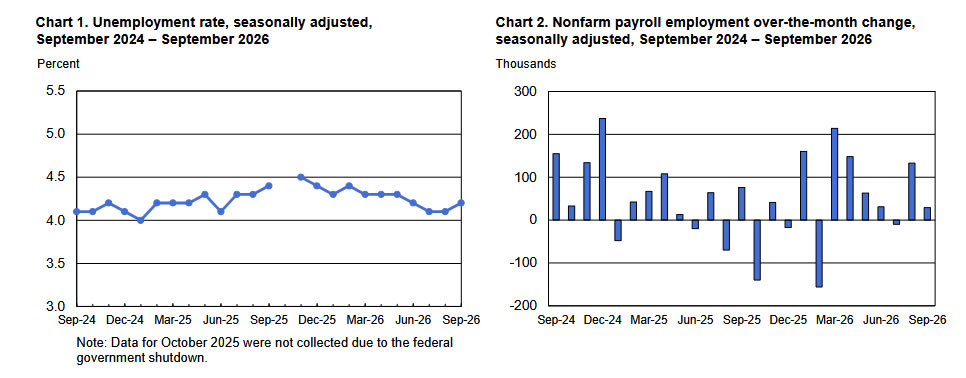
Data Summary
| Indicator | Previous | Current | Expected |
|---|---|---|---|
| Nonfarm Payrolls | 133K revised | 29K | 90K |
| Unemployment Rate | 4.1% | 4.2% | 4.1% |
| Average Hourly Earnings, m/m | 0.3% | 0.1% | 0.3% |
August payrolls were revised down from 162K to 133K, while July was revised from +21K to -10K. Combined, the two prior months were revised 60K lower.
Labor Market Details
| Indicator | Previous | Current |
|---|---|---|
| Labor Force Participation Rate | 61.6% | 61.8% |
| Employment-Population Ratio | 59.1% | 59.2% |
| Average Workweek | 34.4 hours | 34.4 hours |
| U-6 Underemployment Rate | 7.7% | 7.6% |
Household employment increased by 406K, while the labor force expanded by 485K, helping explain why unemployment rose even as household employment improved.
Key Takeaways
- Nonfarm payroll growth slowed sharply from a revised 133K to 29K, far below the 90K consensus.
- The prior months were also weaker than previously thought: July was revised to -10K and August to 133K, cutting the two-month total by 60K.
- The unemployment rate rose from 4.1% to 4.2%, slightly above expectations.
- Average hourly earnings slowed from 0.3% to 0.1% m/m, missing the 0.3% forecast and adding a softer wage signal to the weak payroll headline.
- Annual wage growth stood at 3.0% y/y in September.
- Labor-force participation increased from 61.6% to 61.8%, while household employment rose by 406K, preventing the report from looking like an outright labor-market break.
- Hiring breadth was soft, with the private-sector employment diffusion index falling below 50.
- Health care, construction and manufacturing still added jobs, while government, information and professional and business services declined.
- Overall, the report shows a clear loss of hiring momentum and softer wage pressure, strengthened by substantial downward revisions to prior months.





