US initial jobless claims edged higher in the week ending October 10 but remained below 200,000, suggesting that layoffs continue to be relatively contained. According to the Department of Labor, seasonally adjusted initial claims rose from an upwardly revised 198,000 to 199,000, slightly exceeding expectations of 195,000. The previous week’s reading was revised up from 197,000. Meanwhile, the four-week moving average increased marginally from 198,250 to 198,500, reinforcing the picture of broadly stable claims activity. Initial claims were also below the 222,000 recorded in the comparable week a year earlier, indicating that unemployment insurance filings remain subdued by historical comparison.
Continuing claims provided further evidence of labor market stability, declining modestly as the number of workers receiving unemployment benefits remained relatively low. Seasonally adjusted continuing claims fell from a revised 1.714M to 1.710M in the week ending October 3, while their four-week moving average declined from 1.7105M to approximately 1.709M. The insured unemployment rate held unchanged at 1.1%. Continuing claims were also considerably below the 1.928M recorded a year earlier. The combination of limited new claims and a modest decline in continuing claims suggests that layoffs have not accelerated significantly, while unemployment benefit rolls show little evidence of sustained upward pressure.
The latest figures reinforce the picture of a US labor market holding relatively steady despite persistent inflation pressures and uncertainty over the economic outlook. Initial claims have fluctuated around 200,000 in recent weeks, while continuing claims have generally trended lower over the past several months. This suggests that businesses have not responded to tighter financial conditions with a significant increase in layoffs. However, low jobless claims do not necessarily indicate strong hiring, as the figures primarily capture unemployment insurance activity rather than new job creation. The report therefore provides reassurance about employment stability without establishing that labor demand is accelerating. For now, the absence of a meaningful increase in claims suggests that a pronounced deterioration in US labor market conditions has yet to emerge.
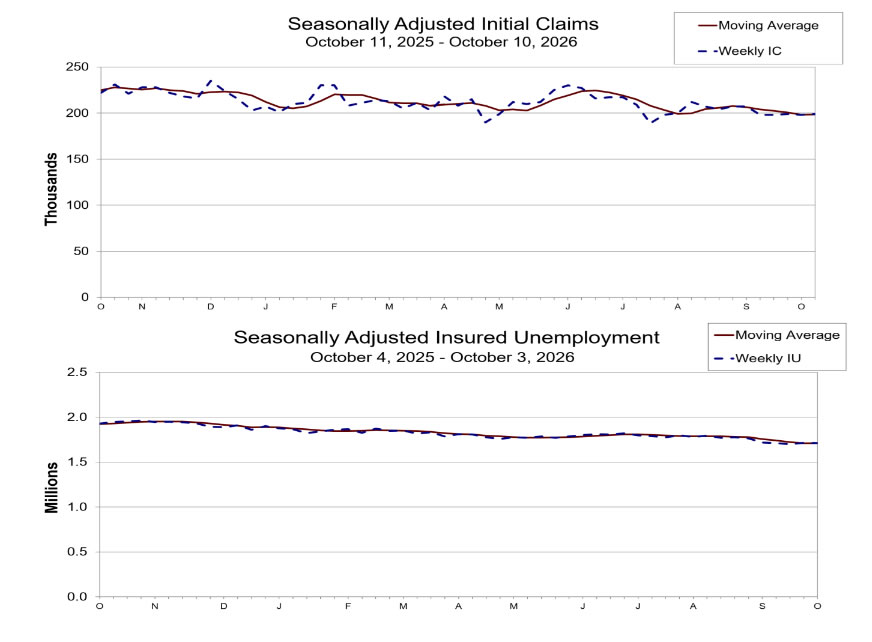
Data Summary — US Weekly Jobless Claims
Initial and Continuing Claims
| Indicator | Previous | Current | Consensus |
|---|---|---|---|
| Initial Jobless Claims | 198K | 199K | 195K |
| Initial Claims 4-Week Average | 198.25K | 198.50K | |
| Continuing Claims | 1.714M ) | 1.710M | |
| Continuing Claims 4-Week Average | 1.7105M | 1.7088M | |
| Insured Unemployment Rate | 1.1% | 1.1% |
Reporting periods:
- Initial claims: Week ending October 10, 2026.
- Continuing claims: Week ending October 3, 2026.
The previous week’s initial claims reading was revised upward from 197K to 198K, while continuing claims were revised downward from 1.716M to 1.714M.
Key Takeaways
- Initial claims remain below 200K: US initial jobless claims edged up from 198K to 199K, slightly exceeding expectations of 195K. The modest increase suggests layoffs remain relatively contained.
- Four-week average shows little change: The initial claims moving average increased marginally from 198.25K to 198.50K, reinforcing the picture of broadly stable unemployment insurance filings.
- Continuing claims decline: The number of workers receiving unemployment benefits fell from 1.714M to 1.710M, while the four-week average also decreased. The insured unemployment rate remained unchanged at 1.1%.
- Claims remain below year-earlier levels: Initial claims were lower than the 222K recorded in the comparable week last year, while continuing claims remained well below the previous year’s 1.928M.
- Labor market stability does not necessarily imply stronger hiring: Low initial and continuing claims suggest limited layoffs and little deterioration in unemployment insurance conditions. However, the figures provide limited information about new job creation or hiring demand.