The Bank of Japan kept its policy rate unchanged at 1.25% by an 8–1 vote, with board member Hajime Takata dissenting in favour of an increase to 1.50%. Takata argued that underlying CPI inflation had reached the 2% price stability target and that the BoJ had entered a phase requiring faster adjustment of interest rates toward neutral. Although the majority opted to hold, the accompanying Outlook Report reinforced the case for further normalization, stating that underlying inflation is now at a level generally consistent with the 2% target. The decision therefore highlights a growing debate over the appropriate pace of tightening rather than whether monetary accommodation should eventually be reduced.
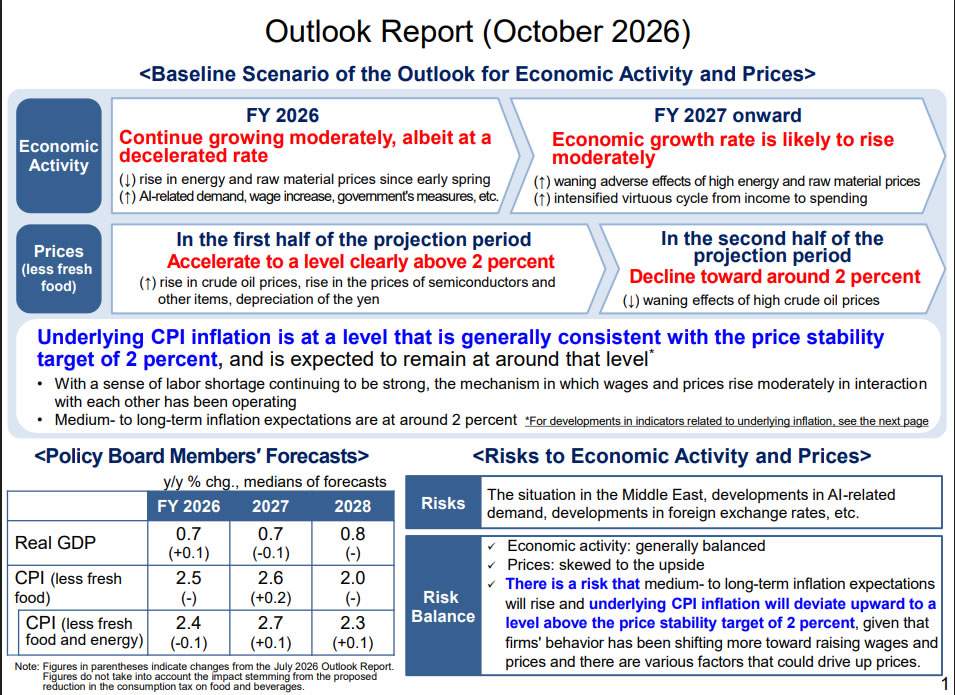
The BoJ also raised its FY2027 inflation forecasts while slightly lowering its growth outlook. Median core CPI inflation, excluding fresh food, was revised from 2.4% to 2.6%, while core-core inflation, excluding fresh food and energy, was raised from 2.6% to 2.7%. Meanwhile, projected GDP growth was lowered from 0.8% to 0.7%. The Bank expects higher crude oil prices, rising semiconductor and other goods prices, and Yen depreciation to push measured inflation clearly above 2% in the first half of its projection period, before moderating toward target later. It also warned that inflation risks are skewed to the upside, particularly if higher import costs and increasingly proactive corporate pricing behaviour lift medium- to long-term inflation expectations.
More importantly, the BoJ judges the underlying wage-price mechanism to be operating at a level consistent with sustainable 2% inflation. Persistent labour shortages have supported moderate wage increases and their transmission into consumer prices, while medium- to long-term inflation expectations have moved to around 2%. Despite previous policy-rate increases, the Bank considers financial conditions accommodative, with real interest rates and borrowing costs continuing to support economic activity. Against this backdrop, it reiterated that further rate hikes and reductions in monetary accommodation are appropriate if its economic and inflation projections materialize. The October hold therefore leaves the tightening direction intact, although the pace and timing will depend on incoming data and the evolving risks from energy prices, foreign exchange movements and global AI-related demand.
Separately, the BoJ unanimously decided to accelerate sales of its exchange-traded fund holdings from approximately ¥330B to ¥860B annually, beginning in January 2027. The new pace represents around 0.1% of stock-market trading value, compared with 0.05% previously, and would shorten the estimated disposal period from 112 years to approximately 43 years. The Bank said ETF sales had proceeded smoothly since January 2026, while expanding market turnover provided scope for a faster disposal pace without major disruption. It also retained the flexibility to adjust or suspend sales according to market conditions. The decision represents an additional step toward balance-sheet normalization, distinct from the unchanged policy-rate setting, and reinforces the broader process of gradually withdrawing extraordinary monetary accommodation.
Data Summary
Bank of Japan Monetary Policy Decision — October 30, 2026
| Item | Decision |
|---|---|
| Policy Rate | Held at 1.25% |
| Policy Board Vote | 8–1 |
| Dissenting Member | Hajime Takata |
| Dissenting Proposal | Raise policy rate to 1.50% |
| Underlying Inflation Assessment | Generally consistent with 2% target |
| Policy Outlook | Further rate hikes if economic and inflation forecasts materialize |
| Inflation Risk Balance | Skewed to the upside |
BoJ Economic Projections — October 2026 Outlook Report
Median forecasts, fiscal years; July → October 2026
| Indicator | FY2026 | FY2027 | FY2028 |
|---|---|---|---|
| Real GDP | 0.6% → 0.7% | 0.8% → 0.7% | 0.8% → 0.8% |
| Core CPI | 2.5% → 2.5% | 2.4% → 2.6% | 2.0% → 2.0% |
| Core-Core CPI | 2.5% → 2.4% | 2.6% → 2.7% | 2.2% → 2.3% |
Forecasts exclude the impact of the proposed reduction in consumption tax on food and beverages.
ETF Disposal Programme
| Indicator | Previous | New Plan |
|---|---|---|
| Annual ETF Sales (Book Value) | ¥330B | ¥860B |
| Share of Stock-Market Trading Value | ~0.05% | ~0.10% |
| Estimated Disposal Period | ~112 years | ~43 years |
| Implementation | — | January 2027 |
The new annual sales pace corresponds to approximately ¥2.46 trillion in market value, based on the BoJ’s valuation estimate. The Bank retains flexibility to adjust or suspend sales in response to financial-market conditions.
Sources: Bank of Japan, October 30, 2026 Statement on Monetary Policy; October 2026 Outlook for Economic Activity and Prices; and Decision Regarding the Pace of ETF Sales.
Key Takeaways
- BoJ holds rates with one hawkish dissent: The policy rate stays at 1.25% following an 8–1 vote. Hajime Takata proposed an immediate increase to 1.50%, arguing that underlying inflation had reached target and monetary normalization should proceed more quickly.
- Underlying inflation is judged broadly consistent with 2%: The BoJ assesses that Japan’s underlying inflation has reached a level generally consistent with its price-stability objective, supported by persistent labour shortages, wage-price interaction and longer-term inflation expectations around 2%.
- FY2027 inflation outlook is upgraded: Core CPI inflation is revised from 2.4% to 2.6%, while core-core inflation rises from 2.6% to 2.7%. Meanwhile, projected GDP growth is reduced from 0.8% to 0.7%.
- Energy costs and Yen depreciation drive additional price pressure: Higher crude oil prices, rising semiconductor costs and Yen weakness are expected to push measured inflation clearly above 2% before pressures ease later in the projection period.
- Inflation risks are skewed upward: The BoJ warns that more active corporate wage and price-setting behaviour could lift medium- to long-term inflation expectations and push underlying inflation above target.
- Financial conditions remain accommodative: Despite previous rate increases, the Bank judges borrowing conditions and real interest rates to be supportive of economic activity, leaving scope for further normalization.
- Further rate increases remain the baseline policy direction: The BoJ reiterates its intention to raise rates and reduce monetary accommodation if the economy and inflation evolve in line with its projections, without committing to a specific timetable.
- Growth outlook faces competing forces: Higher energy and raw-material costs are expected to constrain household purchasing power and corporate profits, while global AI-related demand, wage increases and government measures provide support.
- ETF sales accelerate substantially: The Bank unanimously increases planned annual ETF disposals from ¥330B to ¥860B, beginning January 2027, shortening the estimated disposal period from 112 years to 43 years.
- Normalization continues despite the rate hold: The combination of a sustained tightening bias and faster ETF disposal indicates continued withdrawal of monetary accommodation, while the majority favours a gradual approach to interest-rate adjustments.
Full BoJ statement, Outlook for Economic Activity and Prices.