Eurozone private-sector growth slowed to a four-month low in October, with PMI Composite falling from 53.1 to 51.7, as activity weakened across both manufacturing and services. PMI Services declined from 53.0 to 51.4, also a four-month low, although both indicators remained above the 50 expansion threshold. The composite index recorded its first monthly decline since May, indicating a loss of momentum at the start of Q4 following stronger activity during the previous quarter. S&P Global Chief Business Economist Chris Williamson estimated that the survey was consistent with approximately 0.3% economic growth, describing the pace as respectable but warning that the recent expansion was showing signs of weakening.
The deterioration in demand was more pronounced than the slowdown in output, with new business growth approaching stagnation after three months of solid expansion. Services new orders declined slightly, while continued growth in manufacturing orders provided only a narrow offset. Export business increased for a third consecutive month, but at a slower pace. Employment also weakened, with eurozone firms reducing staffing at the fastest rate since May, driven by the first decline in services employment over the same period. Business confidence fell for a third consecutive month to its lowest level since May, remaining below its long-run average. Growth slowed in Germany, Italy, Spain and Ireland, while France returned to contraction amid domestic political uncertainty and weaker business conditions.
Inflation pressures remained an important constraint despite softer activity. Composite input cost inflation accelerated to a five-month high, while output prices continued rising sharply, albeit at a slower rate than September. However, services input and output price inflation both eased slightly, highlighting a distinction between broader private-sector cost pressures and developments within services. Williamson identified three main headwinds facing businesses: “inflation, geopolitical uncertainty and higher borrowing costs.” He also warned that further weakening in growth could “sow some doubts as to the need for more tightening” by ECB. The survey therefore points to an economy that continues expanding but faces increasingly fragile demand, subdued confidence and persistent cost pressures, complicating the outlook for both growth and monetary policy.
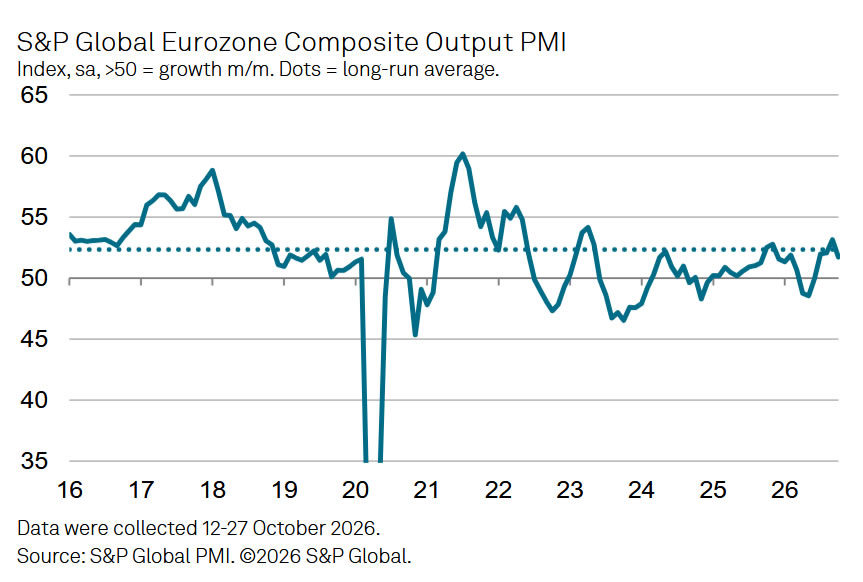
Data Summary
Eurozone PMI — October 2026 Final
| Indicator | September | October |
|---|---|---|
| PMI Services | 53.0 | 51.4 |
| PMI Composite | 53.1 | 51.7 |
Both indices fell to four-month lows but remained above 50, indicating continued expansion at a slower pace.
PMI Services — Key Components
| Component | October Trend |
|---|---|
| Business activity | Growth slowed to four-month low |
| New business | Declined slightly |
| Export business | Growth slowed |
| Employment | Fell for first time since May |
| Outstanding business | Declined |
| Input costs | Inflation eased slightly |
| Output prices | Inflation eased slightly |
| Business confidence | Weakened |
PMI Composite — Key Components
| Component | October Trend |
|---|---|
| Private-sector output | Growth slowed to four-month low |
| Manufacturing output | Growth moderated |
| Services activity | Growth moderated |
| New business | Near-stagnation |
| Export orders | Third consecutive increase |
| Employment | Declined; fastest pace since May |
| Input costs | Inflation at five-month high |
| Output prices | Inflation remained high but eased |
| Business optimism | Lowest since May |
Regional Performance
| Economy | October Trend |
|---|---|
| Germany | Expansion continued, slower |
| France | Returned to contraction |
| Italy | Expansion continued, slower |
| Spain | Expansion continued, slower |
| Ireland | Expansion continued, slower |
Key Takeaways
- Eurozone growth slowed to a four-month low: PMI Composite declined from 53.1 to 51.7, while PMI Services fell from 53.0 to 51.4. Both remained in expansion territory, with S&P Global estimating approximately 0.3% economic growth at the start of Q4.
- New business growth approached stagnation: Services orders declined slightly, while modest growth in manufacturing orders narrowly offset the weakness. Export business expanded for a third consecutive month, but at a slower pace.
- Employment weakened as demand lost momentum: Services employment fell for the first time since May, contributing to the fastest overall private-sector job losses over the same period. The reductions remained marginal.
- Business confidence continued deteriorating: Expectations weakened for a third consecutive month to their lowest level since May, reflecting concerns about inflation, geopolitical uncertainty and higher borrowing costs.
- France returned to contraction: Germany, Italy, Spain and Ireland continued expanding at slower rates, while France slipped back into contraction amid weaker demand and domestic political uncertainty.
- Broader inflation pressures persisted: Composite input cost inflation accelerated to a five-month high, while output price inflation remained elevated despite easing from September. Within services, both input and selling-price inflation moderated slightly.
- Slower growth complicates the ECB outlook: Persistent price pressures support the case for further tightening, but weakening demand and business confidence raise questions about how much additional restraint the economy can absorb. S&P Global’s Chris Williamson cautioned that further slowing could challenge the case for additional hikes.
Full Eurozone PMI Services and Composite final release here.