TL;DR: The RBA raised its cash rate 25bps to 4.85% on a split 6–3 vote, dropped its explicit tightening bias and signalled a pause for assessment, so the Australian Dollar fell despite sharply higher inflation forecasts. AUD/CAD broke structural support at 0.9778, and the next tests are 0.9722 and the 55-week EMA near 0.9660.
Why Did the Australian Dollar Fall After an RBA Hike?
The RBA raised interest rates again on Tuesday, but the Australian Dollar fell instead of strengthening. The explanation lies in the difference between what the central bank did and what it suggested might happen next. The widely expected 25bps increase to 4.85% came with substantially higher inflation forecasts, yet a divided Board, softer guidance and Governor Michele Bullock’s remarks encouraged investors to interpret the decision as a possible pause in the tightening cycle.
AUD/CAD extended its decline from the September high at 1.0011, breaking through structural support at 0.9778 and reinforcing signs of a medium-term top. The move comes as the Bank of Canada maintains the possibility of further tightening, creating a contrast between the two commodity-linked currencies.
The underlying question is whether the Australian Dollar’s weakness reflects a temporary disappointment after a well-anticipated decision, or whether the relative monetary-policy outlook is becoming sufficiently unfavourable to support a larger AUD/CAD reversal.
Follow AUD/CAD and the RBA–BoC policy divergence on the ActionForex Telegram channel.
RBA Hikes, but Three Members Wanted to Wait
The headline decision appeared straightforward. The RBA raised the cash rate from 4.60% to 4.85%, delivering its fifth increase this year and taking borrowing costs to their highest level since 2008.
Markets had already assigned a high probability to the move, so the hike itself offered little surprise.
What attracted attention was the 6–3 vote, with three Board members preferring to leave rates unchanged. That was a substantial minority for a central bank confronting persistent inflation and sharply higher price forecasts.
The accompanying statement also changed in a revealing way.
In September, the RBA explicitly preserved the option of “increasing the cash rate target further if needed”. That phrase disappeared from November’s statement, replaced by broader commitments to assess incoming data and respond to changes in the economic outlook.
The omission did not amount to a promise that rates had peaked. However, alongside the divided vote, it suggested that policymakers were becoming less willing to signal further increases before assessing the impact of the tightening already delivered.
Governor Michele Bullock reinforced that interpretation during her press conference, describing the current position as “a good point to take stock”.
Five increases have already been delivered this year, and the most recent moves have yet to work fully through household borrowing costs, consumption and investment. Bullock indicated that the Board wants to observe those effects before determining what additional action, if any, is necessary.
But she also avoided declaring the tightening cycle over. Inflation risks remain skewed to the upside, and the central bank continues to view the possibility of higher inflation expectations becoming embedded as a serious concern.
The message was therefore a pause for assessment, not a declaration that inflation had been defeated.
That distinction becomes even more important when the updated forecasts are considered.
Hawkish Inflation Forecasts Meet a Weakening Economy
If investors looked only at the November Statement on Monetary Policy, they might have expected a more hawkish reaction.
The inflation outlook deteriorated substantially from August. Headline CPI for December 2026 was revised from 3.6% to 4.5%, while the June 2027 projection increased from 2.8% to 3.7%. Underlying inflation also remained troubling, with trimmed mean CPI now expected at 3.5% by June 2027, compared with 3.0% previously.
- Headline CPI, December 2026: revised from 3.6% to 4.5%.
- Headline CPI, June 2027: revised from 2.8% to 3.7%.
- Trimmed mean CPI, June 2027: now 3.5%, up from 3.0%.
The RBA expects inflation to remain elevated through much of 2027, with a return to the midpoint of its target range delayed until around mid-2028.
Much of the deterioration reflects higher energy and commodity prices associated with the Middle East conflict. However, the Bank also believes domestic capacity pressures have been stronger than previously assessed, allowing rising costs to spread beyond fuel and into a broader range of goods and services.
Rapid investment in AI-related infrastructure, particularly data centres, has added another source of demand and pushed up costs for technology-related goods.
The difficulty is that the higher inflation projections already incorporate an assumed interest-rate path more restrictive than the one used in August. In other words, the RBA expects inflation to remain persistent even under tighter financial conditions.
That might normally argue for keeping further rate increases firmly on the table.
Yet the economy is already showing signs of strain.
Housing prices have fallen significantly, consumption growth is weakening, and unemployment has risen further than previously expected. The RBA now forecasts GDP growth of 1.3% by December 2027, down from its earlier 1.6% projection, while unemployment is expected to reach 4.9% rather than 4.7%.
By the end of 2028, the jobless rate is projected to rise to 5.1%.
- GDP growth by December 2027: 1.3%, down from 1.6%.
- Unemployment by December 2027: 4.9%, up from 4.7%.
- Unemployment by end-2028: 5.1%.
The resulting policy problem is uncomfortable. Inflation is taking longer to return to target, but additional tightening risks deepening a slowdown that is already developing.
This helps explain why three Board members preferred to hold rates, and why the majority, despite supporting another increase, avoided committing to a subsequent move.
Markets See a Pause Rather Than an End to Restrictive Policy
The immediate reaction in interest-rate markets shows how investors interpreted the decision.
After the announcement and Bullock’s press conference, OIS pricing placed the probability of another RBA increase in December at just 2.8%. The implied cash rate was around 4.91% in February 2027 and peaked near 4.92% in March, only slightly above the new 4.85% target.
That leaves room for another hike early next year, but little expectation of a sustained tightening sequence.
Importantly, markets are not anticipating meaningful rate cuts in the near term either. The implied cash rate declines only marginally toward 4.82% by September 2027 and 4.80% by November.
- December hike probability: 2.8%.
- Implied cash rate: about 4.91% in February 2027, peaking near 4.92% in March.
- Implied cash rate later: 4.82% by September 2027 and 4.80% by November.
The market’s interpretation is therefore that the RBA may have reached a point where rates remain high for an extended period, rather than one where easing is about to begin.
This is consistent with the central bank’s assessment that financial conditions are already restrictive and the cash rate sits slightly above its central estimates of neutral.
Nevertheless, the Australian Dollar weakened following the decision. AUD/USD fell toward 0.6974, while AUD/CAD extended its existing decline.
The response suggests that the split vote and cautious guidance mattered more to currency traders than the higher inflation forecasts. The longer-term OIS path changed relatively little, indicating that the reaction was not accompanied by a wholesale abandonment of future tightening expectations.
That makes the comparison with Canada particularly relevant.
BoC Still Has Room to Tighten, and Markets Expect It To
The Bank of Canada raised its policy rate from 2.25% to 2.50% on October 28, but the circumstances surrounding its decision were different.
Canada also faces higher inflation driven partly by energy costs, and the Bank expects headline CPI to rise toward 3.5% by year-end. However, underlying inflation measures remain closer to target, while the economy still has some excess supply and unemployment around 6.5%.
Despite that slack, the BoC judged that the inflation outlook had deteriorated enough to justify an increase.
Governor Tiff Macklem indicated that there was “less scope for monetary accommodation” and left the possibility of additional tightening open. He also emphasized that future decisions would be taken “one meeting at a time”, acknowledging the uncertainty surrounding energy prices and economic activity.
The contrast with Australia is not simply that one central bank is hawkish and the other dovish.
The RBA is already operating with interest rates judged restrictive and is assessing how much additional tightening is necessary. The BoC has started raising rates again and is keeping the possibility of further increases open.
Markets have translated that difference into markedly different expected policy paths.
Following Tuesday’s decision, the RBA’s implied cash rate reaches only about 4.92% at its projected peak in March before edging lower later in 2027.
For Canada, OIS pricing implies a possible increase in December, another step toward 2.75% in January, and a policy rate around 3.24% by September 2027.
Consequently, Australia’s current 235bps policy-rate advantage over Canada could narrow toward roughly 158bps over the coming year.
- RBA: implied cash rate peaks near 4.92% in March, then edges lower later in 2027.
- BoC: possible December hike, another step toward 2.75% in January, and around 3.24% by September 2027.
- Australia’s policy-rate advantage over Canada: 235bps now, narrowing toward roughly 158bps over the coming year.
This expected compression provides a plausible backdrop for AUD/CAD weakness, although much of the narrowing is already priced.
The outlook is not without risks. The BoC has not committed to the full tightening trajectory implied by markets, and further declines in oil prices could reduce some Canadian inflation concerns. Both currencies are also sensitive to commodity and global growth developments, meaning their relative performance will not be determined by interest-rate expectations alone.
Nevertheless, the immediate policy contrast has become less favourable for the Australian Dollar.
ActionForex’s Technical View: AUD/CAD, the Break Below 0.9778 Changes the Picture
The technical deterioration in AUD/CAD began before the latest central-bank decisions, but Tuesday’s selloff reinforced an already weakening structure.
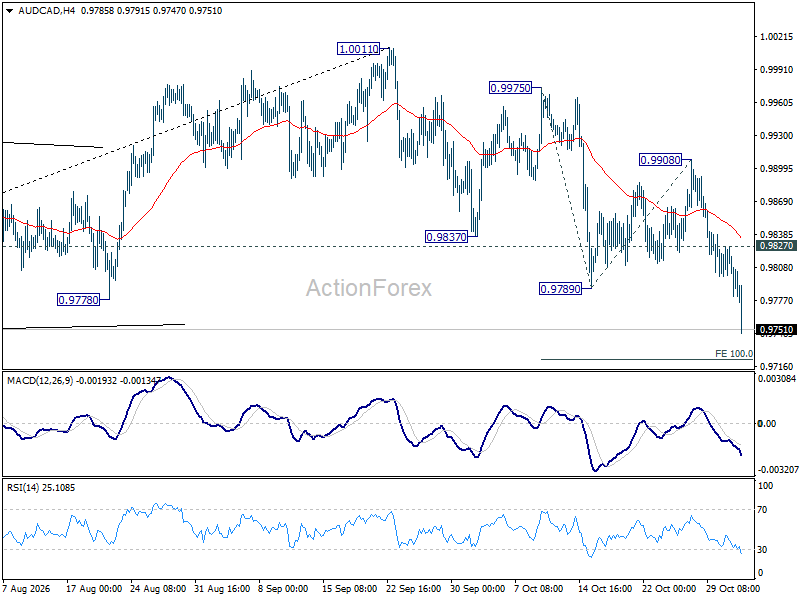
The cross has continued falling from 1.0011, and the break below 0.9778 structural support confirms a medium-term top at 1.0011, supported by bearish divergence in the daily MACD.
This divergence had warned that upward momentum was fading even before prices began falling more decisively. The subsequent support break now provides further evidence that the earlier advance has lost its immediate upward structure.
With AUD/CAD trading around 0.9751, further decline is expected while 0.9827 minor resistance holds.
The next important objective is 0.9722, representing the 100% projection of the decline from 0.9975 to 0.9789, measured from 0.9908.
This is more than a routine downside target. It is the level that could help determine whether the decline from 1.0011 continues as a relatively contained correction or develops into a larger bearish move.
A sustained break below 0.9722 would suggest that selling pressure is accelerating beyond the initial measured decline. That would bring the 161.8% projection at 0.9607 into focus.
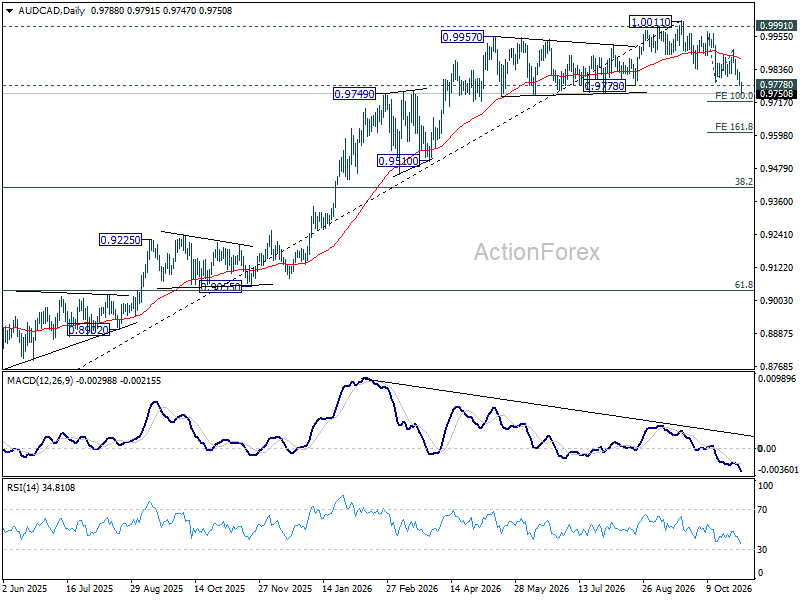
However, the longer-term technical picture requires another important test before that objective is reached.
The 55-week EMA, currently near 0.9660, stands between the initial projection and the deeper downside target. Its behaviour will be critical in determining the outlook beyond the immediate decline.
It remains too early to decide whether the fall from 1.0011 is correcting the broader uptrend that began at 0.8440.
If AUD/CAD finds strong support around the weekly moving average and rebounds, the longer-term advance could remain intact. Such a recovery would preserve the possibility of another attempt at the 2021 high around 0.9991 at a later stage.
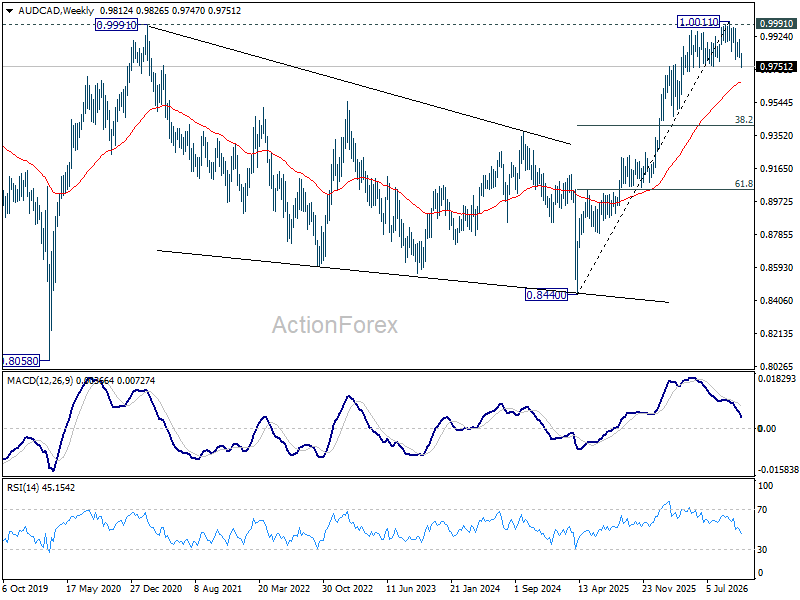
But a sustained break below the 55-week EMA would substantially strengthen the bearish interpretation, indicating that the decline from 1.0011 may be evolving beyond a normal correction.
That would open the way toward the 38.2% retracement of the advance from 0.8440 to 1.0011 at 0.9411.
Near-term oversold conditions could still trigger temporary recoveries, particularly after the latest sharp fall. The 4-hour RSI has dropped to a depressed level, suggesting that some consolidation or rebound would not be surprising.
However, such moves would not alter the immediate bearish outlook while 0.9827 resistance remains intact.
From RBA Disappointment to a Bigger AUD/CAD Reversal?
The RBA’s November decision has created an unusual combination: materially higher inflation forecasts, but a more cautious immediate policy signal.
Markets have interpreted the divided vote and Bullock’s remarks as reasons to expect an extended pause rather than another quick increase. The BoC, meanwhile, retains a tightening bias, and its market-implied policy path points toward a substantial narrowing of Australia’s interest-rate advantage.
Those developments reinforce the downward pressure already visible in AUD/CAD’s charts.
The break below 0.9778 confirms an important medium-term top, but the more consequential test now lies at 0.9722 and the 55-week EMA near 0.9660.
A sustained move through those levels would strengthen the argument that the decline from 1.0011 is developing into a larger bearish reversal, potentially exposing 0.9607 and eventually 0.9411.
A strong rebound from the weekly moving average, however, would keep the broader uptrend from 0.8440 alive and leave open another challenge of 0.9991.
For now, the immediate direction remains bearish. Whether that develops into a lasting trend reversal will depend on both the technical response at major support and whether the RBA-BoC policy divergence continues to widen beyond what markets have already priced.
Key Takeaways
- The RBA raised its cash rate from 4.60% to 4.85% on a 6–3 vote and dropped the September language about “increasing the cash rate target further if needed”, so markets read the decision as a pause.
- Headline CPI for December 2026 was revised from 3.6% to 4.5%, yet OIS pricing gives just 2.8% odds of another RBA hike in December.
- The BoC raised its policy rate from 2.25% to 2.50% on October 28 and keeps further tightening open, so Australia’s 235bps advantage could narrow toward roughly 158bps over the coming year.
- AUD/CAD, around 0.9751, broke 0.9778 and confirmed a medium-term top at 1.0011; further decline is expected while 0.9827 holds.
- The key tests are 0.9722 and the 55-week EMA near 0.9660; a sustained break would expose 0.9607 and 0.9411.
Stay ahead of the RBA–BoC policy divergence and its impact on AUD/CAD—join the ActionForex Telegram channel for regular market updates and analysis.