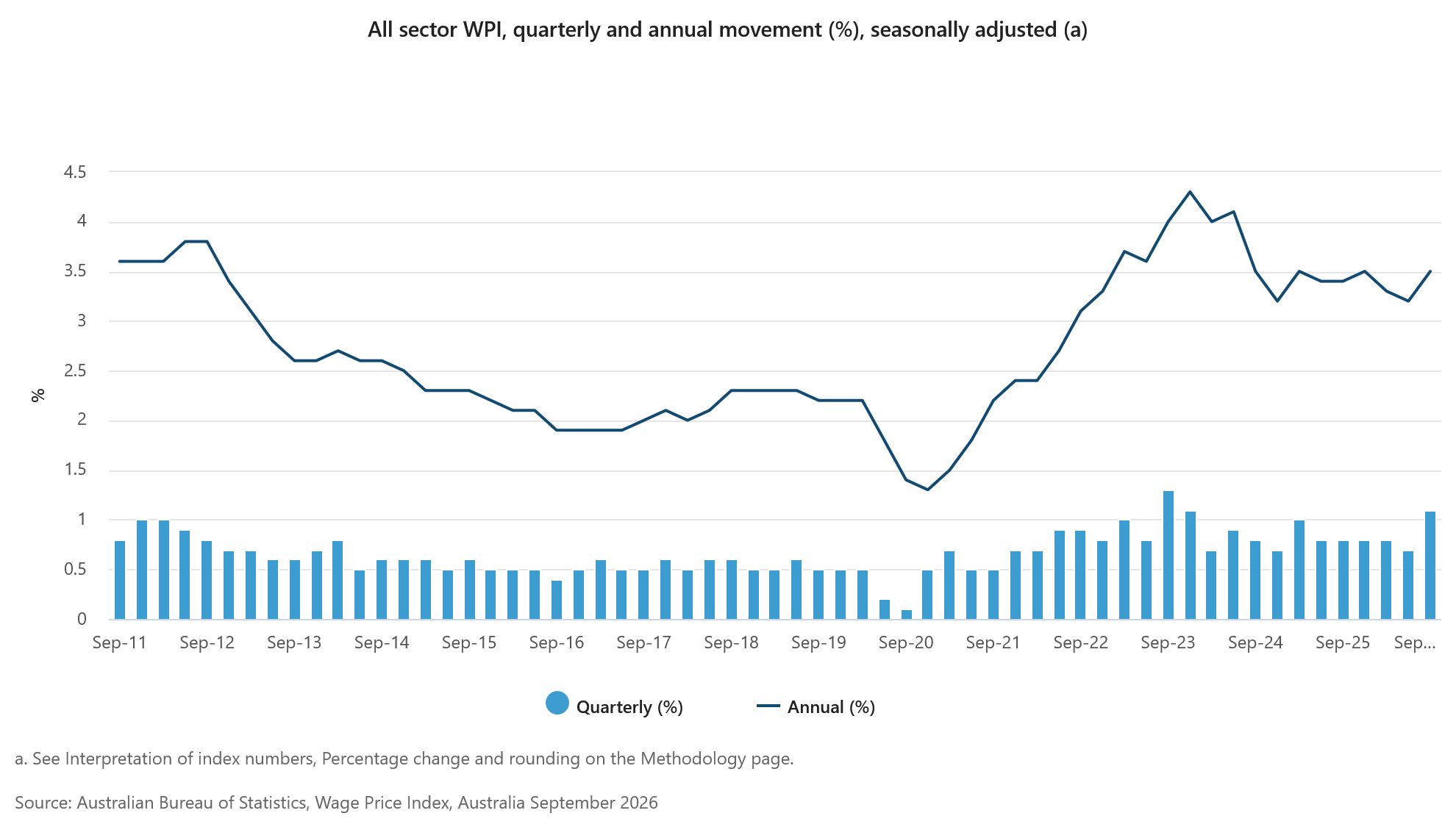
Australia’s Wage Price Index accelerated from a revised 0.7% to 1.1% qoq in the September quarter, exceeding market expectations of 0.9% and recording its strongest quarterly increase since December 2023. Annual wage growth reached 3.5%, compared with 3.4% a year earlier, although it remained below the 4.3% peak recorded in late 2023. The stronger quarterly result indicates renewed wage growth momentum, with the Australian Bureau of Statistics (ABS) identifying increases under individual employment arrangements, enterprise agreements and award wage decisions as important contributors.
Both private and public-sector wages recorded substantial increases, rising 1.0% and 1.3% qoq, respectively. Annual private-sector wage growth reached 3.4%, while public-sector wages rose 3.9%, outpacing private-sector growth for the seventh consecutive quarter. In the private sector, the Fair Work Commission’s 4.75% increase to modern award rates from July 1, compared with 3.5% in the previous year, was a key driver. Public-sector growth was supported by enterprise agreement pay increases for state government frontline workers, including nurses, midwives and police officers. Although public wages rose faster, the private sector accounted for approximately 80% of the overall quarterly wage-growth contribution, reflecting its larger share of total wage expenditure.
The distribution of wage adjustments also pointed to firmer pay outcomes. Among jobs receiving wage increases, the proportion recording annualised rises above 4% increased from 24% to 34% over the past year, while the share receiving smaller increases declined. Health care and social assistance was the largest industry contributor, while New South Wales made the largest contribution among states, supported by pay rises for government employees. Nevertheless, the ABS noted that increases exceeding 6% remained below their 2023–24 peaks. The latest figures therefore show a meaningful acceleration in wage growth, but the prominent role of scheduled award adjustments and negotiated enterprise agreements suggests the quarterly increase should not be interpreted solely as evidence of renewed labour-market tightness.
Data Summary — Australia Wage Price Index, Q3 2026
Headline Wage Growth — Seasonally Adjusted
| Indicator | Q3 | Exp. | Q2 |
|---|---|---|---|
| Wage Price Index Q/Q | 1.1% | 0.9% | 0.7% |
Annual Wage Growth — Seasonally Adjusted
| Indicator | Q3 2026 | Q3 2025 |
|---|---|---|
| All Sectors | 3.5% | 3.4% |
| Private Sector | 3.4% | 3.2% |
| Public Sector | 3.9% | 3.8% |
Quarterly Wage Growth by Sector
| Indicator | Q3 | Q2 |
|---|---|---|
| Private Sector | 1.0% | 0.7% |
| Public Sector | 1.3% | 0.8% |
Source: Australian Bureau of Statistics, Wage Price Index, September Quarter 2026. Figures are seasonally adjusted. The June-quarter headline reading was revised from 0.8% to 0.7%.
Key Takeaways
- Wage growth accelerates beyond expectations: Australia’s WPI rose from a revised 0.7% to 1.1% qoq in Q3, exceeding expectations of 0.9% and recording its strongest quarterly increase since Q4 2023. Annual growth reached 3.5%, still below its late-2023 peak.
- Award decisions and public-sector agreements drive stronger pay growth: Private-sector wages increased 1.0% qoq, supported by the Fair Work Commission’s 4.75% award wage increase. Public-sector wages rose 1.3%, driven by enterprise agreement pay rises for state government frontline workers.
- Larger wage adjustments become more prevalent: Among jobs receiving wage increases, the share recording annualised rises above 4% increased from 24% to 34% over the past year. However, the prominent role of scheduled pay decisions means the acceleration does not necessarily indicate renewed labour-market tightness.