


- We expect the Fed to maintain its monetary policy unchanged in the July meeting, in line with consensus and market pricing.
- With no new economic projections, all eyes will be on Powell’s remarks. Unclear data will not allow the Fed to pre-commit, but Powell could verbally open up the door for a cut in the September meeting.
- Market is pricing around 16bp worth of cuts by September, and cumulative 43bp by year-end. Risks are skewed towards a modestly dovish reaction on Wednesday evening, but further out we think downside potential to USD rates is limited.
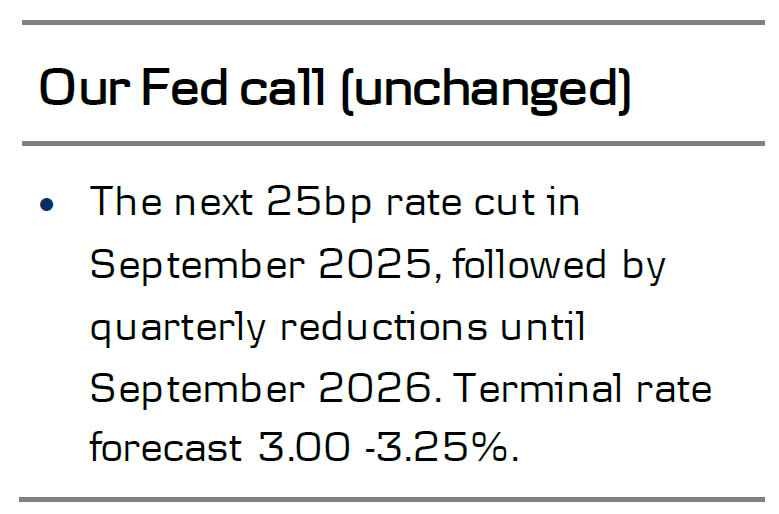
The Fed is inching towards resuming its cutting cycle but now is not yet the time. The June meeting was characterized by divided views across the FOMC – few participants did not see cutting rates this year as appropriate at all, while others favoured cutting already in July. Governor Waller has continued to signal that he could dissent in favour of a cut.
Since then, macro indicators have shifted in favour of further cuts, but data remains distorted. Higher realized and expected inflation were flagged as hawkish risks in the June minutes, but both have surprised to the downside since then. The July flash manufacturing PMI was weaker than expected, but the decline at least partly reflected slowdown in front-loading and firms awaiting clarity on tariffs.
The uncertain outlook for tariffs beyond 1st of August make pre-committing difficult at this stage, but we still think a cut in September looks likely. Needless to say, Powell will dodge any questions regarding political motivations for monetary policy changes.
As tariff payments continue to rise, firms will eventually have to either start passing through the costs to higher prices or look for ways to cut costs elsewhere. While we do pencil in accelerating goods and food inflation towards the fall, we are more concerned with the risk of tariffs causing weaker labour markets, than persistent inflation.
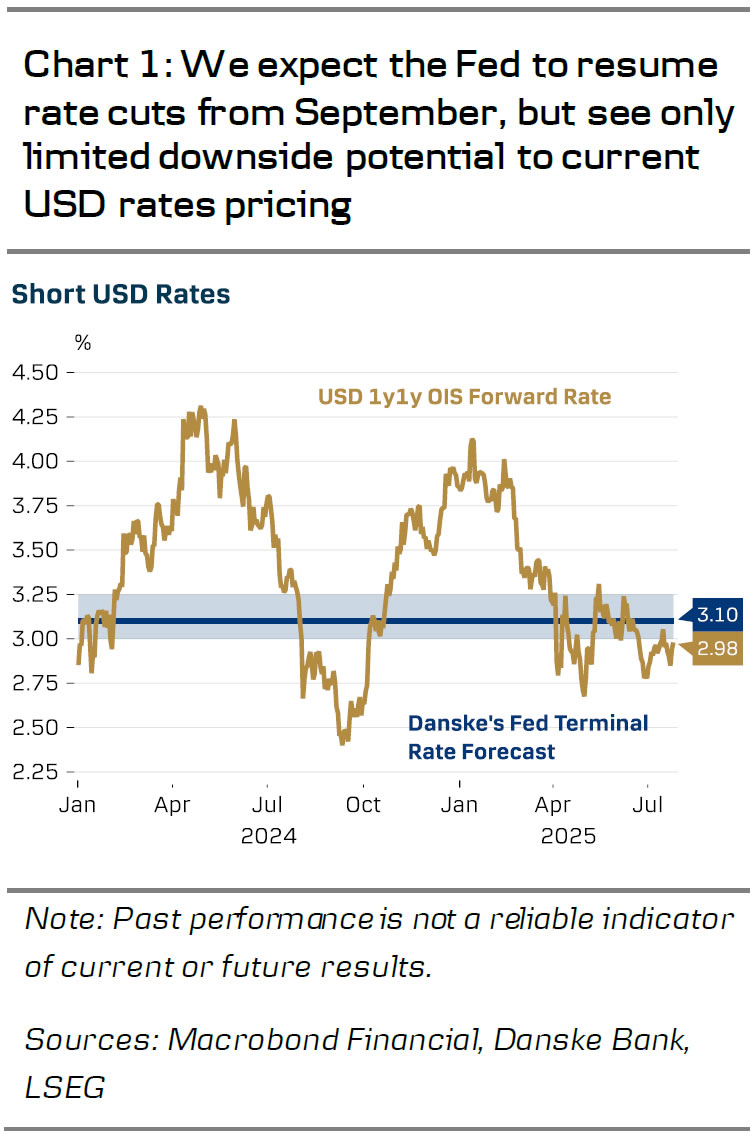
Beyond September, we pencil in quarterly 25bp reductions until the Fed Funds Rate target reaches 3.00-3.25% in September of 2026. Risks around the outlook are balanced in our view. We can easily sketch a scenario, where the Fed ends up cutting in every meeting after September, if macro data begins to undershoot expectations. But on the other hand, the renewed fiscal support from the start of 2026 could also ease the need for further cuts.
Altogether, we think the downside potential to USD rates is limited from current level. In the short-end of the curve, market is pricing cumulative 43bp worth of cuts by the end of 2025 – slightly less than we forecast. But from 2026 onwards, the pricing is well aligned with our call. In the long-end, we think the recent decline in term premium is unlikely to last given the fiscal outlook. We forecast the 10y UST yield at 4.50% in 12M horizon.
We still forecast further weakening for the broad USD, and maintain our 12M EUR/USD target at 1.23. We think the persistent policy uncertainty and structurally slowing economic growth are likely to weigh on the attractiveness of USD denominated assets even if our relative rates view is more neutral for the cross.





