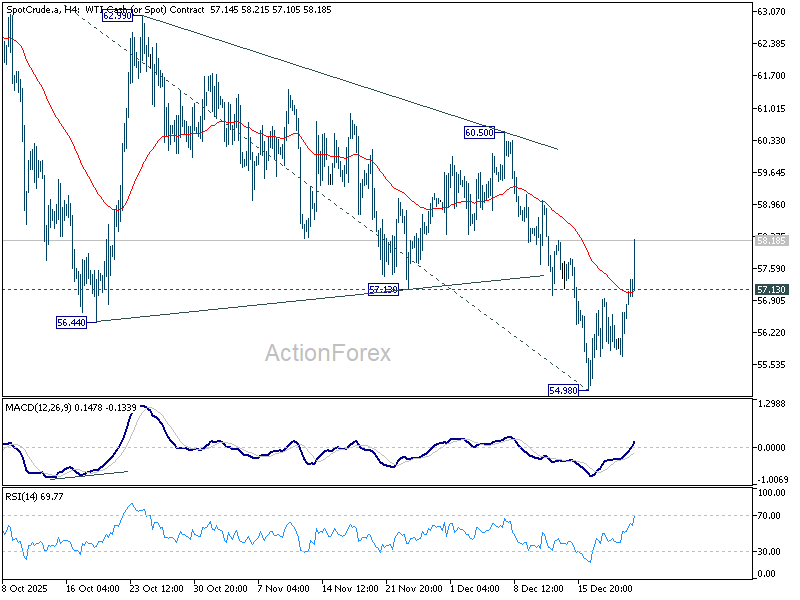
WTI crude staged a sharp rebound at the start of the week, confirming a short-term bottom at 54.98. The move followed a brief breach of 55.20 last week that failed to gain traction, before price surged back through 57.13, former support-turned-resistance.
The catalyst was a renewed escalation around Venezuela. News that U.S. authorities had intercepted another oil tanker in international waters off the Venezuelan coast raised concerns over supply disruption. The US Coast Guard is now pursuing yet another vessel, potentially marking the third such action in under two weeks.
This follows last week’s hardening stance from President Donald Trump, who announced a “total and complete” blockade of sanctioned Venezuelan oil shipments. Markets are increasingly sensitive to the risk that enforcement actions could escalate further, especially if more seizures follow.
That said, skepticism over the durability of the rebound remains widespread. The structural backdrop for oil is far less supportive than in past geopolitical flare-ups. OPEC+ has steadily increased output through 2025, unwinding years of coordinated production cuts that were originally designed to defend higher prices.
That shift has coincided with growing competition from the U.S., which has now established itself as the world’s largest producer and exporter of both crude oil and LNG. The battle for market share between OPEC+ and U.S. producers acts as a structural cap on prices, making sustained rallies harder to maintain.
As a result, geopolitical tensions are more likely just catalysts for short-term volatility rather than drivers of lasting trends. Unless conflicts expand beyond regional scope or disrupt major supply corridors, price spikes are likely to fade as supply realities reassert themselves.
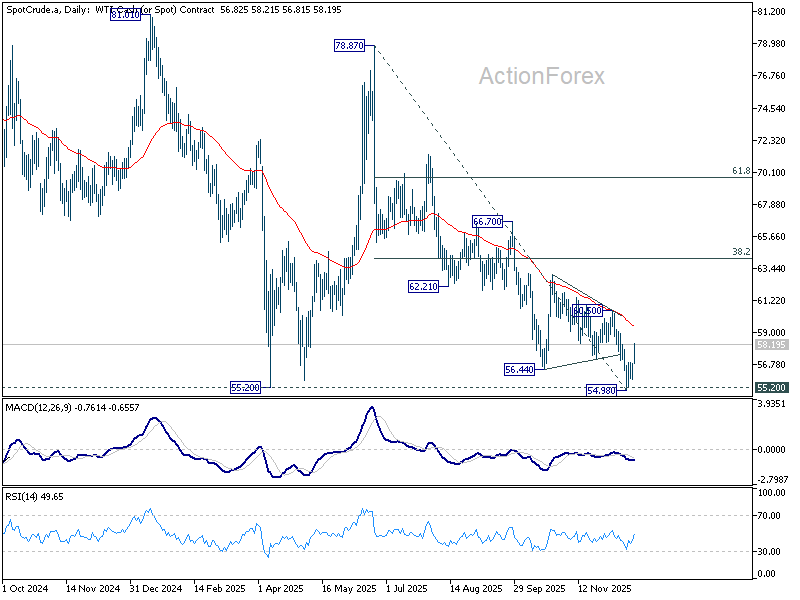
Technically, WTI now faces a dense resistance zone ahead. Initial resistance sits at the 55 D EMA (now at 59.44), currently near 59.44, followed closely by resistance at 60.50. Together, these levels form a strong barrier around the psychologically important 60 mark.
As long as this zone caps advances, the broader downtrend from the 78.87 high remains intact, with risk of another leg lower toward a decisive break below 55.20.
Conversely, sustained trading above 60 would argue that WTI is at least correcting the larger downtrend, opening room for extended rise towards 38.2% retracement of 78.87 to 54.98 at 64.10, likely in the first half of next year.