Cryptocurrencies are under renewed pressure alongside technology stocks as risk aversion intensified on fresh fears of a transatlantic trade war linked to the Greenland dispute. The macro backdrop is deteriorating quickly. Renewed tariff threats between the U.S. and Europe have revived concerns over growth, policy uncertainty, and capital flows.
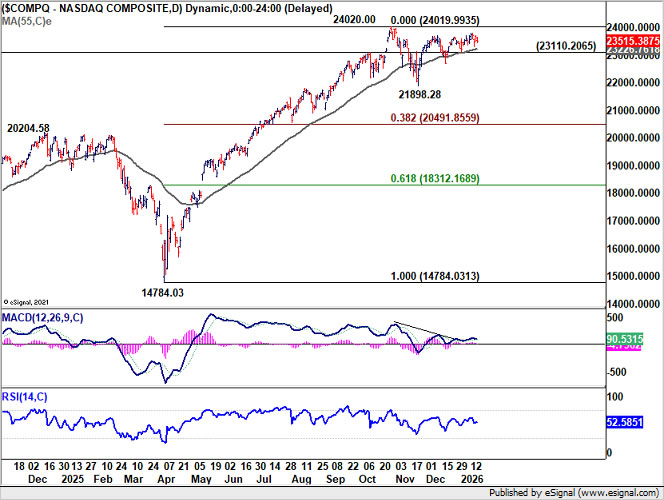
From a market structure perspective, the current selloff suggests that Bitcoin’s corrective recovery since last November may already be complete. Price action has turned decisively lower, raising the risk that the broader downtrend resumes if risk sentiment continues to worsen. A key near-term catalyst will be the NASDAQ’s reaction to support around 23,000 at today’s open. A clean break below that zone would likely accelerate equity downside, and history suggests crypto would not be spared in such a move.
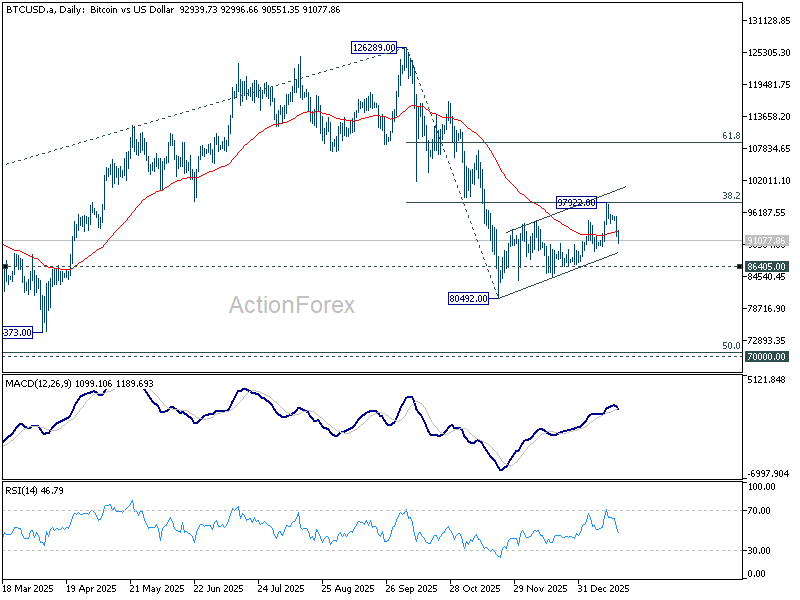
Technically, Bitcoin’s rebound from 80,492 appears to have topped at 97,922, following rejection by 38.2% retracement of 126,289 to 80,492 at 97,986, as well as 55 W EMA. Firm break below 86,405 support would strengthen the case that fall from 126,289 is resuming, opening the door to a full retest of 80,492 low.
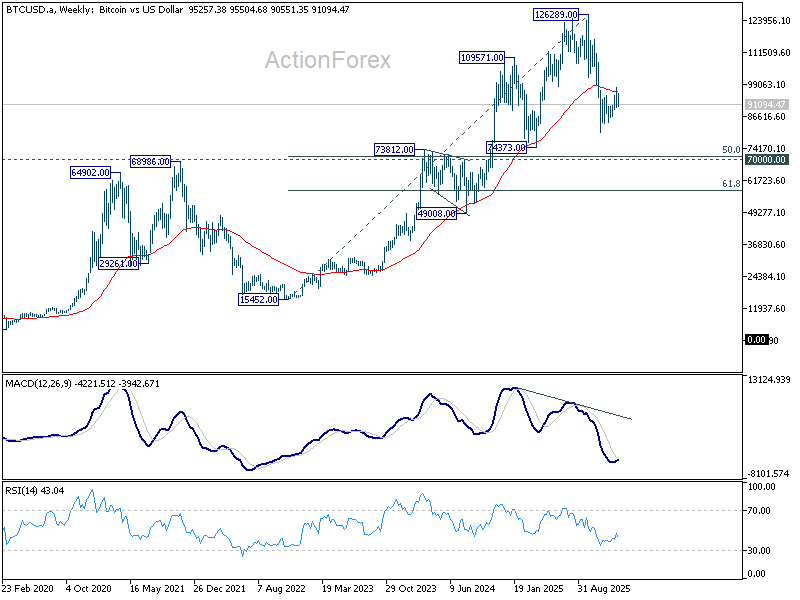
Failure at 80, 492 would shift focus to a deeper medium-term correction. On that view, the next major downside objective sits near 70,000 psychological level, close to 50% retracement of the long-term rise from 2022 low at 15,452 to 2025 high at 126,289, located at 70,870.
NASDAQ’s rebound from 21,898.28 appears corrective, representing the second leg of the corrective pattern that began from 24,020 peak. Decisive break of 23,110.20 support would signal the start of the third leg lower. In that scenario, downside would likely extend back toward 21,898.28, and possibly further to 38.2% retracement 14,784.03 (2025 low) to 24,020.00 (2025 high) at 20,491.85.
Such a move in NASDAQ would almost certainly intensify pressure on crypto markets. Historically, extended drawdowns in tech equities have produced non-linear declines in cryptocurrencies, as leverage unwinds and liquidity thins rapidly.