


- The U.S. Supreme Court struck down the administration’s use of the International Emergency Economic Powers Act (IEEPA) to impose sweeping global tariffs.
- President Trump has already signaled a pivot to using Section 122 of the Trade Act of 1974 to propose a new 15% “bridge tax,” indicating that the “peak tariff” era may be a temporary ceiling before new volatility returns.
- Why are safe havens rallying in the aftermath of the decision?
On Friday February the US Supreme Court delivered a landmark 6–3 decision in Learning Resources, Inc. v. Trump, striking down the administration’s use of the International Emergency Economic Powers Act (IEEPA) to impose sweeping global tariffs.
The ruling had sparked a notable rally in risk assets including equities and international currencies as market participants priced in a shift from “tariff chaos” toward a more regulated, though still complex, trade environment.
However, once the dust settled market participants were left with more questions than answers. This has led to a rally in safe havens such as Gold to start the week while risk assets experienced a selloff.
The questions for everyone is what are driving these moves?
The factors driving prices and volatility
Reduction of “Policy Shocks”
The primary driver of the risk-on rally last Friday was the removal of the President’s ability to impose sudden, unilateral tariff hikes under the guise of national emergencies. Since early 2025, the market has lived under the constant threat of “Twitter-style” trade policy where rates could jump 10% to 25% overnight.
By ruling that IEEPA does not grant the executive branch the “extraordinary power to raise revenue,” the Court has effectively dismantled the administration’s primary tool for aggressive trade maneuvers. The ruling “reduces trade policy uncertainty at the margin,” allowing businesses to plan capital expenditures without the fear of an immediate supply-chain “shock.”
The $175 Billion “Refund Rally”
Perhaps the most tangible catalyst for risk assets is the prospect of massive corporate refunds. Since the IEEPA-based tariffs were implemented in February 2025, the U.S. government has collected an estimated $130 billion to $175 billion in duties.
With the Court declaring these collections illegal, a door has opened for importers to claw back these funds. This potential “fiscal injection” is being viewed by some economists as a late-cycle stimulus. For sectors like retail, automotive, and technology, which absorbed much of the initial cost, the promise of significant cash-back on balance sheets has sent stock prices climbing.
Global Relief and Currency Stabilization
Outside the US, the ruling acted as a pressure-release valve for export-heavy economies. Risk assets in Canada, Mexico, and across Asia surged following the news.
- The “Loonie” and the Peso: The Canadian dollar and Mexican peso strengthened as the “fentanyl/border” tariffs were invalidated.
- European Equities: Indices like the FTSE 100 and the DAX hit near-record highs, led by carmakers and luxury goods manufacturers (e.g., Diageo and BMW) that had been heavily penalized by reciprocal duties.
Lower Inflationary Tailwinds
Risk assets thrive in a low-inflation environment because it allows the Federal Reserve more room to cut interest rates. The invalidation of IEEPA tariffs which accounted for approximately 60% of the total tariff revenue collected over the last year, removes a significant “tax” on consumers.
While the administration has already proposed “Plan B” workarounds using Section 122 of the Trade Act of 1974, these alternative paths are legally more narrow and slower to implement, leading markets to believe the “peak tariff” era has passed.
Looking Ahead: A temporary ceiling?
Just hours after the US Supreme Court blocked the administration’s “Liberation Day” emergency tariffs, President Donald Trump pivoted by announcing a new round of trade restrictions. This time, the administration is invoking Section 122 of the 1974 Trade Act, a provision designed to address “international payment problems” by allowing surcharges of up to 15% for a 150-day window.
While these tariffs technically expire unless Congress intervenes, the President could theoretically bypass this limit by letting the surcharge lapse and immediately declaring a new emergency to restart the clock, creating a perpetual tariff cycle. Though the White House initially signaled a 10% rate effective February 24, Trump quickly increased the figure to 15% the following day. Because these measures rely on a different legal statute, they are currently exempt from the recent Supreme Court ruling.
Despite this tactical shift, the use of Section 122 invites significant legal vulnerability. The provision is a relic of the gold standard and fixed exchange rate era; because it was finalized just as that global financial system collapsed, it has never actually been utilized in practice.
Proving a “balance of payments crisis” in a modern economy where the balance of payments is technically always in balance, presents a difficult hurdle for government lawyers.
Consequently, these new tariffs may serve primarily as a stalling tactic or “smoke and mirrors” while the administration prepares a more robust case under Section 301 of the same law. While Section 301 targets unfair trade practices and agreement violations, it requires a more rigorous and time-consuming investigation before it can be implemented.
Safe haven demand surges
Safe haven demand began surging late on Friday when President Trump announced he may use other means to enact his tariff policy.
This has left market participants in a state of limbo and thus the demand for safe haven assets has surged.
The Supreme Court’s ruling last Friday served as a powerful reminder of the constraints on executive authority, suggesting that the American system of checks and balances remains functional.
Nevertheless, it would be a mistake to assume President Trump will view this legal setback as an opportunity to quietly retreat from his protectionist agenda. Recent announcements following the court’s decision underscore his commitment to trade barriers, signaling that he has no intention of abandoning his favorite economic tool.
As a result, market uncertainty has resurfaced, and with European leaders increasingly showing their own willingness to retaliate, the potential for a full-scale trade escalation is significantly higher today than it was a year ago.
Technical Analysis – Gold (XAU/USD)
From a technical standpoint, Gold has continued its surge and breached the $5207 handle.
Gold looks poised to continues its trajectory and make a run for the all-time highs.
This will depend on either a catalyst such as a US-Iran situation.
For now though immediate resistance is at 5250 before the 5300 handle comes into focus.
Looking at pullback and markets may look toward the 5100 handle as a point of support before the 5000/oz psychological level comes into focus.
Gold (XAU/USD) Four-Hour Chart, February 23, 2026
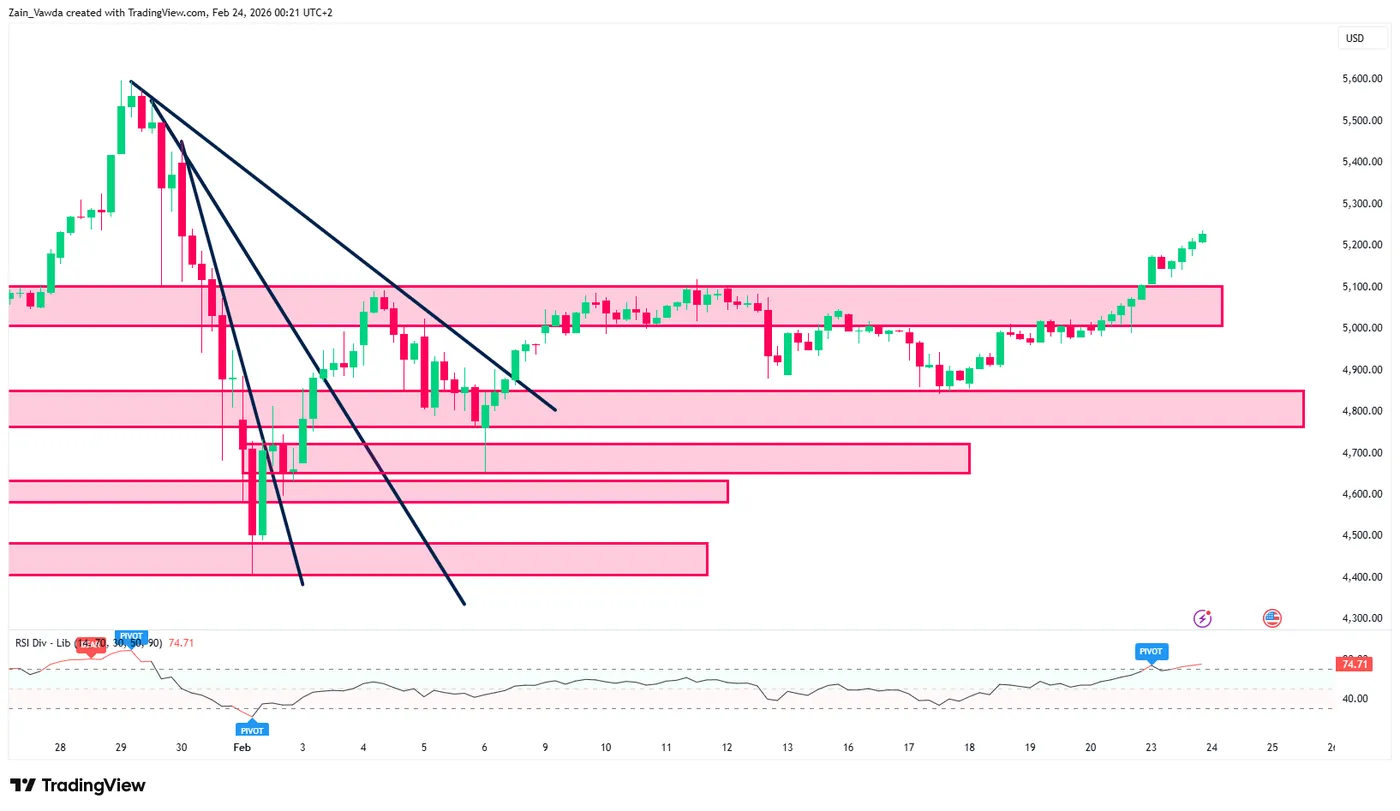
Source:TradingView.Com (click to enlarge)





 to impose sweeping global tariffs.)