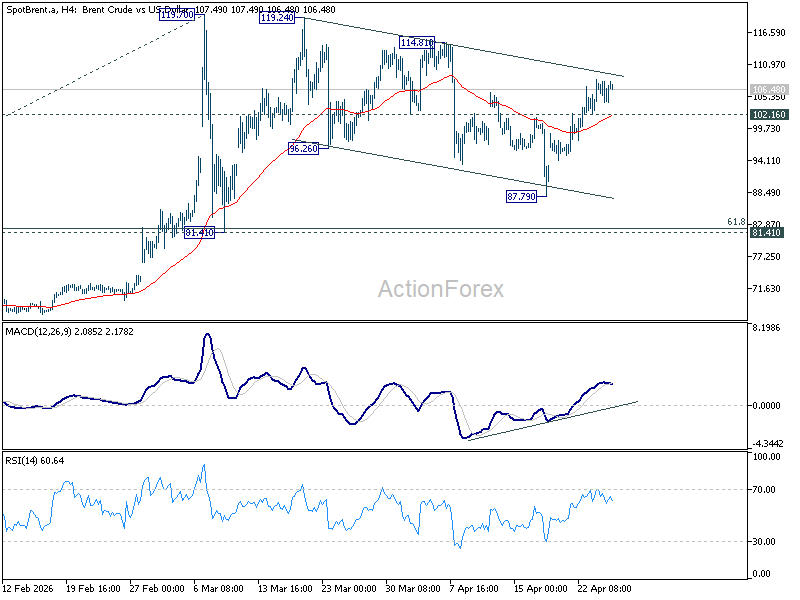
Despite the cancellation of a second round of US–Iran talks, crude oil prices showed little urgency to push higher, with Brent holding near $106 and WTI anchored around $98. In earlier phases of the conflict, such a diplomatic failure would likely have triggered a sharp rally. This time, the market response was muted, signaling a deeper shift in how geopolitical risk is being priced.
The key transition is from escalation risk to what can best be described as a “frozen conflict.” The dual blockade remains firmly in place—Iran continues to restrict flows through the Strait of Hormuz while the US maintains pressure on Iranian ports—yet neither side is moving toward decisive confrontation. With the indefinite ceasefire still in place, the market is interpreting the conflict as contained rather than expanding.
That distinction matters for oil pricing. The market has repeatedly tested the upside but failed to sustain a break above the 110 zone, reinforcing the view that current conditions represent tension without escalation. Even with significant supply disruptions from the Hormuz chokepoint—responsible for a substantial portion of global oil transit—the absence of further deterioration is capping the risk premium.
There are also tentative signs of diplomatic movement, though far from a breakthrough. US President Donald Trump acknowledged receiving a “much better” proposal from Iran, while reports suggest Tehran has floated a tactical compromise—reopening the Strait in exchange for delaying nuclear negotiations. These incremental steps support a scenario of prolonged negotiation rather than sudden resolution or renewed conflict.
At the same time, traders are showing clear signs of war fatigue. Price spikes are increasingly being faded rather than chased, reflecting a reluctance to commit to directional trades without confirmation of either escalation or de-escalation. Oil is effectively trapped between structural supply constraints and a lack of fresh catalysts.
This leaves the near-term outlook skewed mildly higher, but with limited momentum. Without a clear break in the narrative—either through escalation or a verified diplomatic breakthrough—oil is likely to grind higher rather than surge.
Technically, Brent crude is now testing the ceiling of a near-term falling channel around 109.50. Failure at this level, followed by a break below 102.16, would confirm rejection and resume the corrective move from 119.24 with another leg toward 87.79.
Conversely, a clean break above channel resistance would mark a shift back into escalation pricing, opening the path toward a retest of the 120 key psychological level.