


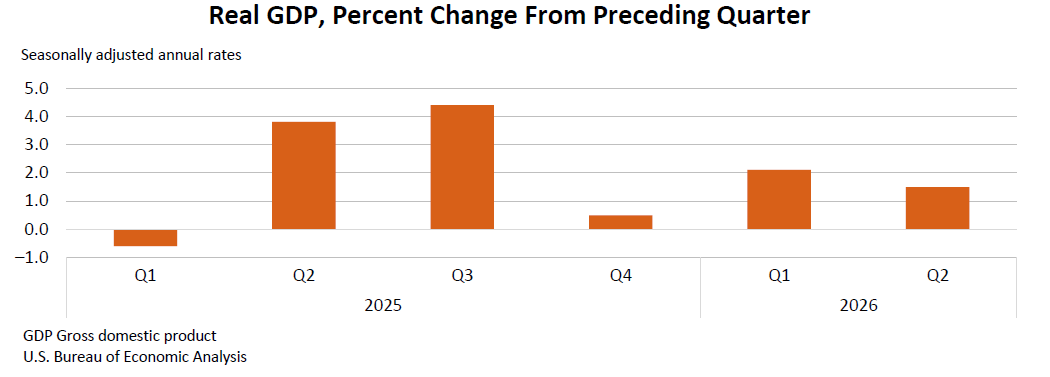
The US economy expanded at an annualized rate of 1.5% in the second quarter, according to the advance estimate from the Bureau of Economic Analysis, slowing from 2.1% in the first quarter and falling short of market expectations of 2.3%. The softer headline reflected a downturn in government spending alongside slower investment and export growth, while a larger increase in imports also weighed on overall GDP. Consumer spending remained the main pillar of growth, accelerating from the previous quarter and helping keep the economy on a positive footing.
Beneath the headline, however, domestic demand remained considerably stronger than the top-line figure suggests. Real final sales to private domestic purchasers—a measure often viewed as a better gauge of underlying economic momentum—accelerated sharply to 3.9% from 1.7% in the first quarter. The improvement indicates that private consumption and business investment continued to hold up well despite restrictive monetary policy and tighter financial conditions, with much of the GDP slowdown driven by more volatile components such as government spending and trade.
Inflation presented a more mixed picture. The gross domestic purchases price index accelerated from 3.6% to 5.7%, while the headline PCE price index rose from 4.6% to 5.1%, reflecting the impact of higher energy prices during the quarter. At the same time, core PCE inflation eased from 4.4% to 3.4%, suggesting underlying price pressures outside food and energy continued to moderate.
Economic Data
| Indicator | Actual | Expected | Previous |
|---|---|---|---|
| GDP Annualized Q2 (Advance) | 1.5% | 2.3% | 2.1% |
| Real Final Sales to Private Domestic Purchasers | 3.9% | — | 1.7% |
| Gross Domestic Purchases Price Index | 5.7% | — | 3.6% |
| PCE Price Index | 5.1% | — | 4.6% |
| Core PCE Price Index | 3.4% | — | 4.4% |
Key Takeaways
- US economic growth slowed more than expected. Real GDP expanded at an annualized 1.5% in Q2, down from 2.1% in Q1 and below the 2.3% consensus, reflecting weaker government spending, slower investment and exports, and a larger drag from imports.
- Underlying private demand strengthened significantly. Real final sales to private domestic purchasers accelerated to 3.9% from 1.7%, suggesting household spending and business investment remained resilient despite restrictive monetary policy.
- Consumer spending remained the key growth engine. Stronger household spending partly offset weakness elsewhere and prevented a sharper slowdown in overall GDP.
- Headline inflation pressures picked up because of energy. The gross domestic purchases price index accelerated from 3.6% to 5.7%, while headline PCE inflation rose from 4.6% to 5.1%, highlighting the impact of higher energy prices during the quarter.
- Underlying inflation continued to improve. Core PCE inflation slowed from 4.4% to 3.4%, indicating broader domestic price pressures continued to moderate despite the energy shock.





