


TL;DR: Brent’s break above $90 is doing double duty for CAD/JPY — strengthening Canada’s terms of trade while pushing global bond yields higher and deepening Yen funding pressure — and this time Canada’s own data are contributing too, unlike June’s Yen-only rally.
CAD/JPY Has Found a Rare Double Tailwind
Brent’s break above $90 is doing more than lifting Canadian Dollar. It is also pushing global inflation expectations and bond yields higher, adding pressure to Yen. For CAD/JPY, that creates an unusually clean setup: same US-Iran shock strengthens one side of cross while weakening other.
June 17 ceasefire framework formally expired on August 17 without renewal, leaving no clear diplomatic settlement in sight. Higher oil improves Canada’s terms of trade and supports petro-currency, while renewed energy and freight inflation keeps global yields elevated. For Yen, still one of market’s principal funding currencies, wider yield differentials reinforce carry pressure. Instead of two separate narratives, CAD strength and JPY weakness are being driven by same underlying shock.
This Time Canada Is Contributing Too
That is important because CAD/JPY has rallied on Yen weakness before. Late-June advance eventually stalled because Canadian Dollar itself offered limited independent support. Current move starts from a stronger domestic backdrop.
May GDP rose 0.3% m/m, beating 0.2% forecast and expanding across 13 of 20 sectors. July labor data then surprised decisively, with employment jumping 75K against 15K expected and unemployment dropping to a two-year low of 6.4%. July CPI followed with headline inflation accelerating from 2.8% to 3.0% y/y, above 2.9% consensus, while Trimmed and Median CPI firmed to 1.9% and 2.0% respectively.
Gasoline was a substantial part of headline inflation surge, rising 25.7% y/y, and part of that effect is linked to tax treatment that rolls off in September. That argues against treating CPI as proof that BoC has already returned to a tightening path. But combined with stronger growth and employment, data have at least reopened hike discussion after it had largely disappeared. For CAD, that is enough to distinguish current rally from June’s mostly Yen-driven move.
Oil Shock Is Also Hurting Yen Through Bonds
Global bond market supplies second leg. US 30-year yield has climbed to around 5.31%, highest in 19 years, while 10-year is near 4.74%. Germany’s 10-year Bund has reached about 3.22%, highest since 2011, and Canada’s 10-year recently touched 3.75%, a 26-month high.
Current rise in yields carries a stagflationary flavor rather than a straightforward growth signal. Hormuz disruptions and higher energy and freight costs are lifting inflation concerns and encouraging investors to price restrictive rates for longer. That is exactly environment in which Yen’s yield disadvantage becomes harder to ignore.
BoJ normalization may eventually narrow that gap, but global yields are moving higher in meantime. Until Japanese rates catch up more substantially, higher overseas yields continue to reinforce Yen-funded carry trades. Brent above $90 therefore creates a double effect for CAD/JPY: stronger Canadian terms of trade and greater funding pressure on Yen.
Brent Consolidation Will Tell Us Whether CAD Strength Is Real
Best test of this rally may come when oil stops rising.
If Brent consolidates around $90–91 and CAD/JPY continues holding or extending gains, that would be strong evidence that Canadian Dollar’s domestic improvement is doing meaningful work. GDP, employment and CPI would then be providing enough support for CAD to carry rally even without another daily oil breakout.
If CAD/JPY instead stalls immediately whenever crude stops climbing, move would look more like June again: predominantly Yen weakness with limited independent CAD follow-through.
That gives current trade a falsifiable fundamental test. A durable move toward 120 should increasingly survive without requiring Brent to make new highs every session.
Japan Can Still Interrupt the Trade
Main risk does not currently come from Canada. It comes from Japan.
USD/JPY is moving back toward 160 intervention-sensitive zone, reviving possibility of verbal or direct action from Japanese authorities. September 18 BoJ meeting also approaches with substantial probability of another rate increase already priced.
Either development could hit CAD/JPY even if oil remains high. Actual intervention would likely trigger broad Yen buying across crosses, while a BoJ hike would challenge carry mechanism more fundamentally.
That makes 120 a plausible target, but not a low-volatility one. Stronger oil and global yields are pushing Yen in exactly direction that increases likelihood of Japanese response.
ActionForex’s Technical View on CAD/JPY: Break of 117.50 Would Put 120.86 on Map
Technical structure supports bullish case. CAD/JPY has decisively reclaimed 55-day EMA around 114.52, adding to argument that correction from 117.50 ended at 110.82 in a three-wave structure. That low held around 111.28, 38.2% retracement of larger rise from 101.24 to 117.50, preserving medium-term uptrend.
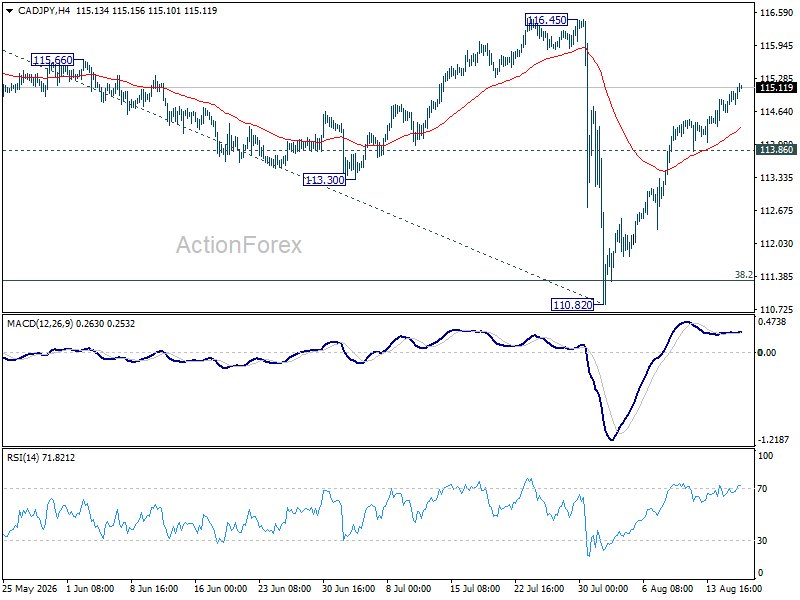
Near-term bias stays higher while 113.86 holds. 116.45 is first resistance and a firm break would strengthen case that rebound has enough momentum to retest 117.50. Decisive break of 117.50 would be more important, signaling likely resumption of broader uptrend and opening 120 psychological level, followed by 120.86, 61.8% projection of 101.24 to 117.50 from 110.82.
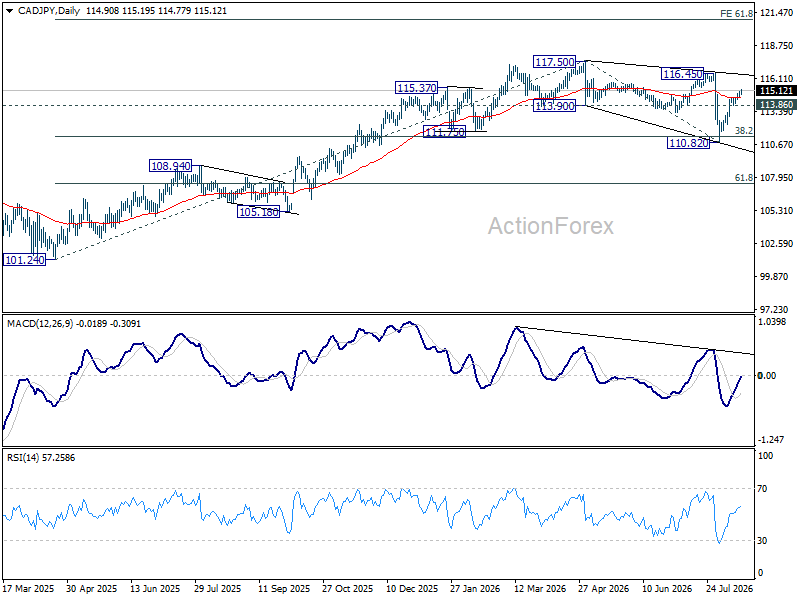
Break below 113.86 would postpone that bullish scenario and suggest correction from 117.50 is extending. But while oil stays elevated, Canadian data remain firm and global yields keep Yen under pressure, CAD/JPY has a stronger foundation than during June’s failed advance. This time, both sides of cross are helping.
Key Takeaways
- Brent’s break above $90 is strengthening CAD/JPY from both sides: improving Canada’s terms of trade while pushing global yields higher and pressuring the Yen’s carry-funding role.
- Unlike June’s Yen-only rally, Canada’s own data are now contributing, with a 75K jobs beat, firmer May GDP, and CPI reopening the BoC hike discussion.
- Global bond yields are rising with a stagflationary character, with the US 30-year at a 19-year high and German and Canadian yields at multi-year highs.
- Brent stabilizing around $90-91 is a falsifiable test: continued CAD/JPY strength without new oil highs would confirm the domestic Canadian story is real.
- 117.50 is the key resistance for a run toward 120 and then 120.86, but USD/JPY nearing the 159.6-160.6 intervention zone and the September 18 BoJ meeting remain the main risks to that path.





