


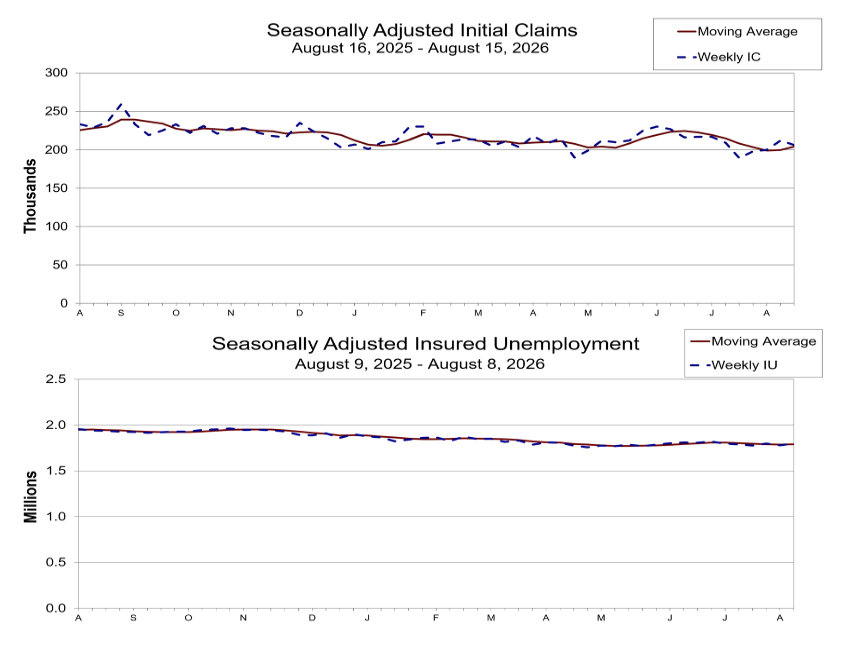
U.S. initial jobless claims fell 6,000 to 206,000 in the week ended August 15, below market expectations for 210,000 and pointing to continued stability in labor-market conditions. However, the previous week’s figure was revised up to 212,000 from 209,000, meaning the latest decline partly reflects a higher starting point. The four-week moving average, which smooths weekly volatility, increased to 204,000 from a revised 199,750.
The broader picture is less reassuring than the headline decline suggests. Continuing claims rose 18,000 to 1.799 million in the week ended August 8, while the four-week average increased to 1.789 million. The insured unemployment rate was unchanged at 1.2%. Rising continuing claims indicate that workers who have lost jobs may be taking longer to return to employment, even as the flow of new claims remains relatively low.
Data Summary
| Indicator | Latest | Previous | Consensus |
|---|---|---|---|
| Initial Jobless Claims | 206K | 212K | 210K |
| 4-Week Moving Average | 204K | 199.75K | — |
| Continuing Claims | 1.799M | 1.781M | — |
| 4-Week Avg. Continuing Claims | 1.789M | 1.7865M | — |
| Insured Unemployment Rate | 1.2% | 1.2% | — |
Key Takeaways
- Initial claims fell to 206K, beating expectations for 210K and suggesting layoffs remain contained.
- Previous week’s claims were revised higher to 212K, from 209K, reducing the strength of the latest decline.
- Four-week average rose to 204K, pointing to some softening in the underlying trend despite the weekly fall.
- Continuing claims increased 18K to 1.799M, suggesting unemployed workers are taking somewhat longer to find new jobs.
- Labor market is cooling gradually rather than deteriorating sharply. Low initial claims argue against an abrupt downturn, while rising continuing claims provide evidence of weaker labor-market momentum.





