


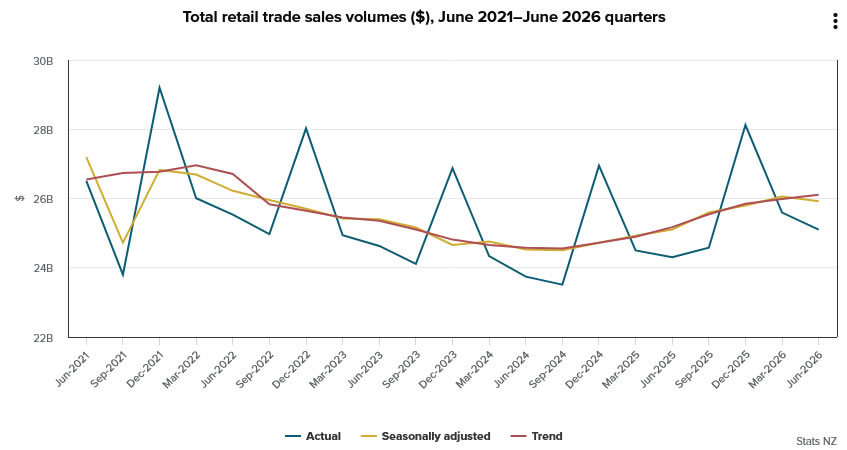
New Zealand retail sales volumes fell -0.5% q/q in Q2, reversing a revised 1.0% rise in Q1 and missing expectations for a 0.1% increase. Excluding autos, however, sales rose 0.7%, slowing from a revised 1.1% but comfortably beating consensus of 0.3%. Eight of 15 industries recorded lower sales volumes, pointing to a mixed rather than uniformly weak quarter.
Fuel retailing was by far the largest drag, with volumes plunging -13%, while accommodation fell -8.0%, food and beverage services dropped -2.8%, and motor vehicle and parts retailing declined -2.3%. Electrical and electronic goods retailing provided a notable offset, rising 9.2%. Weakness therefore extended beyond autos, but sharp fall in fuel volumes had an outsized impact on headline result.
Price effects created a striking contrast with volume data. Seasonally adjusted retail sales values rose 0.9% q/q to NZD 33bn, even as real volumes contracted. Fuel retailing values surged 12% despite -13% fall in volumes, with Stats NZ attributing increase to higher fuel prices. Divergence suggests households paid considerably more for fuel while buying less, leaving headline nominal spending looking much firmer than underlying consumption volumes.
Data Summary
| Indicator | Actual | Expected | Previous |
|---|---|---|---|
| Retail Sales q/q Q2 | -0.5% | +0.1% | +1.0% |
| Retail Sales ex Autos q/q Q2 | +0.7% | +0.3% | +1.1% |
Key Takeaways
- New Zealand retail sales volumes fell 0.5% q/q in Q2, reversing 1.0% growth in Q1 and missing expectations for a 0.1% increase.
- Underlying picture was firmer than headline suggested, with ex-auto sales rising 0.7%, beating 0.3% consensus despite slowing from 1.1%.
- Fuel was biggest drag on real activity, with sales volumes plunging 13%, while accommodation fell 8.0%, food and beverage services declined 2.8%, and motor vehicle and parts sales dropped 2.3%.
- Higher prices sharply distorted nominal figures. Fuel retailing values jumped 12% even as volumes fell 13%, helping total retail sales values rise 0.9% q/q.
- Report therefore points to softer real consumption at headline level, but not broad-based spending weakness, with price effects—particularly fuel—masking decline in physical purchases.





