


EUR/USD rose to 1.1627. The US dollar fell sharply yesterday and remains under pressure today. Pressure on the US currency intensified after a Federal Reserve official made more dovish comments, prompting markets to scale back expectations for a September rate hike.
Federal Reserve Governor Christopher Waller stated that he would support keeping rates unchanged if price pressures continue to ease. According to him, the next policy decision will largely depend on August inflation data, due for release next week.
Markets now put the probability of a September rate hike at approximately 50%, down from around 63% the previous day. Friday’s US labour market report for August will provide another important signal and could significantly shift market expectations for Fed policy.
Another factor weighing on the dollar has been the yen’s sharp appreciation. Investors are monitoring the risk of currency intervention while also assessing the likelihood of more aggressive Bank of Japan policy tightening before year-end.
Technical Analysis
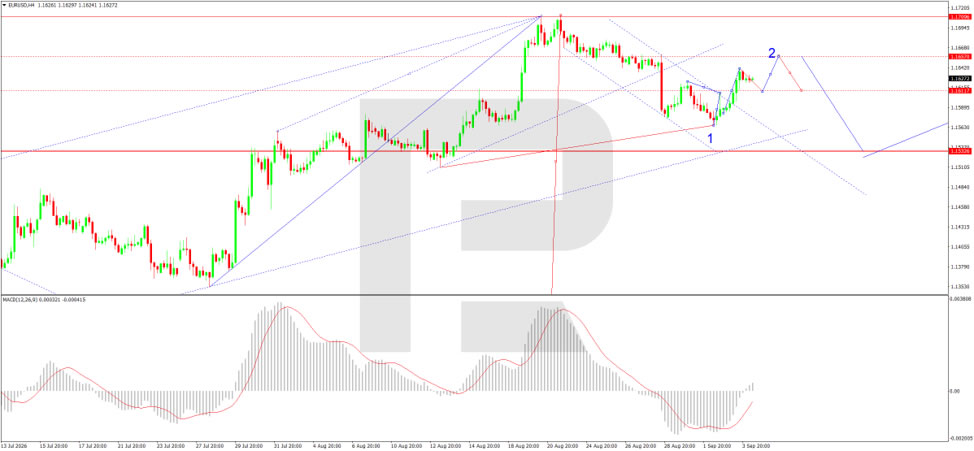
On the H4 chart of EUR/USD, the market is moving lower towards 1.1611. A consolidation range is currently forming around this level. A move higher towards 1.1657 is possible, followed by a further decline to 1.1555. The MACD indicator supports this scenario, with its signal line below zero and pointing firmly downward, indicating continued bearish momentum and scope for further downside.
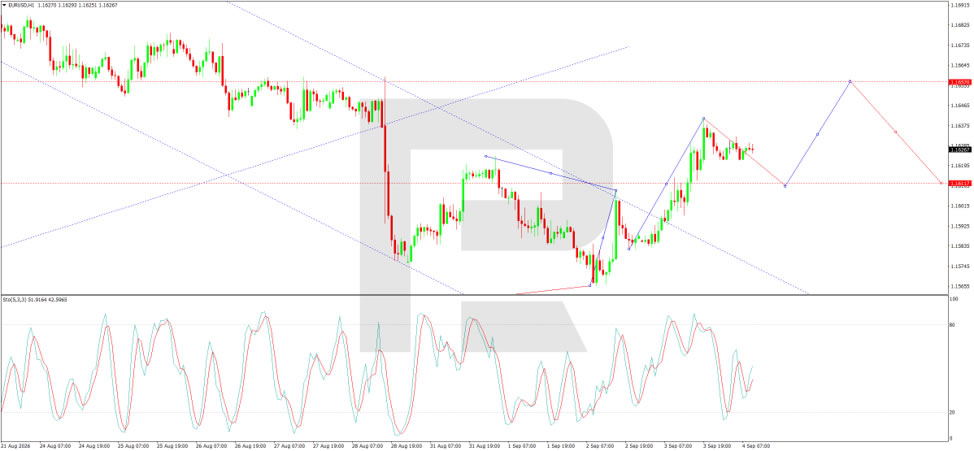
On the H1 chart, the market has completed another downward move to 1.1625. A consolidation range is currently forming around this level. A move lower towards 1.1611 is expected today, followed by a rebound to 1.1657. The Stochastic oscillator supports this scenario, with its signal line below 50 and pointing firmly downward towards 20.
Conclusion
EUR/USD has gained ground as the dollar retreats following dovish comments from Fed Governor Christopher Waller, who signalled a preference for keeping rates unchanged if inflation continues to ease. The implied probability of a September rate hike has fallen from 63% to 50%, with markets now focused on Friday’s US jobs report and next week’s inflation data for further guidance. The sharp appreciation of the yen has also contributed to dollar weakness, as investors weigh intervention risks and the prospect of more aggressive BoJ tightening. Technically, the pair may see a near-term bounce towards 1.1657 before resuming its broader bearish trend towards 1.1555. The US labour market report will be the key catalyst for the next directional move.
Disclaimer
Any forecasts contained herein are based on the author’s particular opinion. This analysis may not be treated as trading advice. RoboForex bears no responsibility for trading results based on trading recommendations and reviews contained herein.





