


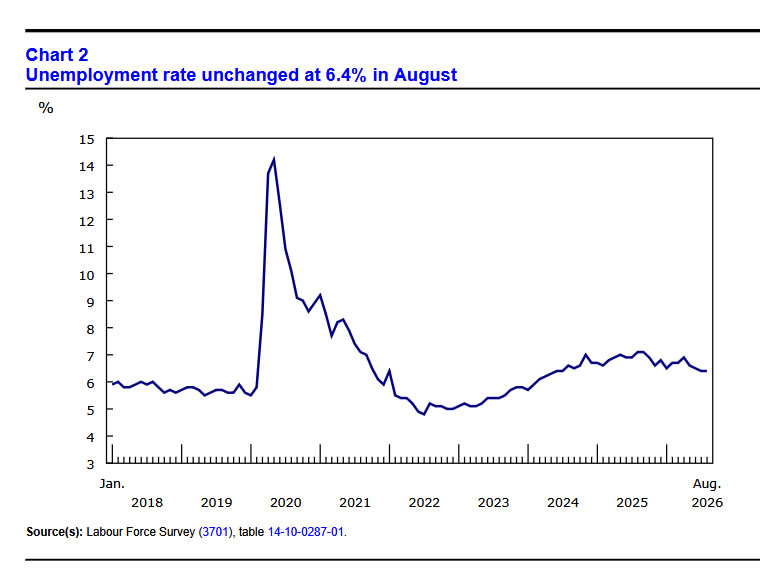
Canada’s labor market weakened notably in August, with employment swinging from +75.1K in July to -41.7K, against expectations for a 15.1K increase. Employment rate slipped from 60.9% to 60.8%, while unemployment held at 6.4%. Stability in unemployment rate was less reassuring than headline suggested, however, as labor force contracted by 36.8K and participation rate fell from 65.1% to 65.0%. Full-time employment accounted for most of decline, dropping 35.9K, while part-time employment fell 5.8K.
Weakness was spread across several industries. Business, building and other support services lost 19.9K jobs, public administration 8.8K, natural resources 7.7K and utilities 5.6K. Services-producing industries shed 51.5K overall, more than offsetting a 9.8K increase in goods-producing employment. Manufacturing stood out as main bright spot, adding 22.1K, and was only industry Statistics Canada identified as posting a statistically significant increase. Public-sector employment also fell 20K for a third consecutive month, taking cumulative decline since May to 78K.
Wage data added another soft element. Average hourly earnings growth slowed from 2.8% to 2.0% y/y, marking a second consecutive deceleration and weakest pace since November 2017 outside pandemic-distorted 2021. August decline still follows cumulative employment growth of 181K from April through July, so latest report is better read as a sharp setback after a stronger run rather than evidence of outright labor-market contraction. Still, combination of falling employment, lower participation and cooling wages points to a clear loss of momentum in August.
Data Summary
| Indicator | August | July | Consensus |
|---|---|---|---|
| Employment change | -41.7K | +75.1K | +15.1K |
| Unemployment rate | 6.4% | 6.4% | 6.4% |
| Employment rate | 60.8% | 60.9% | — |
| Participation rate | 65.0% | 65.1% | — |
| Average hourly wages y/y* | +2.0% | +2.8% | — |
*Wage data are not seasonally adjusted.
Employment Details
| Component | August Change |
|---|---|
| Public-sector employment | -20.0K |
| Private-sector employment | -22.8K |
| Self-employment | +1.1K |
| Services-producing sector | -51.5K |
| Goods-producing sector | +9.8K |
| Manufacturing | +22.1K |
| Business, building and other support services | -19.9K |
| Public administration | -8.8K |
| Natural resources | -7.7K |
| Utilities | -5.6K |
Key Takeaways
- Canada employment swung from +75.1K in July to -41.7K in August, sharply missing expectations for +15.1K.
- Unemployment held at 6.4%, but labor-force details were softer: participation fell from 65.1% to 65.0%, while employment rate slipped from 60.9% to 60.8%.
- Full-time employment accounted for most of decline, falling 35.9K, while part-time employment dropped 5.8K.
- Services employment fell 51.5K, more than offsetting a 9.8K increase in goods-producing employment.
- Manufacturing was clear bright spot with 22.1K gain and was only industry Statistics Canada identified as recording a statistically significant increase.
- Public-sector employment fell 20K for a third consecutive month and is now down 78K since May.
- Wage growth slowed from 2.8% to 2.0% y/y, second straight deceleration and weakest pace since November 2017 outside pandemic-distorted 2021.
- August weakness follows cumulative employment growth of 181K from April through July, so report marks a sharp loss of momentum rather than confirming an established contraction.





