


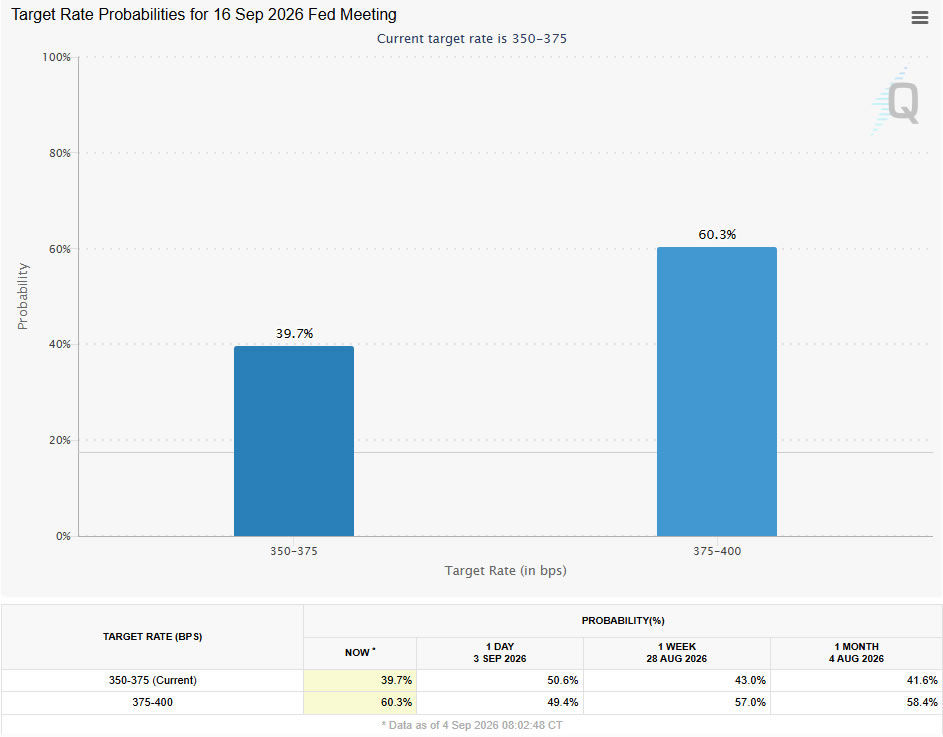
What’s happening: Dollar rebounded after August nonfarm payrolls jumped from a revised 21K in July to 162K, nearly three times the 58K consensus, while June and July were revised up a combined 55K. Yet September Fed hike probability only edged up to around 60%, and Treasury yields have yet to decisively break key resistance levels.
Why it matters: Fed Governor Christopher Waller had already framed his September decision around whether disinflation proves durable, not around labor-market strength, and he expected August payrolls to deliver “more of the same.” Friday’s report answered July’s labor-market question. It did not answer September’s Fed question, which is why next week’s CPI report, not Friday’s NFP, is now the more decisive test.
Also today:
- Norway’s Norges Bank Investment Management proposed cutting government bonds from 70% to 50% of its roughly $2.3tn fixed-income portfolio, reducing the Treasury share from 34.1% to 21.9%, a gradual, longer-horizon signal for US bond demand unrelated to Friday’s jobs data.
Strong NFP Repairs Much of July’s Labor-Market Scare
Dollar rebounded sharply after the August employment report delivered a much stronger labor-market picture than markets expected. Nonfarm payrolls jumped from a revised 21K in July to 162K in August, nearly three times the 58K consensus. More importantly, July’s initially reported 23K decline was revised into positive territory, while June was also lifted from 20K to 31K. The combined revisions added 55K jobs to the prior two months, substantially reducing concern that July marked the start of a more serious deterioration in employment.
Details were broadly constructive. Unemployment held at 4.1% even as labor-force participation rose from 61.4% to 61.6%, while average hourly earnings increased 0.3% m/m, matching expectations, and 3.1% y/y. Private payrolls rose 127K. Some of the headline strength was concentrated in food services and local government education, but the overall report still delivered a clear message: the US labor market is in considerably better shape than July data had suggested.
Yet Dollar’s rebound has so far been surprisingly restrained. September Fed hike probability only edged up to around 60%, leaving the next meeting essentially just slightly better than a coin toss despite the large upside NFP surprise. Outside USD/CAD, where Canadian Dollar is dealing with its own weak employment report, the greenback has struggled to convert stronger US data into a broader breakout.
August NFP at a Glance
- Headline: 162K, nearly three times the 58K consensus, up from a revised 21K in July.
- Revisions: July revised from -23K to positive; June lifted from 20K to 31K; 55K added combined.
- Unemployment: held at 4.1%, participation rose from 61.4% to 61.6%.
- Average hourly earnings: 0.3% m/m, matching expectations, 3.1% y/y.
- Private payrolls: 127K, with strength concentrated in food services and local government education.
Payrolls Answered July’s Question, Not September’s Fed Question
One reason is Fed Governor Christopher Waller’s message earlier this week. Waller had already made clear that his September decision would depend heavily on whether the recent improvement in inflation proves durable. He highlighted the decline in three-month core inflation from 4.76% in February to 3.05% through July, calling it “a considerable improvement” and noting “some signs of disinflation.”
His conditional preference was straightforward: if incoming data continue to confirm that improvement, he would be “inclined to support holding” rates at the September 15–16 meeting. If August inflation instead shows that progress was fleeting, a hike would remain appropriate.
Importantly, Waller did not frame the labor market as a source of immediate concern even before Friday’s report. He described it as being in “satisfactory shape” and said he expected August employment data to deliver broadly “more of the same.” Payrolls have clearly surprised on the stronger side of that assumption, so the report raises the hurdle for a September hold. But Waller’s reaction function still points toward next week’s inflation data as potentially more decisive than NFP itself.
That helps explain the muted Fed repricing. Payrolls answered July’s labor-market question. They did not answer September’s Fed question.
Waller’s Pre-NFP Framework vs. Friday’s Actual Report
| Waller’s Framework (Before NFP) | Friday’s Actual Report | |
|---|---|---|
| Labor market characterization | “Satisfactory shape,” expected “more of the same” | 162K vs. 58K consensus, plus 55K in positive revisions |
| What decides September | Whether disinflation proves durable (CPI-dependent) | Strong jobs data, but doesn’t override the CPI test |
| September hike odds | Conditional on inflation data, not payrolls | Edged up only to about 60% |
Treasury Yields Still Need to Confirm Dollar Rebound
The rates market is telling a similar story. Both 2-year and 10-year Treasury yields moved higher after payrolls, but neither has yet decisively broken through levels that would signal a broader resumption of hawkish US-rate repricing.
For the front end, 4.40% in the 2-year yield is the immediate hurdle. At the long end, 4.80% in the 10-year yield remains equally important. Both levels have repeatedly acted as psychological barriers this week.
A decisive break through them would strengthen the case that NFP has done more than simply remove labor-market downside risk. It would suggest markets are rebuilding a more aggressive tightening path and would give Dollar a firmer foundation for extending its recovery before the weekly close.
Without that confirmation, the current move can still be interpreted more narrowly: employment risk has fallen, but the Fed policy path has not materially shifted.
Hurdle Levels to Watch
- 2-year Treasury yield: 4.40%, repeated psychological barrier this week.
- 10-year Treasury yield: 4.80%, equally important long-end hurdle.
CPI Now Becomes the Bigger Test
That puts next week’s August CPI report in an unusually important position.
Strong payrolls have eliminated much of the argument for holding rates because the labor market may be deteriorating rapidly. But inflation remains a separate question. If CPI confirms Waller’s recent disinflation signal, the market could again tilt toward a September hold despite Friday’s employment strength.
A hotter inflation report would create a much cleaner hawkish combination: strong jobs, firmer wages, and renewed price pressure. That would be far more likely to push September hike odds decisively above 50%, lift front-end yields through resistance, and turn the current Dollar bounce into a more durable move.
So Friday’s NFP matters greatly—but its most important effect may be to narrow the Fed debate rather than settle it. The September decision increasingly comes down to whether a strong labor market is accompanied by continued disinflation or renewed price pressure.
Norway Adds Another Signal on Treasury Demand
A separate development in Europe adds a longer-term wrinkle to the Treasury market. Norges Bank Investment Management, manager of Norway’s roughly $2.3tn sovereign wealth fund, has formally proposed reducing government bonds from 70% to 50% of its fixed-income portfolio.
Under the proposal, the US Treasury share of the bond portfolio would fall from 34.1% to 21.9%, while euro-area government bonds would also decline. Japanese government bonds, by contrast, would rise from 4.6% to 7.4%, while non-government US fixed income would increase sharply from 16.2% to 27.6%.
The reallocation would be gradual, limiting any immediate market impact. But the rationale is notable. NBIM argues that high debt burdens across developed economies weaken the case for the existing government-bond allocation framework and sees scope to seek higher returns elsewhere while preserving sufficient liquidity for periods of stress.
One fund reducing Treasury exposure is not enough to reshape the US bond market. But against a backdrop of already elevated long-term yields and persistent fiscal concerns, the move adds another signal that traditionally reliable sovereign-debt buyers are becoming more selective. For Dollar today, NFP and the Fed still dominate. For Treasuries over a longer horizon, the demand side remains a story worth watching.
NBIM’s Proposed Reallocation
- Government bonds: 70% to 50% of the fixed-income portfolio.
- US Treasury share: 34.1% to 21.9%.
- Japanese government bonds: 4.6% to 7.4%.
- Non-government US fixed income: 16.2% to 27.6%.
US & Canada Employment Contrast
US NFP Smashes Forecasts With 162k Growth, July Revisions Turn Positive — the full breakdown of Friday’s report, including the 55K in combined upward revisions to June and July.
Canada Employment Falls -41.7K as Participation and Wage Growth Weaken — a sharply weaker read across the border, with participation and full-time jobs both declining even as unemployment held at 6.4%.
Dollar and Gold Positioning Into NFP
Dollar Squeezed on Two Fronts, Gold Rebounds Sharply From Critical Support Ahead of NFP Cue — how Yen strength and Waller’s dovish framing were already pressuring Dollar heading into Friday’s release.
Global Data & Central Bank Watch
Eurozone Retail Sales Slide -0.6% mom as Discretionary Spending Weakens — a softer July print, though June’s upward revision tempers the deterioration signal.
RBNZ’s Silk Signals December Hike More Likely Than October — New Zealand’s central bank still leaning toward another hike, but pushing the likely timing back to allow more assessment time.
What causes the disconnect between a strong jobs report and muted Fed pricing?
Fed Governor Christopher Waller had already tied his September decision to whether disinflation proves durable, not to labor-market strength, and said he expected August payrolls to be “more of the same.” Because the report answered the labor-market question rather than the inflation question his framework depends on, September Fed hike odds only edged up to about 60% despite the size of the beat.
What would confirm the Dollar rebound is durable?
A decisive break of the 2-year Treasury yield above 4.40% and the 10-year above 4.80% would signal markets are rebuilding a more aggressive tightening path. Next week’s August CPI report matters even more: a hotter print would combine with strong jobs and firmer wages to push September hike odds clearly above 50%.
Is Norway’s sovereign wealth fund reducing its US Treasury holdings?
Norges Bank Investment Management has proposed cutting government bonds from 70% to 50% of its roughly $2.3tn fixed-income portfolio, which would lower the US Treasury share from 34.1% to 21.9%. The reallocation would be gradual, so it isn’t an immediate market catalyst, but it adds to a longer-term signal about sovereign demand for US debt.
Key Takeaways
- August NFP surged to 162K, nearly three times the 58K consensus, with June and July revised up a combined 55K.
- Despite the beat, September Fed hike odds only edged up to about 60%, because Waller’s framework ties the decision to inflation durability rather than labor-market data.
- The 2-year Treasury yield at 4.40% and the 10-year at 4.80% are the key levels that need to break for the Dollar rebound to gain a firmer foundation.
- Next week’s August CPI report is now a bigger test for the September Fed decision than Friday’s payrolls.
- Norway’s NBIM has proposed cutting its Treasury allocation from 34.1% to 21.9% of its bond portfolio, a gradual but notable longer-term signal for US bond demand.
What to Watch Next
August CPI next week is now the decisive input for the September 15–16 Fed meeting. Also watch whether the 2-year (4.40%) and 10-year (4.80%) Treasury yields break through this week’s resistance levels, and any follow-through on NBIM’s proposed Treasury reallocation, though that shift would unfold gradually rather than as a near-term market mover.





