TL;DR: A week of strong catalysts — a hawkish jobs report, Trump’s renewed pressure on the Fed, Yen strength, and geopolitical risk — left the Dollar, Treasury yields, and the Dow all testing key levels without breaking them, setting up September 11’s CPI report as the release that could finally force a resolution.
Markets Reacted to Everything, but Committed to Nothing
This was a week packed with catalysts that, on their own, looked capable of forcing a decisive repricing across US assets. Labor-market fears were challenged by a surprisingly strong employment report. Fed officials offered a path toward either holding or tightening depending on inflation. White House pressure on the Fed returned with unusual force. Yen strength hit the Dollar from an independent direction. Geopolitical tensions kept an inflationary energy tail risk alive.
Yet by Friday close, none of those forces had won.
The Dollar approached important resistance and reversed, but eventually held above a key near-term support. Two-year and 10-year Treasury yields both pushed into major breakout zones but failed to establish themselves above them. The Dow remained supported, but couldn’t resume its record-setting advance. Each market reacted to the week’s news, sometimes sharply, yet each ultimately returned to the same unresolved technical structure it started with.
That’s the paradox worth carrying into next week. Markets weren’t complacent and they weren’t ignoring the data. They were actively repricing competing narratives, only for those moves to offset one another. Stronger growth argued for higher rates. Signs of disinflation argued for patience. Political pressure pointed toward the Fed holding. Oil stopped short of delivering another inflation shock. Equities remained resilient enough to resist a broader risk-off adjustment.
The result wasn’t an absence of movement, but an absence of confirmation. That distinction matters because next week brings the one release capable of forcing several of these markets to resolve together: August CPI.
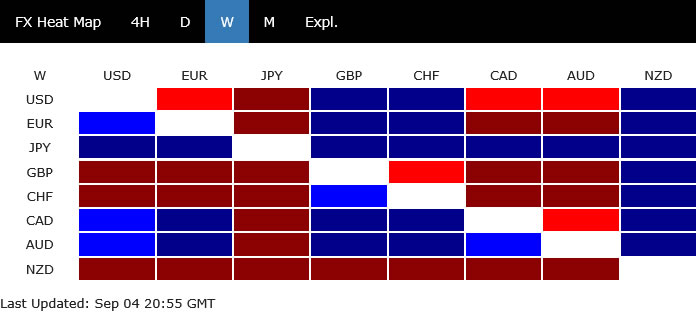
NFP Removed July’s Labor-Market Scare
Friday’s employment report delivered the clearest hawkish input of the week. Nonfarm payrolls rebounded from a revised 21K in July to 162K in August, far above the 58K consensus. The headline was strong enough on its own, but the revisions were arguably more important for the broader narrative. July’s initially reported 23K contraction was revised into a 21K gain, while June was lifted from 20K to 31K. Combined, the previous two months were revised 55K higher.
That materially changes the interpretation of recent labor-market momentum. Before Friday, July’s negative payroll reading had opened the possibility that employment growth was no longer merely slowing, but beginning to roll over. Combined with other softer labor indicators, it gave markets a credible reason to think the Fed might need to place greater weight on downside employment risks. The August report largely removed that concern.
Unemployment stayed at 4.1%, even as labor-force participation increased. Average hourly earnings rose 0.3% m/m, while private payrolls increased 127K. Hiring wasn’t uniformly broad, and a meaningful share of the headline gain came from food services and local government education, but the report was still far too strong to sustain the idea of an economy slipping quickly toward labor-market contraction.
Most importantly, the revisions tell markets that July was never as weak as initially thought. That changes the Fed debate in a subtle but important way. A strong NFP doesn’t automatically mean the Fed must hike. But it removes one of the strongest arguments for patience: fear that tighter policy might be colliding with a rapidly deteriorating labor market.
In other words, Friday’s report did more than add one strong month. It repaired the recent history.
Fed Pricing Moved, but Only Back Toward a Hawkish Lean
Markets did respond to that repair. The probability of a September hike rose from 49.4% before NFP to 59.4% after the report. That’s a meaningful move, but it’s hardly decisive. Indeed, one week earlier, the market had already been pricing roughly 57% odds of a hike.
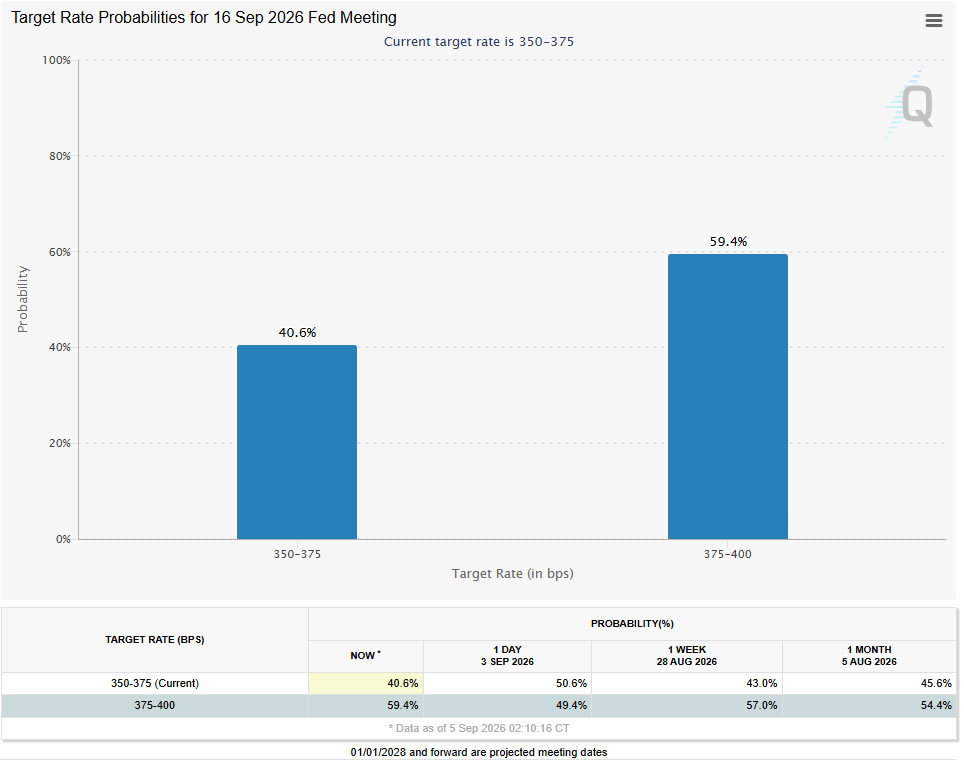
That comparison is revealing. Fed Governor Christopher Waller’s comments earlier in the week had pushed pricing back toward an even split. Friday’s NFP then reversed that move and restored a modest tightening bias. But despite payrolls exceeding expectations by more than 100K and prior months being revised sharply higher, markets still stopped at roughly three-in-five odds.
So NFP didn’t create a fresh hawkish breakout in Fed pricing. It largely re-established the debate that existed before Waller spoke. That restraint is one of the most important signals of the week.
If investors believed the August jobs report had settled the September decision, hike odds should have moved much closer to levels associated with a near-consensus policy call. Instead, the market is saying something more nuanced: labor data now favor tightening at the margin, but inflation data can still overturn that conclusion.
This is why front-end yields matter so much. The 2-year yield briefly traded through 4.40%, but failed to hold. Fed pricing and the Treasury market are effectively saying the same thing: employment has strengthened the tightening case, but not enough to establish conviction. There’s now a hawkish lean. There’s not yet a hawkish resolution.
Waller Explains Why Jobs Alone Were Never Going to Settle September
Waller’s remarks earlier in the week provide the clearest framework for understanding that restraint. Waller didn’t describe the labor market as being in distress. He called it “in satisfactory shape,” pointed to low layoffs and claims, and expected August employment to deliver broadly more of the same. He also stressed that policy was only slightly restrictive and acknowledged it might not take much acceleration in inflation to justify tighter policy.
But his central message wasn’t about payrolls. It was about disinflation.
Waller highlighted the decline in three-month core inflation from 4.76% in February to 3.05% through July, describing the improvement as considerable. He argued underlying inflation may be behaving better than headline core readings suggest, partly because non-market and imputed services had accounted for a large share of recent increases.
His policy condition was explicit. If disinflation continues, he’d be inclined to support holding rates and allowing current policy more time to work. If inflation comes in hot, he’d consider a hike.
Friday’s jobs report complicates that framework, but doesn’t destroy it. Waller expected employment to be broadly steady rather than dramatically stronger. That assumption was clearly too cautious. August payrolls materially exceeded what he appeared to anticipate, while upward revisions removed much of July’s apparent weakness. That weakens one leg of the hold case because the labor market now looks less vulnerable. But it doesn’t change his hierarchy of evidence.
Waller had already told markets his September vote would be influenced more heavily by August inflation than by payrolls. Stronger jobs therefore raise the hurdle for holding, but they don’t automatically clear the hurdle for hiking. That’s the distinction the market appears to be pricing. NFP removed one reason for the Fed to hold. CPI still has to provide sufficient reason to hike.
Trump Pushes From the Opposite Direction
Political pressure added another force pulling markets away from a clean hawkish resolution. President Donald Trump responded to the strong employment report not by acknowledging the stronger case for restrictive policy, but by escalating his demand for lower rates. He argued a stronger US economy and stronger credit position should translate into lower borrowing costs, then tied that demand directly to trade policy.
Trump threatened to stop trading with countries running surpluses against the US unless the Fed cuts rates, later naming Canada as an example.
That’s a notable escalation because monetary policy criticism is now being linked explicitly to external trade access. The economic logic also runs directly against the normal market interpretation of strong jobs data. A labor market stronger than expected typically reduces urgency for easing and, when inflation is still above target, can strengthen the case for tighter policy. Trump instead used employment strength as evidence the US deserves lower rates.
That creates a second policy axis running alongside the Fed’s own reaction function. The Fed is asking whether inflation is sufficiently contained to justify patience. The White House is asking why a stronger country should pay high rates at all. Those are very different frameworks.
Administration messaging itself isn’t entirely uniform. Vice President JD Vance has also argued for lower rates. National Economic Council Director Kevin Hassett, however, was more restrained on Friday, saying the case for holding steady was strong.
And then there’s Fed Chair Kevin Warsh. Only a week earlier, Warsh emphasized monetary discipline, reaffirmed the 2% inflation target, and made clear that short-term rates remain the primary instrument for achieving the Fed’s mandate. His remarks were interpreted by markets as reopening the possibility of a September hike.
That leaves an unresolved political-policy tension heading toward the meeting: Trump is intensifying pressure for cuts at exactly the moment when stronger employment is making tighter policy easier for the Fed to defend. There’s no evidence yet that political pressure is overriding the Fed’s reaction function. But it adds another source of uncertainty around how aggressively markets should price the tightening case.
Oil Failed to Supply Another Hawkish Catalyst
Energy was another potential source of resolution, but it too stopped short. The US-Iran conflict escalated materially during the week, with retaliation widening across several countries and rhetoric intensifying. Yet WTI failed to decisively clear 93.50 resistance.
That doesn’t mean geopolitical risk has disappeared. Nor does it mean energy prices are irrelevant to the inflation outlook. What it means is that oil didn’t deliver a fresh breakout strong enough to reinforce the hawkish interpretation already coming from NFP.
That matters because Waller and his dovish-to-neutral camp are waiting specifically for evidence on inflation. Had crude broken sharply higher, markets could have entered CPI week already questioning whether recent disinflation was vulnerable to another energy shock. Instead, the failure to clear resistance leaves that channel contained for now.
Oil therefore removed one potential source of immediate confirmation. Strong jobs pushed toward higher rates. Political pressure pushed toward lower rates. Waller kept focus on CPI. Oil declined to settle the argument. That’s exactly why markets finished where they did.
Technical Picture: Four Markets, Same Signature
Dollar Index: Bearish Bias Persists, but Bears Still Need 98.55
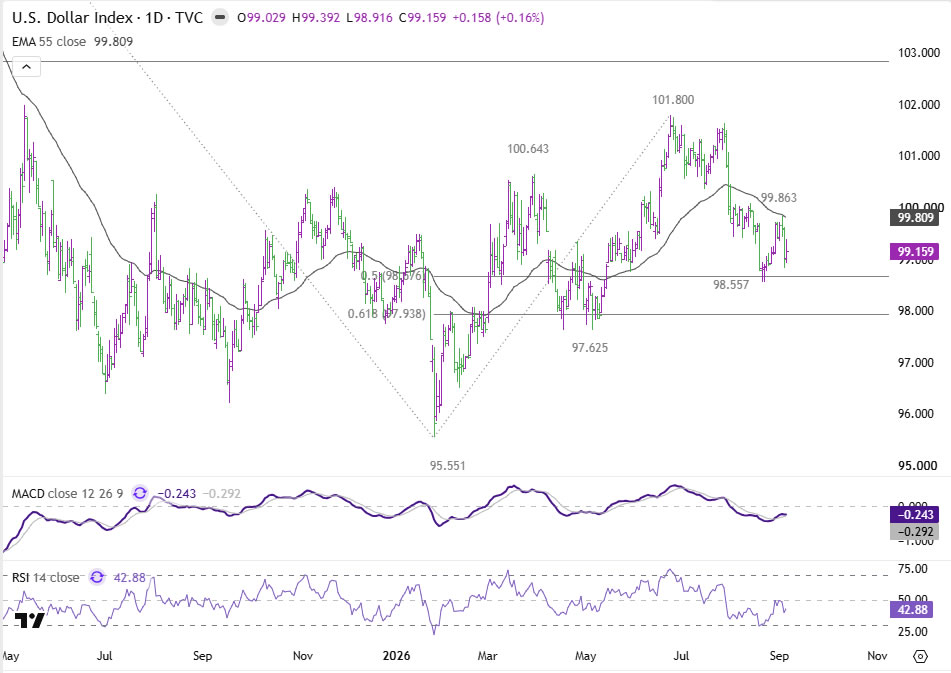
The Dollar Index staged a recovery during the week but failed exactly where technical resistance became important. DXY was rejected around 99.79–99.86, where the 38.2% retracement of the decline from 101.80 to 98.55 at roughly 99.79 converges with the 55-day EMA near 99.80.
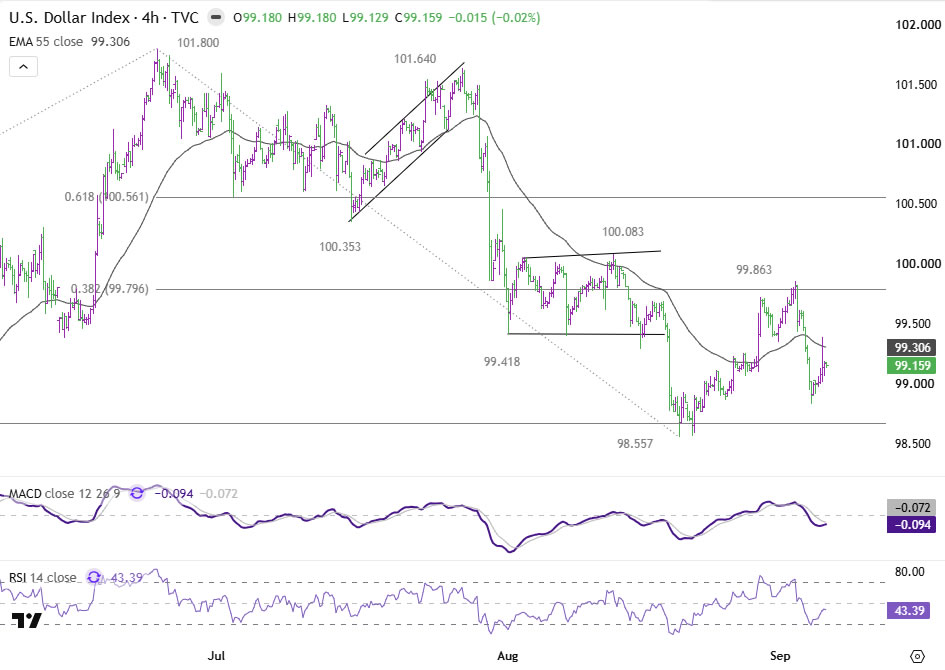
That rejection keeps the decline from 101.80 intact and leaves near-term risk tilted lower. But bears have yet to prove control. Key support remains 98.55. A decisive break there would add to the case that the rebound from 95.55 completed at 101.80 as a three-wave corrective structure, bringing a deeper fall to 97.62 support next, with a sustained break opening the way back toward the 95.55 low.
On the upside, a firm break through 99.86 would instead suggest the fall from 101.80 has completed and would weaken the immediate bearish case.
So DXY ends the week caught between two confirmation points. Below 99.86, the downside structure remains intact. Above 98.55, the breakdown remains incomplete. That’s indecision in its clearest technical form.
US 2-Year Yield: NFP Couldn’t Hold 4.42%
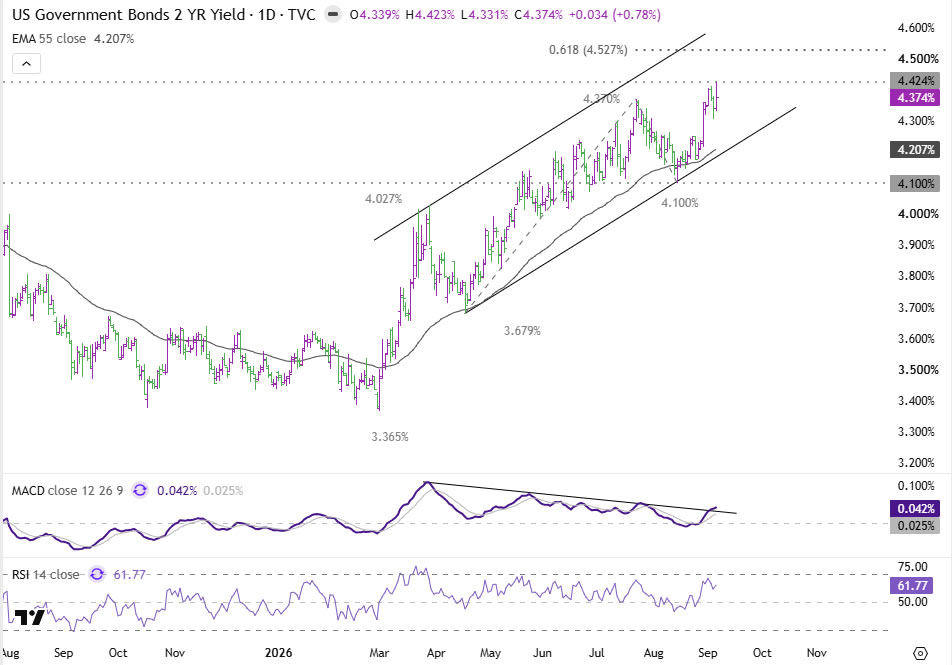
The front end produced perhaps the cleanest failed breakout of all. The 2-year yield rose to 4.423%, effectively testing both the 4.40 psychological barrier and the 2025 high around 4.424%, but retreated to close near 4.37%.
That’s especially important because the 2-year yield is the closest market proxy for near-term Fed expectations. If Friday’s NFP had decisively shifted the policy path, this was where confirmation should have appeared first. Instead, the yield reached resistance and stopped.
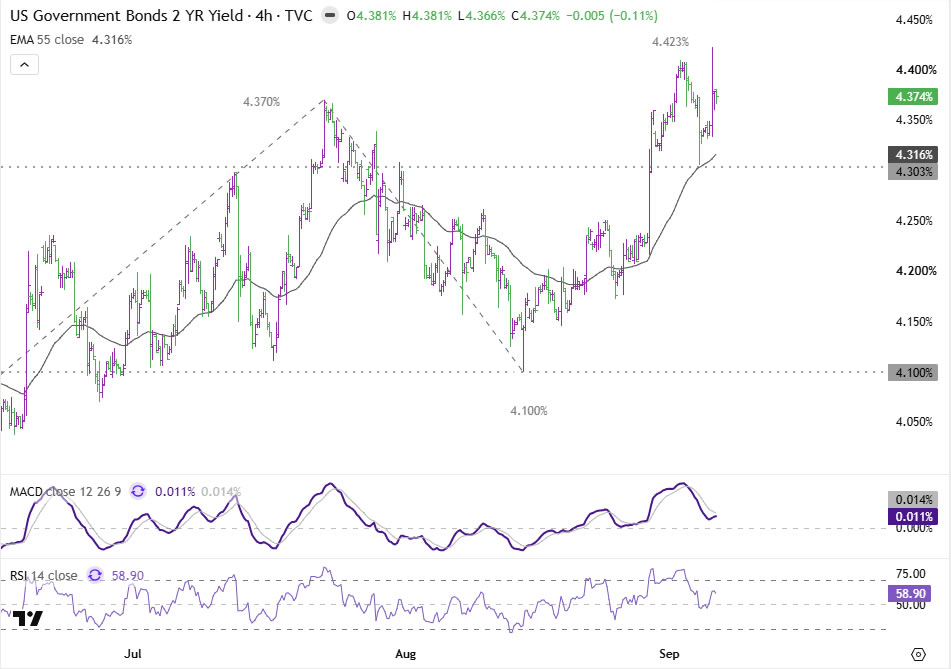
Further rise remains favored while 4.316% support holds. A firm break above 4.423–4.424% would confirm renewed upside momentum and target 4.527%, the 61.8% projection of 3.679% to 4.370% from 4.100%.
But failure at current resistance keeps the broader range intact. A break below 4.316% would suggest the latest upside attempt has failed more materially and could trigger a deeper pullback toward rising channel support, now around 4.19%.
So the front end is leaning hawkish, but still withholding confirmation.
US 10-Year Yield: 4.81% Is the Long-End Breakout Trigger
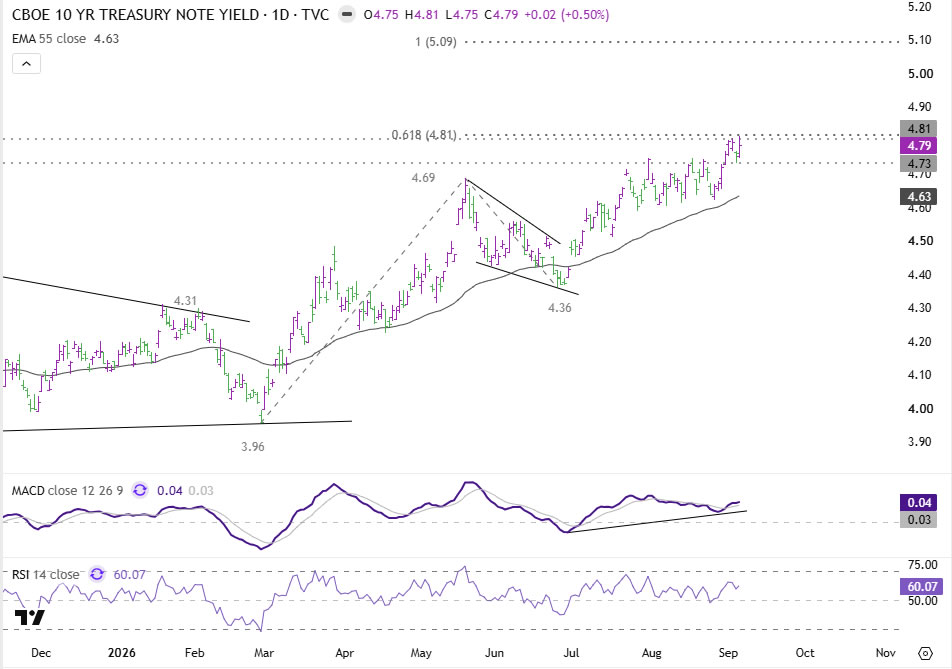
The 10-year yield tells almost an identical story. It advanced to 4.81%, retesting major 2025 resistance, but couldn’t establish itself above that level and finished around 4.79%.
The near-term bias remains higher while 4.73% holds. A decisive break above 4.81% would confirm another leg higher and open the way toward 5.09%, the 100% projection of the rise from 3.96% to 4.69% measured from 4.36%. That would also put the psychological 5.00% area and the 2023 peak back into immediate focus.
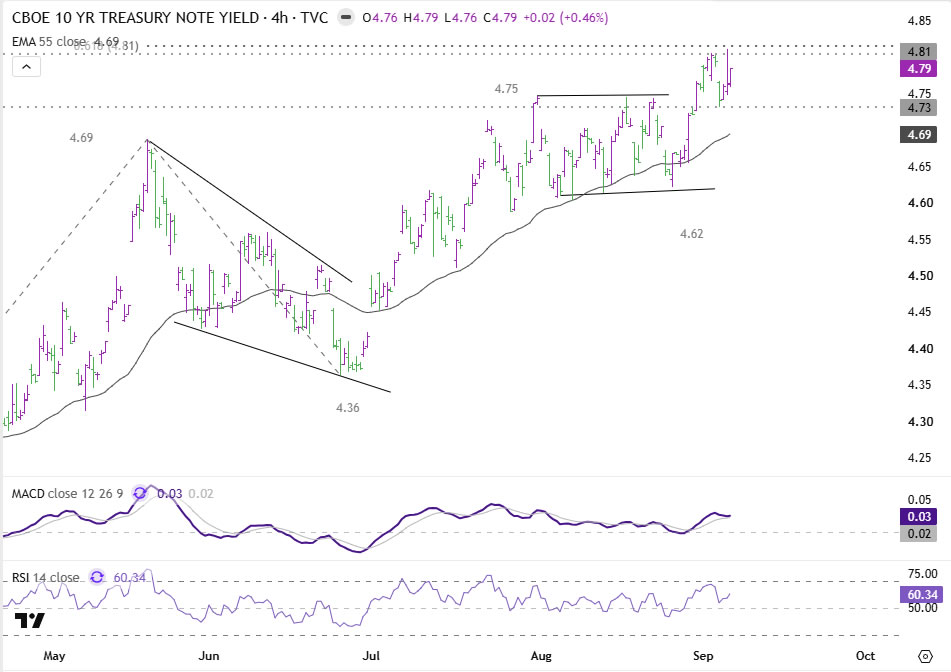
Conversely, a firm break below 4.73% would indicate a loss of upside momentum and bring a deeper decline back to the 55-day EMA around 4.63%.
The significance is broader than chart structure. The 2-year yield failing 4.42% says markets aren’t yet fully committed to a more aggressive Fed path. The 10-year yield failing 4.81% says they’re also not yet committing to a larger repricing of inflation, term premium, and fiscal risk. Both ends of the curve reached levels where a major narrative shift could have been confirmed. Neither confirmed it.
Dow: Supported, but Still Consolidating Below Record High
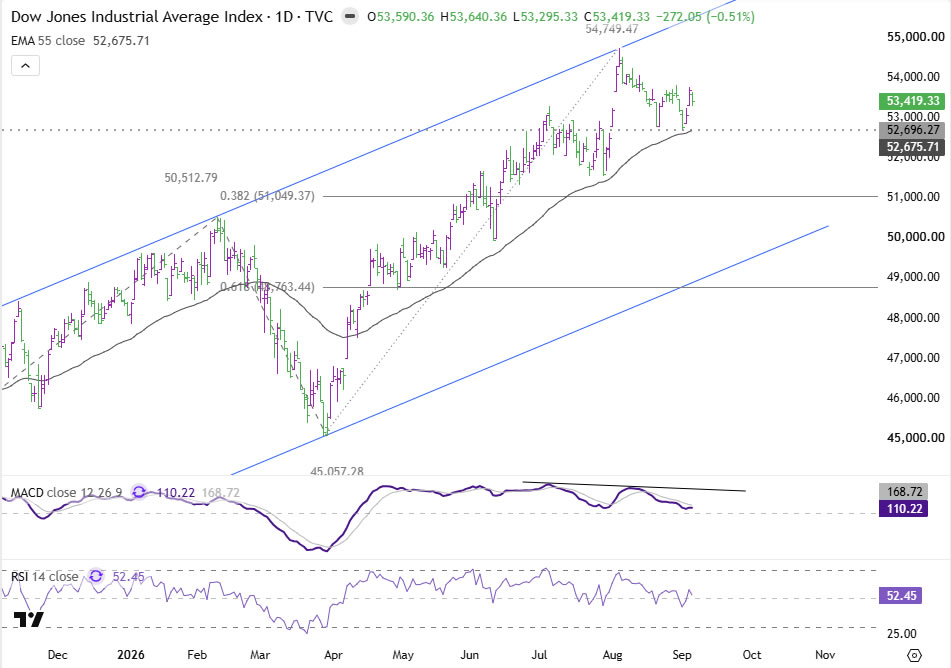
The Dow offered the same message from equities. The index remained within consolidation from the 54,749.47 record high. The near-term structure continues to favor another upside attempt while 52,696.27 support holds, but buyers have yet to force resumption of the larger uptrend.
A firm break above 54,749.47 would confirm uptrend continuation and target the medium-term channel ceiling, currently around 55,475.
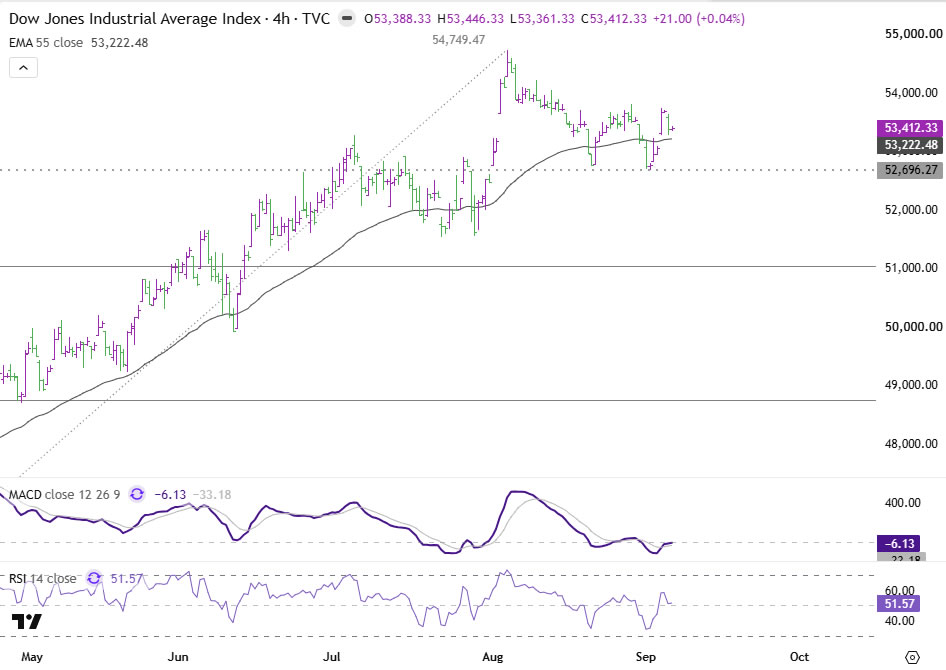
But a loss of 52,696.27 would change the tone more materially and argue that consolidation has developed into a correction of the whole rise from 45,057.28. In that case, 51,049.37, the 38.2% retracement of that advance, would become the next major downside target.
For now, equities are neither endorsing a major hawkish shock nor breaking into fresh risk-on acceleration. That balance is another reason the cross-asset picture feels unusually unresolved.
September 11 CPI: The Data Point That Can Finally Break the Deadlock
If NFP answered the question about the labor market, CPI must now answer the question about policy. This is why the August inflation report is unusually important.
The September Fed decision isn’t primarily about whether the labor market is weak enough to require protection. Friday’s report substantially reduced that concern. Instead, the question is whether inflation has improved enough to justify holding despite stronger employment — or whether recent disinflation is beginning to reverse.
A CPI report showing inflation broadly stable around recent levels may not be enough by itself to force tightening. Waller has already indicated willingness to give disinflation time if the underlying direction remains favorable. A one-month stall is different from renewed acceleration.
For the market to move decisively toward a September hike, it likely needs evidence that the improvement since spring isn’t merely pausing but reversing. That would create a much more powerful combination:
- Labor market stronger than feared.
- Prior payroll weakness revised away.
- Wages still firm.
- Policy only modestly restrictive.
- Inflation moving higher again.
Under that scenario, September hike odds would have room to move materially above the current 59.4% and toward levels associated with a much more settled policy call. Treasury yields would then have a fundamental catalyst for finally clearing technical resistance. The 2-year yield could establish itself above 4.42%. The 10-year yield could break 4.81%. The Dollar could challenge 99.86 again with rate support behind it rather than merely a temporary post-data bounce.
A softer CPI report would do almost the opposite. If August data confirm underlying inflation is still cooling, Waller’s hold argument becomes much stronger even after NFP. The market could conclude the Fed has the luxury of waiting because the labor market is healthy enough to tolerate patience while inflation is moving in the right direction.
In that scenario, September hike probability could fall back toward an even split or below. The 2-year yield would struggle to sustain its current rise. DXY could return toward 98.55. Long-end yields could retreat from 4.81 as markets reduce urgency for immediate tightening.
That’s why CPI is now more than another data release. It’s the missing piece needed to decide which of this week’s competing forces deserves dominance. NFP settled one side of the dual mandate. CPI now has to settle the other.
Key Takeaways
- August NFP (162K vs. 58K consensus) plus 55K in upward revisions to June and July repaired the labor-market scare, removing one of the Fed’s strongest arguments for patience.
- September hike odds rose from 49.4% to 59.4% after NFP, but that only restored the pre-Waller consensus rather than creating a fresh hawkish breakout.
- Waller has explicitly said his September vote hinges more on August CPI than on payrolls, meaning strong jobs raise the bar for holding without clearing the bar for hiking.
- Trump’s escalating pressure for rate cuts, tied to trade threats against surplus countries, creates a political axis running counter to the Fed’s own reaction function.
- The Dollar, 2-year yield, 10-year yield, and Dow all tested key breakout levels this week without confirming a move, leaving September 11’s CPI as the release that could resolve all four at once.