


Key takeaways
- ECB hike largely priced in: Markets widely expect the ECB to raise its deposit rate by 25 basis points to 2.50%. The bigger catalyst for EUR/USD is whether Christine Lagarde signals further tightening.
- Energy inflation has shifted the ECB outlook: Brent crude above US$100 and Eurozone inflation above 3% have revived hawkish policy risks.
- ECB-Fed divergence is critical: A hawkish ECB combined with stable Fed expectations would favour EUR/USD, while indications that the ECB is near its terminal rate alongside rising Fed hike expectations would strengthen the US dollar.
- EUR/USD technical structure remains constructive: The pair has reclaimed its rising 20-day MA and is moving back above the 200-day MA at 1.1623.
EUR/USD is holding close to a two-week high around 1.1640 ahead of today’s European Central Bank (ECB) monetary policy decision, with markets widely expecting a 25-basis-point rate hike as policymakers respond to renewed inflation pressures from surging energy prices.
The expected move would lift the ECB’s deposit facility rate from 2.25% to 2.50%, marking its second rate hike this year after the central bank restarted tightening in June. The hike itself is largely priced in; therefore, the bigger directional catalyst for EUR/USD is likely to come from ECB President Christine Lagarde’s guidance on whether further tightening is required.
Energy shock has changed the ECB rate outlook
The renewed spike in energy prices has become the dominant macro driver behind the ECB’s hawkish shift. Brent crude has moved back above US$100 per barrel, following another escalation in the US-Iran conflict and disruptions to shipping in the Middle East. Eurozone inflation is running above 3%, leaving headline inflation well above the ECB’s 2% medium-term target.
This creates an uncomfortable policy mix for the ECB. Higher oil and gas prices are simultaneously lifting inflation while threatening economic growth, leaving policymakers to decide how aggressively they should respond to what remains largely a supply-driven inflation shock.
At its July meeting, the ECB kept the deposit rate unchanged at 2.25%, while stressing that the full inflationary impact of the energy shock had yet to materialise and that it would monitor indirect and second-round effects closely. That makes today’s communication particularly important: any evidence that higher energy costs are spreading into service prices, wages or inflation expectations would strengthen the case for additional hikes.
Is this the final ECB hike?
That is probably the most important question for EUR/USD.
A Reuters poll published last week showed economists broadly expecting today’s 25-basis-point hike to 2.50%, but with most forecasting that this would be the final increase in the current cycle. Eurozone growth is expected to remain relatively soft, while wage pressures have moderated, reducing the risk of another sustained wage-price spiral.
However, the balance of risks has shifted toward a more hawkish stance as the Middle East conflict has intensified.
Deutsche Bank, for example, now expects another 25-basis-point ECB hike in December, taking the potential terminal deposit rate to 2.75%, arguing that persistent energy-related inflation risks could require tighter monetary policy for longer.
This distinction matters for EUR/USD.
If Lagarde signals that 2.50% may be the peak, the euro could struggle to extend its recent gains, as today’s hike is already heavily discounted.
Conversely, language suggesting that the Governing Council remains prepared to hike again, particularly if energy inflation feeds into underlying prices, would encourage markets to price a higher ECB terminal rate, providing a potential positive catalyst for EUR/USD.
ECB-Fed rate expectations remain the key FX transmission channel
EUR/USD will also trade on the relative rate outlook between the ECB and Federal Reserve, rather than the ECB decision in isolation.
The Fed currently maintains its policy rate at 3.50%-3.75%. A Reuters poll shows around 70% of economists expect the Fed to remain on hold at its 15-16 September meeting, although market pricing has become significantly more hawkish after stronger US economic data and renewed inflation concerns.
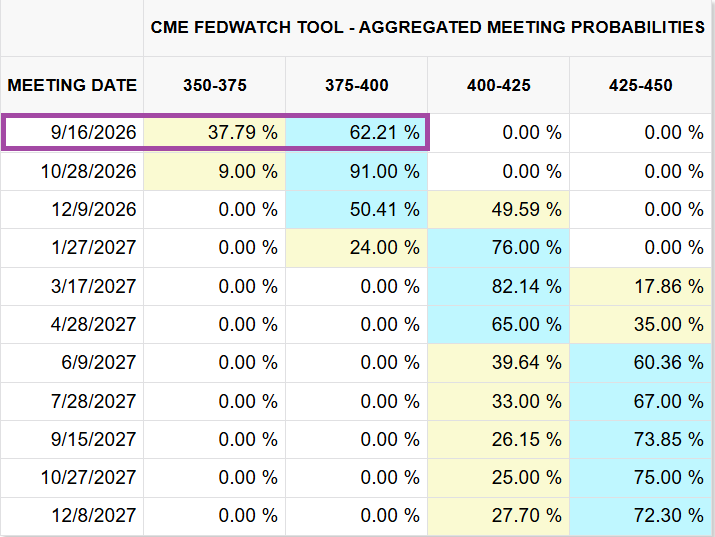
The Fed funds futures market is now assigning roughly a 62% probability of a Fed rate hike this month, with higher energy prices also creating upside risks to US inflation (see Fig. 1).
Fig. 1: CME FedWatch tool aggregated FOMC meeting outcome probabilities as of 10 Sep 2026 (Source: CME website). The information presented is historical information, and past performance is not indicative of future performance.
This sets up an important relative-rates battle for EUR/USD:
A hawkish ECB and unchanged Fed expectations suggest a positive outlook for EUR/USD.
ECB signals tightening is nearly finished, and rising Fed hike expectations suggest EUR/USD is negative.
Further ECB rate hikes priced alongside Fed rate hikes imply that EUR/USD is likely to become more sensitive to economic growth and bond-yield differentials.
Hence, tomorrow’s US CPI release could be almost as important for EUR/USD as today’s ECB meeting, because stronger-than-expected US inflation would reinforce expectations for Fed tightening and potentially widen the US-eurozone yield differential back in favour of the US dollar.
Now, let’s focus on the short-term trajectory (1 to 3 days) of the EUR/USD from a technical analysis perspective.
EUR/USD is trading back above the 200-day MA
Fig. 2: EUR/USD minor trend as of 10 Sep 2026 (Source: TradingView). The information presented is historical information, and past performance is not indicative of future performance.
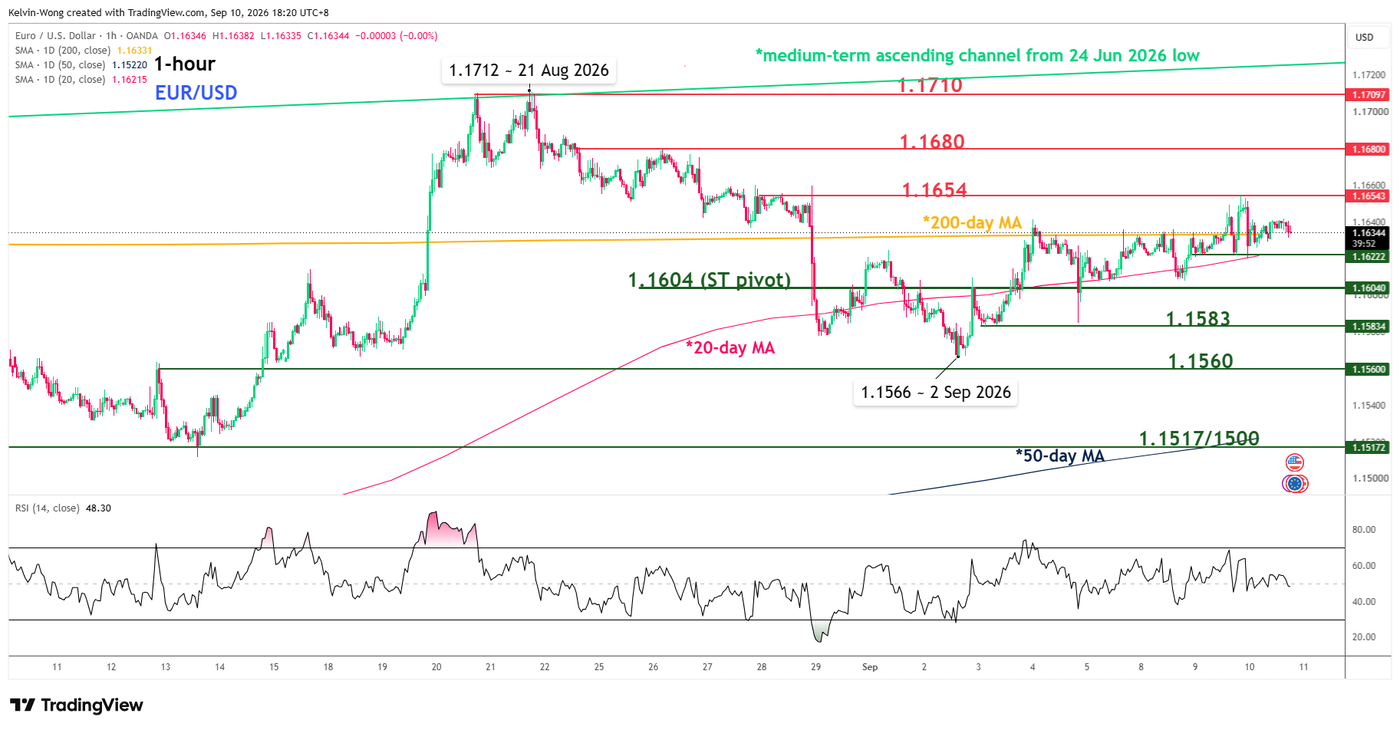
The recent 1.23% minor corrective decline seen in the EUR/USD from the 21 August 2026 high of 1.1712 to the 2 September 2026 low of 1.1566 may have ended.
The price action has traded back above its rising 20-day moving average since Friday, 4 September 2026, ex-post the US non-farm payroll release, and is now inching back above the key 200-day moving average (1.1623) with the current intraday level at 1.1638 at this time of writing (see Fig. 2).
These observations suggest that EUR/USD may be undergoing a new minor bullish impulsive up-move sequence.
Watch the 1.1604 short-term pivotal support to maintain the minor bullish impulsive structure, and a clearance above the 1.1654 near-term resistance targets the next intermediate resistances at 1.1680 and 1.1710 in the first step.
On the other hand, a failure to hold and an hourly close below 1.1604 negate the bullish tone, paving the way for a choppy minor corrective decline that could expose the next intermediate supports at 1.1583 and 1.1560.





 monetary policy decision, with markets widely...)