


TL;DR: The CLARITY Act cloture vote has three possible market outcomes, not two—a clean win, a constructive near miss, or a wide defeat—and Bitcoin and Ethereum don’t need final enactment today, just evidence the legislative process hasn’t stalled.
Three Outcomes, Not Two
The CLARITY Act vote isn’t a simple pass-or-fail event for crypto. A clean cloture victory would open the strongest bullish path, a narrow loss with a credible next step could preserve the catalyst, and a wide defeat would turn attention directly toward the Fed. What matters isn’t only whether cloture reaches 60 votes, but whether the outcome leaves a route back.
Traders aren’t pricing whether the legislation becomes law today. The probability of final enactment during 2026 has already fallen sharply, and success would still leave several difficult legislative stages ahead. The immediate question is whether today’s vote provides enough evidence of progress to keep the story tradeable.
The market has already demonstrated that an intermediate milestone can matter. Bitcoin rose approximately 22% over the five days after Senate Majority Leader John Thune filed cloture in early August and established today’s vote date, despite still trading around 12% lower for the year. The timing doesn’t prove scheduling news alone produced the entire rally, but it shows crypto can respond to signs of legislative momentum before the ultimate outcome is settled.
Three Disputes Stand Between the Bill and 60
The political barriers can be reduced to three issues.
The most charged is an ethics provision affecting US President Donald Trump’s reported $1.4bn in crypto-related income. Democrats have demanded stronger restrictions addressing potential conflicts involving elected officials and their families.
A second dispute concerns how much legal liability decentralized-finance developers should carry for activity conducted through protocols they helped create. The disagreement reaches beyond one company or business model and affects the legal treatment of software developers across the DeFi sector.
The third issue concerns stablecoin yields and rewards. The provision could affect an estimated $1.35bn in annual USDC-related rewards revenue for Coinbase, giving exchanges a direct financial interest in the negotiations.
These disputes combine presidential ethics, developer liability, and material commercial revenue. They also require support from senators whose objections aren’t necessarily solved by the same concession.
The White House Has Moved, but the Votes Have Not
The most important late development came from the White House. In the roughly 10 hours before the vote, the administration agreed to revised ethics language and sent it to Senate Republicans.
A senior administration official described the proposal as the most comprehensive ethics provision produced during the negotiations. A Senate Republican aide said the White House had accepted approximately 80% of Democratic requests on the issue.
US Treasury Secretary Scott Bessent has also been personally calling senators and urging the chamber to advance the legislation following its return from recess.
The concession creates a possible route toward additional support, but no published whip count shows it has secured enough votes. The seven Democratic senators viewed as central to the holdout—Angela Alsobrooks, Cory Booker, Catherine Cortez Masto, Ruben Gallego, John Hickenlooper, Mark Warner, and Raphael Warnock—had not publicly committed in the latest available reporting.
The White House has therefore supplied a potential tailwind, not a confirmed coalition.
The Arithmetic Still Leans Against Passage
The cloture motion requires 60 votes. Republicans hold 53 Senate seats, meaning supporters would need seven Democratic or independent crossovers if every Republican backed the measure.
That’s unlikely to be the actual threshold. Republican Senators Rand Paul and Josh Hawley are among those who could oppose the bill over its stablecoin-yield provisions. Two Republican defections would raise the required number of crossovers to nine; three would raise it to ten.
Only two Democrats supported the legislation during the committee process in May. The committee and Senate floor coalitions aren’t directly comparable, but the earlier result illustrates how much additional support may still be required.
No confirmed public whip count currently establishes a route to 60. The structural evidence therefore suggests failure is at least as plausible as passage. The White House concession is significant because it could move undecided senators, but its effect won’t be known until they vote.
What Each Outcome Would Mean for Crypto
A clean cloture victory would provide the strongest bullish catalyst. It would demonstrate that Senate leaders had assembled a supermajority despite objections from both parties and would move the bill into its next legislative stage. Final enactment would still be distant, but the political process would have a visible pulse.
A constructive near miss requires more than a close number. Cloture could fail while still preserving the catalyst if several holdouts switch to yes and Senate leaders immediately identify a limited remaining disagreement, further negotiations, or a timetable for reconsideration. A result close to 60 with an announced path to another vote would show the coalition is expanding. A close loss without any stated next step would be less constructive—the market needs evidence of a repeatable path to 60, not simply a respectable margin.
A wide failure, especially if most of the central Democratic holdout remains opposed, would be the clearest bearish result. It would indicate the White House concession failed to alter the coalition and would probably end the bill’s realistic 2026 path. Crypto attention would then move quickly to Wednesday’s Fed decision.
This is why the vote has three market outcomes rather than two. The most important information may be the combination of the final count, which senators cross over, and what Senate leaders say immediately afterward.
Today Is About Survival, Not Enactment
Even a successful cloture vote would leave the CLARITY Act well short of becoming law.
Galaxy Digital’s tracked estimate for enactment during 2026 has fallen from approximately 75% in May to around 10%. Prediction-market probabilities have moved in the same direction, dropping from 82% in February into the low-20s ahead of today’s vote.
After advancing in the Senate, the bill would still require a final floor vote. The Senate and House would then have to reconcile their respective versions, particularly if senators adopt amendments. Both chambers would need to approve the resulting legislation before it could reach the President.
The congressional calendar creates another obstacle. The House is scheduled to leave Washington two days after today’s vote. If the Senate changes the bill, the House would be unable to consider that version before departing, making a post-election lame-duck session the more realistic window for final action.
Those longer odds don’t make today irrelevant. They change what traders should demand from the vote. Crypto doesn’t need proof that enactment is imminent; it needs evidence the process hasn’t stalled.
ActionForex’s Technical View on Bitcoin: Recovery Is Still Corrective
Bitcoin is trading around 77,900 following its rebound from 57,736. On the daily chart, that recovery should still be treated as a corrective move within the decline from the 126,230 record high.
The four-hour structure has become more constructive. RSI has recovered to approximately 52, while MACD has turned marginally positive. Bitcoin is also testing the 55-period EMA around 77,944 and pressing against the upper boundary of its short-term falling channel.
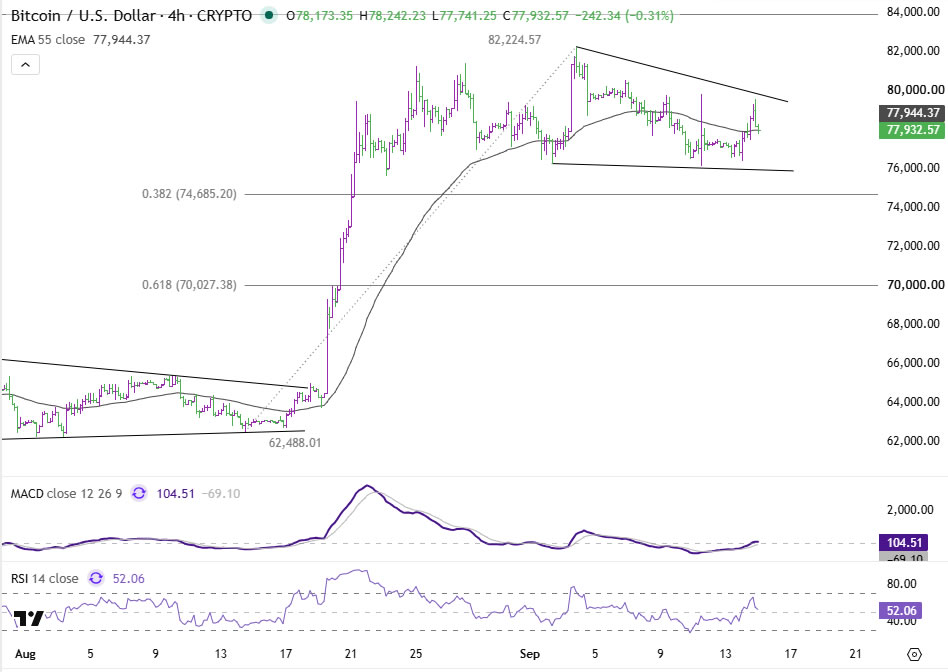
The immediate resistance area extends from approximately 79,500 to 80,560. A break above that zone would open the recent high around 82,225 and medium-term resistance at 82,823.
A bullish trend reversal would require a decisive break through the 82,823–83,901 resistance zone. The upper boundary represents the 38.2% retracement of the decline from 126,230 to 57,736.
Clearing that zone would open the next major area around 97,856–100,066, incorporating horizontal resistance, the $100,000 psychological level, and the 61.8% retracement at 100,066.
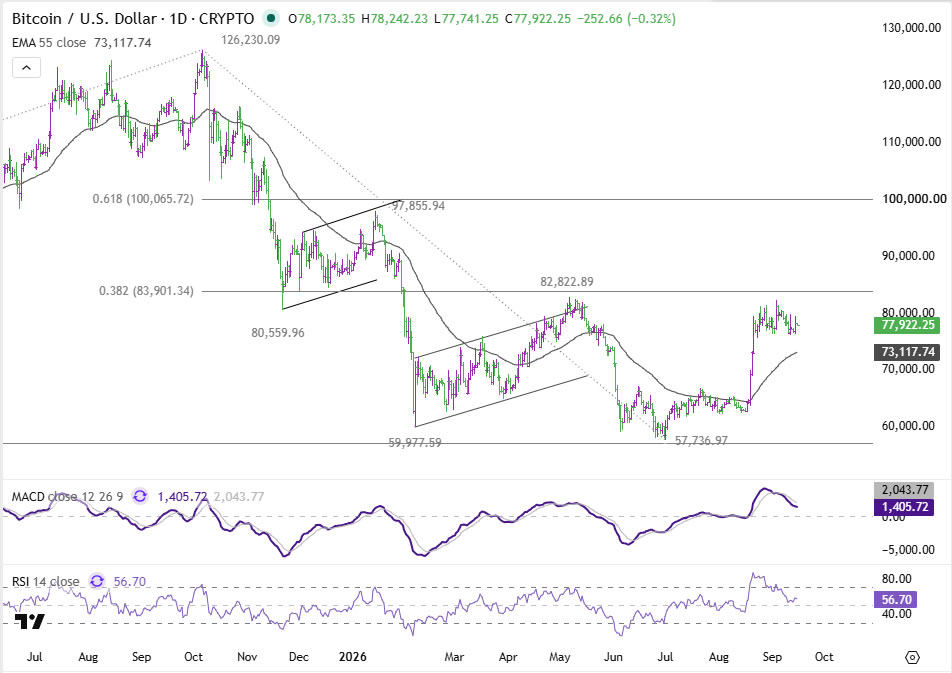
Daily momentum hasn’t yet confirmed such a reversal. Daily MACD remains positive but is losing strength, while RSI around 56.7 is neutral. Bitcoin is therefore positioned for an event-driven break without yet establishing a durable bullish trend.
A firm break below the 55-day EMA around 73,118 would suggest the rebound from 57,736 has completed. Support around 70,027 would then come into focus before a potential retest of 57,736.
ActionForex’s Technical View on Ethereum: Holds the Stronger Setup
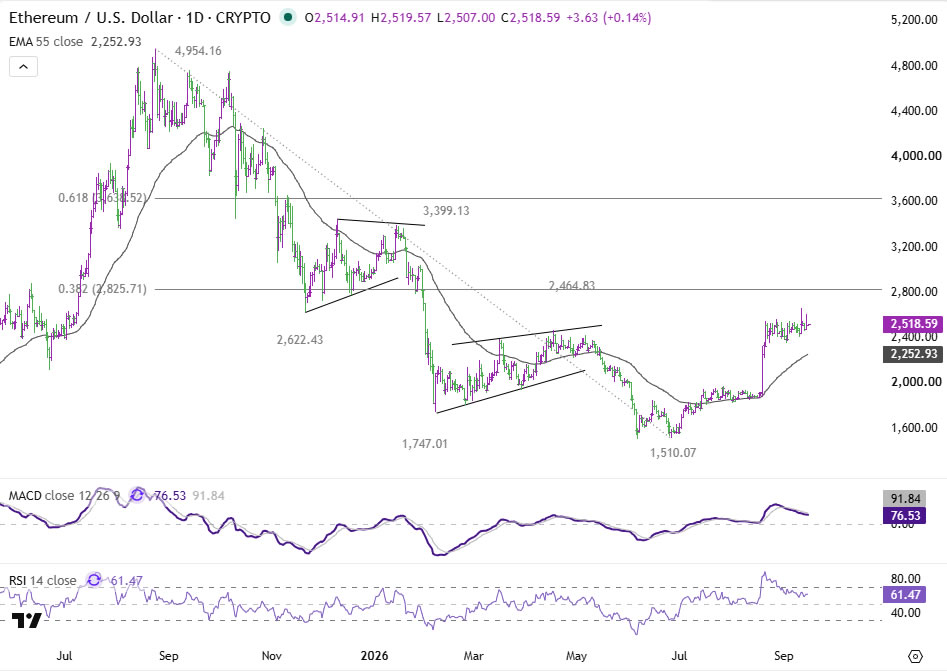
Ethereum’s technical structure is more constructive. The rebound from 1,510.07 has already broken above 2,464.83 resistance, and price remains above the 55-day EMA around 2,253.
The next test is the 2,622–2,662 resistance zone. Ethereum has traded intraday above the lower boundary, but it hasn’t sustained the move. A firm break would open the 38.2% retracement of the decline from 4,954.16 to 1,510.07, at 2,825.71.
A decisive break above 2,825.71 would strengthen the case that the decline from 4,954.16 has completed. The next barriers would be 3,399.13 and the 61.8% retracement at 3,638.52.
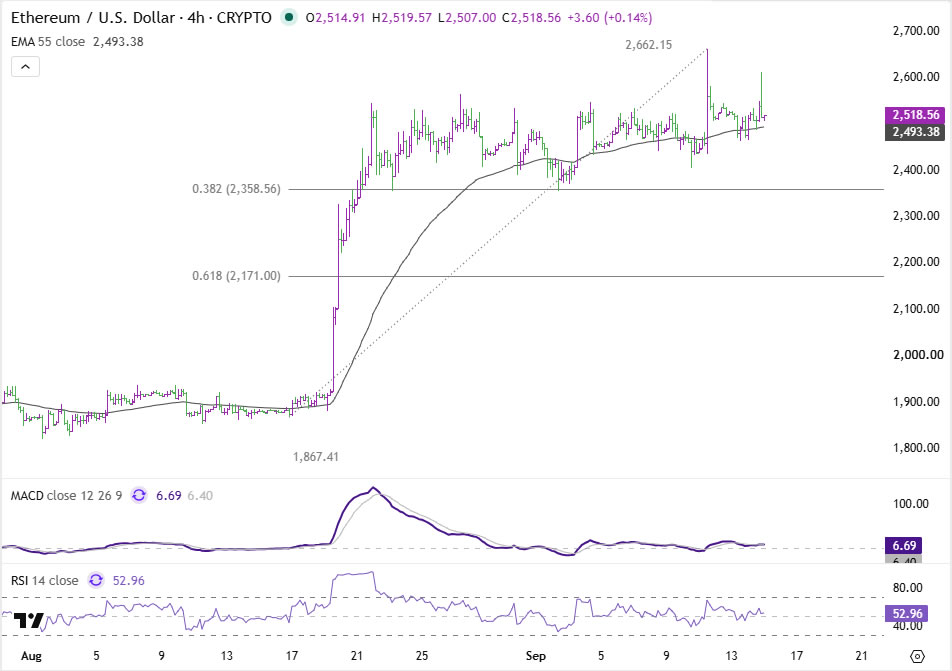
The four-hour structure is stable rather than strongly impulsive. RSI is near 53 and MACD is only marginally above its signal line, leaving room for the political catalyst to determine the next move.
Initial downside support stands at 2,358.56. Below that, a firm break of the 55-day EMA around 2,253 would weaken the recovery and expose 2,171. A deeper reversal would bring the 1,510.07 low back into focus.
Ethereum has therefore cleared its first important daily barrier, while Bitcoin is still below its corresponding resistance zone. That gives Ethereum a modest technical advantage heading into the vote.
The Vote Must Supply the Missing Momentum
A successful cloture vote would give Bitcoin a stronger chance of clearing 79,500–80,560 and challenging 82,823–83,901. Ethereum could sustain a break through 2,622–2,662 and turn toward 2,825.71.
A narrow failure could produce a similar reaction only if it demonstrates support is expanding and another attempt is credible. Without a public path forward, any relief rally would be vulnerable to reversal.
A wide failure would leave Bitcoin’s short-term falling channel intact and place greater pressure on its 55-day EMA at 73,118. Ethereum would risk falling through 2,358 toward its own 55-day EMA around 2,253.
A possible rotation from AI-related equities into crypto should remain only a secondary factor to watch. Bitcoin and Ethereum were modestly lower during Monday’s technology selloff, providing no evidence yet that such a rotation is underway.
Crypto Needs Evidence of Life
The CLARITY Act doesn’t need to become law today for Bitcoin and Ethereum to respond. But the market needs more than a narrow numerical defeat dressed up as progress.
A clean victory would establish that the bill can command a Senate supermajority. A near miss could preserve the catalyst if it reveals new crossover support and an immediate route back. A wide failure would remove the legislative story and leave Wednesday’s Fed decision as the dominant event.
Crypto is pricing the bill’s pulse, not its final passage. Today’s vote will show whether that pulse is strengthening, merely detectable, or gone.
Key Takeaways
- The CLARITY Act cloture vote needs 60 Senate votes, and no public whip count currently shows a confirmed path there despite a late White House ethics concession.
- Three disputes remain unresolved: presidential ethics tied to Trump’s crypto income, DeFi developer liability, and stablecoin-yield provisions affecting an estimated $1.35bn in Coinbase revenue.
- Even a successful cloture vote leaves final enactment unlikely in 2026, with Galaxy Digital’s tracked probability falling from 75% in May to around 10% now.
- Ethereum holds a technical edge over Bitcoin, having already cleared its 2,464.83 resistance while Bitcoin remains below its 79,500-80,560 zone.
- A wide vote failure would shift crypto’s attention to Wednesday’s Fed decision and place renewed pressure on Bitcoin’s 73,118 and Ethereum’s 2,253 support levels.





