TL;DR: Gold is stalling just below 4,400 even as oil retreats and the Dollar’s post-FOMC rally loses steam, leaving India’s distorted physical demand as a plausible but unconfirmed partial explanation for the muted rebound.
Two Headwinds Ease, but Gold Still Can’t Clear 4,400
Gold’s rebound from 4,234.68 has stalled just below the psychological 4,400 level, even as two forces that have weighed heavily on the metal since the Iran conflict began are becoming less hostile. Gold is trading around 4,354, leaving the market with an increasingly important question: if oil-driven inflation pressure is easing and the Dollar’s post-FOMC rally is losing momentum, why hasn’t the recovery accelerated?
The answer starts with the unusual regime Gold has traded under during the conflict. Rather than behaving primarily as an inflation hedge, the metal has repeatedly been pressured by the policy consequences of higher inflation expectations. Rising oil prices intensified inflation concerns, encouraged more hawkish central-bank repricing, and lifted rate expectations, creating a headwind for a non-yielding asset. Geopolitical escalation therefore often hurt Gold through the rates channel rather than supporting it directly.
That mechanism should now be providing some relief. Brent has retreated to around 101.65 from 109.97, reducing the marginal inflation impulse just as crude approaches the important 100 support zone. Meanwhile, the Dollar’s post-FOMC advance has lost momentum and needs a fresh catalyst. Neither development guarantees higher Gold, but both remove pressures that previously worked against it. Yet Gold has still failed to regain 4,400 decisively.
Is India Part of the Missing Demand?
One possible explanation lies in India, where a major policy shock has continued to distort physical demand. The government doubled the import duty on gold and silver from 6% to 15% on May 13, part of an effort to defend the rupee and foreign-exchange reserves during the Iran conflict. The World Gold Council subsequently estimated the measure could reduce India’s full-year 2026 gold demand by 50–60 tonnes, or roughly 10% yoy.
The timing matters because the market is approaching the usual pre-festival restocking period. Yet jewellers have reportedly been relying heavily on recycled gold obtained through exchanges rather than rebuilding fresh inventories ahead of Dussehra and Diwali. If that pattern persists, it could help explain why a more supportive macro backdrop hasn’t translated into a stronger spot-price response.
But the evidence doesn’t justify making India the full answer. Domestic Gold discounts have actually been narrowing, from around $75/oz in the week around September 11 to roughly $60/oz in the week around September 18. That points to gradual normalization after the May duty shock rather than a deepening deterioration in demand.
This distinction is important. If India were becoming an increasingly severe drag on global Gold, a renewed widening in the discount would provide much stronger confirmation. For now, India is best treated as a plausible partial explanation for the muted rebound rather than the factor that definitively resolves the puzzle.
ActionForex’s Technical View on Gold: Only a Slight Bullish Lean
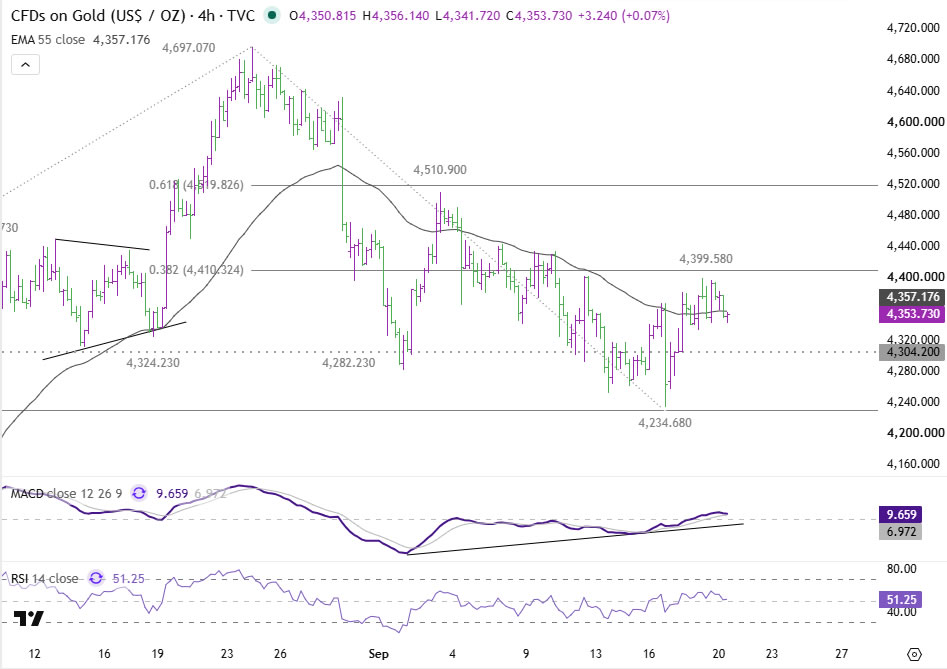
The technical setup reflects the same uncertainty. Gold is trading close to its 4-hour 55 EMA around 4,357, while RSI at 51.25 is effectively neutral. MACD provides a somewhat more constructive signal: its roughly three-week rising trendline has survived the recent sideways consolidation, giving momentum a slight upward bias without yet producing a decisive breakout.
That leaves 4,304.20 as the key near-term support. Another rise remains favored while that level holds, but Gold needs to clear 4,410.32, the 38.2% retracement of the decline from 4,697.07 to 4,234.68, to strengthen the case that the correction from 4,697.07 has completed.
A decisive break would open the way toward a stronger resistance confluence around 4,511–4,520. The zone combines structural resistance at 4,510.90 with the 61.8% retracement at 4,519.82. Clearing it would provide substantially stronger evidence that Gold has moved beyond stabilization and into a more durable recovery.
The downside is also clearly defined. A break below 4,304.20 would revive near-term bearish pressure and expose 4,234.68 again. A subsequent break of that low would indicate the decline from 4,697.07 is extending rather than forming a base.
Three Tests Could Break the Stalemate
The fundamental puzzle now has several identifiable ways to resolve. The first is Brent around 100–100.26. A decisive breakdown would further weaken the energy-inflation channel that has been pressuring Gold through hawkish rate expectations. A strong rebound would restore part of that headwind.
The second is the Dollar. This week’s flash PMIs, extensive Fed speaking schedule, and Trump-Xi summit could provide the catalyst missing from the post-FOMC consolidation. A renewed Dollar breakout would challenge Gold again; a more decisive Dollar reversal would make Gold’s continued inability to regain 4,400 increasingly difficult to explain through macro forces alone.
The third is India. The next few weekly discount readings should show whether the normal pre-Dussehra and Diwali restocking cycle finally emerges. A further narrowing in discounts would weaken the argument that Indian demand is suppressing Gold. A renewed widening, particularly alongside continued reluctance by jewellers to restock, would make the India hypothesis considerably more persuasive.
For now, Gold is caught between easing macro headwinds and incomplete physical-demand confirmation. The chart reflects that uncertainty almost perfectly: mildly constructive above 4,304.20, but still lacking the decisive 4,410.32 breakout needed to prove the rebound has moved beyond another pause within the broader correction.
Key Takeaways
- Gold is stalling near 4,354, just below the 4,400 psychological level, even as Brent’s retreat from 109.97 and a fading Dollar rally both remove prior headwinds.
- India’s May 2026 gold import duty hike (6% to 15%) could cut full-year demand by an estimated 50-60 tonnes, but narrowing discounts ($75 to $60/oz) suggest gradual normalization, not a worsening drag.
- The technical picture is only mildly constructive: RSI near neutral at 51.25, with 4,304.20 as key support and 4,410.32 as the level needed to confirm the correction from 4,697.07 has completed.
- Three separate tests could resolve the stalemate: Brent’s reaction at 100-100.26, the Dollar’s response to this week’s flash PMIs, Fed speeches, and the Trump-Xi summit, and India’s upcoming pre-Diwali discount readings.
- A break above 4,410.32 opens the 4,511-4,520 resistance zone; a break below 4,304.20 would revive bearish pressure and expose the 4,234.68 low again.