


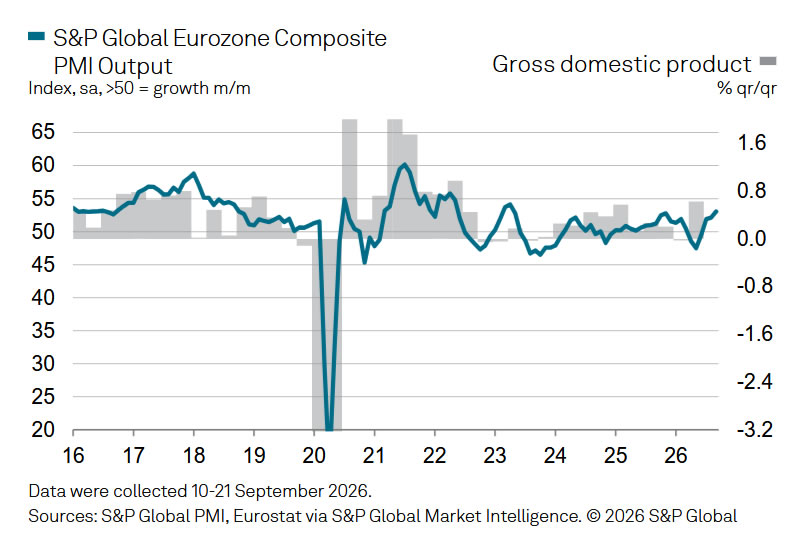
Eurozone business activity strengthened markedly in September, with the Flash Composite PMI rising from 52.0 to 53.1, its highest level in 41 months. Growth was broad-based across sectors: the Services PMI climbed to 53.0 from 51.6, a 10-month high, while the Manufacturing Output Index edged up to 53.4 from 53.3, its strongest reading in 55 months. The headline Manufacturing PMI held at 52.7. Demand also improved, with overall new orders expanding at the fastest pace since May 2022 and export orders rising for a second consecutive month after 53 straight months of decline.
The improvement also broadened geographically. Germany’s Composite PMI jumped to 53.8 from 51.8, an 11-month high, as services returned to expansion at 52.9 from 49.7. Manufacturing remained firmly in growth territory despite some moderation, with the headline PMI easing to 53.8 from 54.3 and the Output Index slipping to 55.9 from 56.6. France also returned to expansion for the first time in 10 months, with its Composite PMI surging to 51.2 from 48.5. The rebound was driven mainly by services, which rose to 51.4 from 48.0, while the Manufacturing PMI eased to 50.3 from 51.1. S&P Global said Germany recorded its fastest growth in just under a year, while France moved back into expansion after nine months of contraction.
The stronger growth picture was accompanied by renewed inflation pressure. Both input costs and output prices rose at their fastest rates in four months, with acceleration seen across manufacturing and services as well as Germany, France and the rest of the Eurozone. S&P Global linked part of the increase to higher energy prices stemming from the Middle East conflict. Chief Business Economist Chris Williamson said the survey was consistent with quarterly GDP growth of around 0.4%, while stronger order books pointed to sustained momentum into Q4. He added that the combination of resilient growth and rising prices could strengthen the case for another ECB rate hike, putting October back into consideration.
Data Summary
Eurozone:
| Indicator | September | August | Trend |
|---|---|---|---|
| Composite PMI | 53.1 | 52.0 | 41-month high |
| Services PMI | 53.0 | 51.6 | 10-month high |
| Manufacturing Output Index | 53.4 | 53.3 | 55-month high |
| Manufacturing PMI | 52.7 | 52.7 | Growth unchanged |
Eurozone private-sector activity expanded for a third consecutive month, with output growth reaching its strongest pace since April 2023.
Germany and France
| Indicator | September | August | Trend |
|---|---|---|---|
| Germany: | |||
| Composite PMI | 53.8 | 51.8 | 11-month high |
| Services PMI | 52.9 | 49.7 | 7-month high; returned to expansion |
| Manufacturing Output Index | 55.9 | 56.6 | Growth eased |
| Manufacturing PMI | 53.8 | 54.3 | Growth eased |
| France: | |||
| Composite PMI | 51.2 | 48.5 | 25-month high; returned to expansion |
| Services PMI | 51.4 | 48.0 | 10-month high; returned to expansion |
| Manufacturing Output Index | 50.2 | 50.7 | Growth eased |
| Manufacturing PMI | 50.3 | 51.1 | Growth eased |
S&P Global said Germany posted its fastest overall expansion in just under a year, while France returned to growth for the first time in 10 months.
Key Takeaways
- Eurozone Composite PMI jumped from 52.0 to 53.1, marking the strongest expansion in 41 months.
- Growth broadened across both major sectors, with services at a 10-month high and manufacturing output at a 55-month high.
- Demand strengthened alongside activity, with new-order growth reaching its fastest pace since May 2022 and export orders rising for a second month.
- Germany accelerated, helped by services returning to expansion, while manufacturing remained strong despite moderating from August.
- France returned to expansion, led primarily by a sharp services rebound, although manufacturing momentum softened.
- Inflation pressures strengthened at the same time, with input costs and output prices rising at their fastest rates in four months.
- S&P Global estimated the survey was consistent with around 0.4% q/q GDP growth, while arguing that resilient activity and rising inflation could put an October ECB hike back into consideration.





