


TL;DR: With an SNB hold at 0% close to fully priced, EUR/CHF and GBP/CHF are already rolling over on a different mechanism—falling oil is easing inflation pressure elsewhere, reducing the need for other central banks to widen their rate advantage over Switzerland and relieving carry pressure on the Franc.
EUR/CHF and GBP/CHF Are Turning Before the SNB Moves
EUR/CHF and GBP/CHF are both rolling over just as the SNB prepares to leave rates at 0% on Thursday. The synchronized reversal suggests the bigger story isn’t tomorrow’s decision, but a broader recovery in the Franc already under way. With a hold close to fully priced, the SNB meeting itself looks unlikely to generate a major repricing in CHF. Yet the Franc is already the second-strongest major currency of the week, behind only the Dollar.
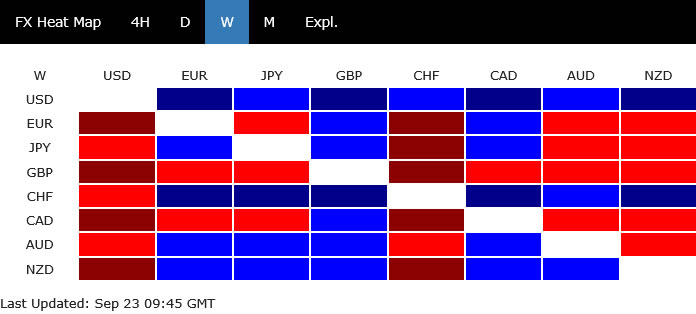
That points to a different near-term mechanism. Falling oil prices are easing inflation pressure across other major economies, reducing the need for central banks elsewhere to keep widening their rate advantage over Switzerland. With the SNB pinned at 0%, that matters: less pressure for further tightening abroad means less additional carry pressure against CHF. The weekly FX heat map is consistent with that thesis, with the Franc strong against EUR, JPY, GBP, CAD, AUD, and NZD, and weaker only against USD.
The distinction is important. The Dollar and Franc are both strong this week, but for different reasons. USD strength reflects a more hawkish Fed repricing, while CHF strength appears more consistent with a relief in rate-differential pressure as oil retreats. That relationship should still be treated as a working market thesis rather than a statistically established correlation, but the current cross-currency flows fit the mechanism well.
SNB Hold Looks Close to a Formality
The policy backdrop gives the SNB little reason to change course. A Swiss Bankers Association survey released in August showed all respondents expecting the policy rate to remain at 0% through the rest of 2026, while 60% expected no change through 2027. ING also expects a hold tomorrow and rates to remain unchanged over coming quarters.
Growth has been firmer than expected, but not uniformly so. ING raised its 2026 growth forecast to 1.9%, supported by a strong 1.5% q/q second-quarter GDP expansion on a sports-event-adjusted basis. But nearly half of that increase came from the volatile chemicals and pharmaceutical sector together with a sharp rise in exports, and ING expects growth to slow in the second half. The message is therefore one of resilience rather than overheating.
Inflation similarly argues against urgency. Headline CPI accelerated from 0.4% to 0.8% y/y in August, but the increase was driven overwhelmingly by petroleum prices, which rose 25.2% y/y. Excluding energy, inflation was just 0.3%, leaving underlying price pressure very weak and comfortably within the SNB’s 0–2% target range.
That means tomorrow’s main policy signal may come through the conditional inflation forecast rather than the policy rate itself. The SNB could nudge its near-term projection higher to reflect energy prices and the weaker Franc, but the draft doesn’t point to a meaningful medium-term reassessment. The June path stood at 0.6% for 2026, 0.6% for 2027, and 0.7% for 2028.
Intervention Risk Remains Asymmetric
The SNB’s intervention framework also remains important, even if it’s unlikely to dominate tomorrow’s meeting. The Bank retains the option of buying foreign currency if the Franc appreciates rapidly and excessively, particularly during a renewed safe-haven episode.
There’s little immediate urgency, however. The Franc had weakened moderately against the Euro before this week’s rebound, while domestic inflation remains contained. That reduces the pressure for the SNB to lean aggressively against current moves.
The structural reason the currency still matters is Switzerland’s sensitivity to imported prices. Imported goods account for around 22% of Swiss CPI, so a sharp Franc appreciation can exert meaningful disinflationary pressure. But the current move isn’t yet of the scale that would automatically force a response.
ActionForex’s Technical View: EUR/CHF Tests Whether the Franc Rebound Has More Room
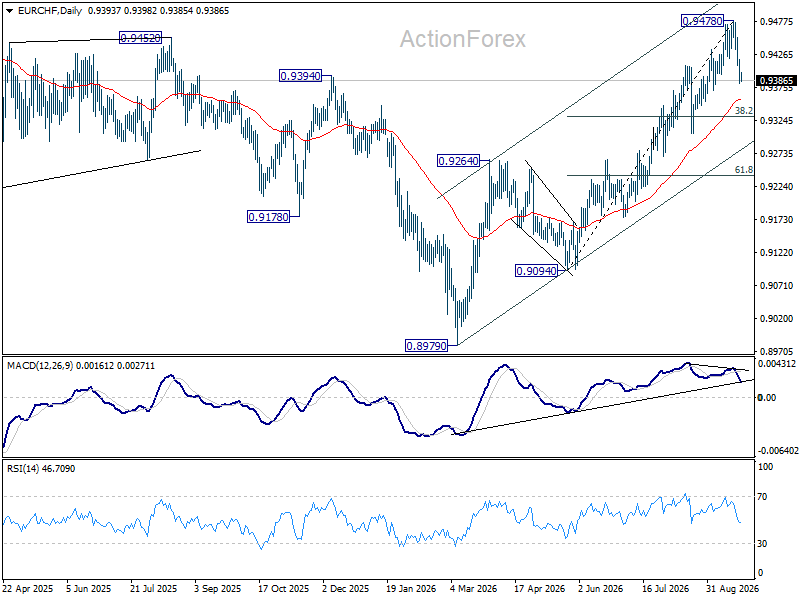
EUR/CHF appears to have formed a short-term top at 0.9478 after failing near the upper boundary of its medium-term rising channel. The reversal has also been accompanied by bearish daily MACD divergence, suggesting upside momentum was already fading before the latest decline.
The next test is the 55-day EMA around 0.9356. A firm break below that level would deepen the correction toward the 38.2% retracement of 0.9094–0.9478 at 0.9331.
That zone should be watched carefully. It could provide support for a rebound and preserve the broader rise. But a sustained move through it would suggest the CHF recovery is developing into something more than a short-term correction.
ActionForex’s Technical View: GBP/CHF Is Showing the Same Pattern
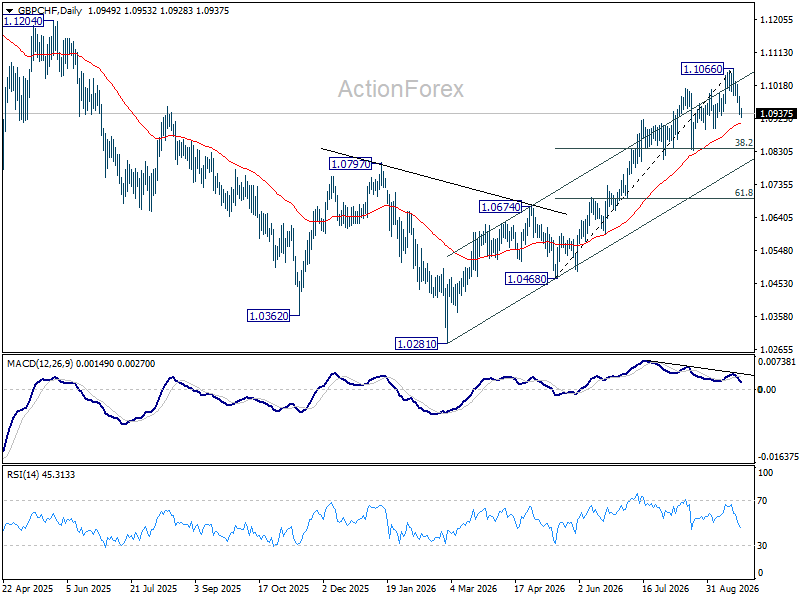
GBP/CHF is sending a similar signal. A short-term top likely formed at 1.1066 after the pair failed to sustain its move above the medium-term rising channel, again with bearish daily MACD divergence.
The immediate downside focus is the 55-day EMA near 1.0909. A sustained break would expose the 38.2% retracement of 1.0468–1.1066 at 1.0838, which should act as the next major support and potential rebound zone.
The similarity between the two crosses matters. EUR/CHF and GBP/CHF aren’t merely falling independently. Both are correcting after extended advances and both are showing deteriorating momentum. That makes a broader CHF-driven move more credible.
Thursday May Be Quiet for the SNB, but Not for FX
The SNB may do very little tomorrow because it doesn’t need to. Growth is holding up, underlying inflation remains subdued, and a 0% policy rate is already deeply embedded in expectations.
But the Franc doesn’t need the SNB to move in order to strengthen.
For now, the more important driver appears to be the changing external rate backdrop. If oil continues to fall and inflation pressure elsewhere eases, the need for further policy divergence against Switzerland diminishes. That can continue to relieve carry pressure on CHF.
The technical confirmation lies in EUR/CHF around 0.9356/0.9331 and GBP/CHF around 1.0909/1.0838. A break through those zones would give the Franc rebound more weight. A reversal in oil or renewed geopolitical escalation would challenge the underlying mechanism.
With the SNB decision and Trump-Xi summit landing in the same Thursday session, FX volatility may ultimately come from outside Zurich even if the Swiss central bank itself delivers exactly what markets expect.
Key Takeaways
- The SNB hold at 0% is close to a formality, with underlying inflation at just 0.3% ex-energy and growth described as resilient rather than overheating.
- CHF is already the second-strongest major currency this week, strong against every G10 peer except USD, pointing to a mechanism unrelated to tomorrow’s meeting.
- Falling oil is easing inflation pressure elsewhere, reducing the need for other central banks to widen their rate advantage over Switzerland’s pinned 0% rate.
- Both EUR/CHF and GBP/CHF have formed short-term tops with bearish MACD divergence, a synchronized pattern that strengthens the case for a genuine CHF-driven move rather than two unrelated currency stories.
- EUR/CHF’s 0.9356/0.9331 and GBP/CHF’s 1.0909/1.0838 are the key confirmation zones; breaking both would give the Franc rebound substantially more weight.





