


What’s happening: Brent broke below $100 after Saudi Arabia restarted its East-West Pipeline, capable of rerouting up to 4 million barrels per day, roughly 4% of global supply, around the Strait of Hormuz, and a senior Iranian official told Reuters Tehran could reopen Hormuz within seven days if Washington eases military pressure. Yet FX didn’t confirm the move uniformly: CAD isn’t broadly underperforming despite the drop, AUD and NZD diverged sharply from each other with no oil or data catalyst, and Dollar stayed broadly firm on the day’s heat map even as oil fell.
Why it matters: This isn’t a demand-driven oil collapse, which would typically produce a clean risk-off, petrocurrency-weakening pattern. It’s a supply-and-diplomacy-driven decline, positive for the inflation outlook and global activity rather than an obvious growth scare, and FX is treating it as a story with its own narrower channel rather than translating it into a uniform cross-market trade. Oil has broken the script technically. FX hasn’t decided whether it believes the same story.
Oil Gives the Clearest Signal, FX the Messiest
Oil delivered one of the clearest macro moves of the day. FX delivered one of the messiest. Brent broke below $100 on improving Gulf supply prospects, yet the usual petrocurrency and risk patterns failed to appear cleanly. The divergence matters because Tuesday’s oil decline is fundamentally different from a demand-driven collapse: supply conditions are improving at the margin while diplomacy is creating a possible route toward reopening Hormuz. That is positive for the inflation outlook and global activity rather than an obvious growth scare.
Two developments drove the oil move. Saudi Arabia restarted its East-West Pipeline, which can reroute around 4m barrels per day, roughly 4% of global supply, away from Hormuz and toward the Red Sea port of Yanbu. Operations initially resumed at a low rate, with full restoration potentially taking weeks, but Reuters reported that the restart itself helped trigger selling in crude. At the same time, a senior Iranian official told Reuters that Tehran could reopen the Strait of Hormuz within seven days if Washington eases military pressure and lifts its blockade on Iranian ports. That independently corroborates the core of the earlier Kyodo report, although there is still no US acceptance of the proposal.
What Drove Oil Below $100
- Saudi Arabia restarted the East-West Pipeline: can reroute around 4 million barrels per day, roughly 4% of global supply, from Hormuz to Yanbu.
- Restart initially resumed at a low rate; full restoration could take weeks.
- A senior Iranian official (Reuters): Tehran could reopen Hormuz within seven days if Washington eases military pressure and lifts its blockade on Iranian ports.
- This corroborates the earlier Kyodo report, though Washington has not accepted the proposal.
Brent Breaks the Floor, but Resolution Is Still Missing
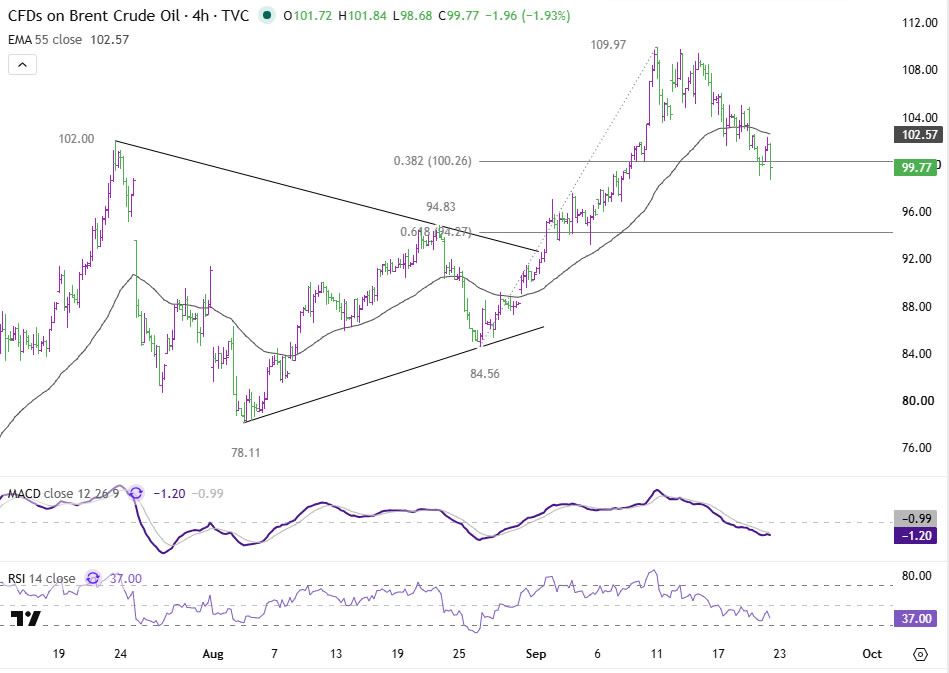
The combination was enough to push Brent through the 100 support that had contained the previous correction. The move into the high-$90s is the first meaningful attempt to escape the $100–110 stand-down range on the downside. But the fundamental distinction from the earlier analysis still holds. Saudi Arabia has restored a workaround; Hormuz itself has not normalized. Iran has made a more concrete diplomatic offer; Washington has not agreed to it.
That keeps 94.27, the 61.8% retracement of the 84.56–109.97 rise, as the next major downside level if Brent can sustain the break below 100.26. Confirmation would ideally come from something more substantive than another day without strikes: a constructive US response, direct negotiations, further restoration of physical supply, or actual progress toward reopening Hormuz. A quick recovery back above 100, by contrast, would suggest the market still regards the latest developments as partial rather than transformational and would restore the old $100–110 framework.
Key Levels
- Brent: broke through $100 support into the high-$90s, the first meaningful downside attempt to escape the $100–110 range.
- Next major downside level: 94.27, the 61.8% retracement of the 84.56–109.97 rise, if Brent sustains a break below 100.26.
- What would confirm the break: a constructive US response, direct negotiations, further physical supply restoration, or real progress toward reopening Hormuz.
- What would invalidate it: a quick recovery back above 100.
CAD Refuses the Textbook Petrocurrency Trade
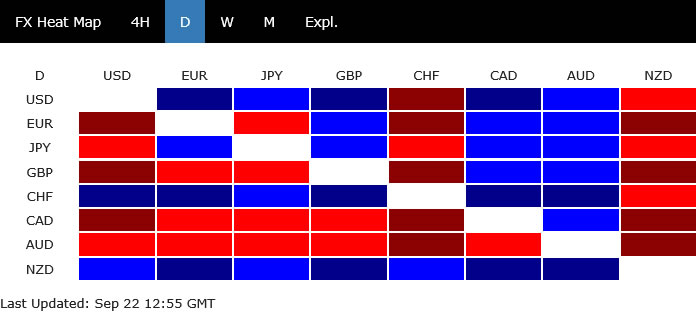
FX is not confirming the oil move with anything like the same clarity. A supply-driven decline in crude should not be expected to behave like an oil collapse caused by recession fears, and Tuesday’s heat map reflects that distinction. There is no broad risk-off pattern and no uniform flight into traditional defensive currencies.
CAD is an example. Despite the sharp fall in Brent, the Canadian Dollar is not broadly underperforming. While it is softer against most major currencies, it’s firmer against AUD. If crude were dominating FX through a simple petrocurrency channel, CAD weakness should be considerably more consistent across the board.
The more striking divergence is between AUD and NZD. NZD is broadly strong while AUD is broadly weak, reversing part of a sharp AUD/NZD advance that had taken the cross to its highest area since 2013 earlier this week. There is no Australian employment release to explain Tuesday’s move; the August labor report is due Thursday. Nor is crude an obvious common driver of the AUD/NZD divergence. That makes the move more consistent with a relative-value reversal or profit-taking after an extended AUD/NZD rally than with a fresh oil-driven macro signal.
The Dollar adds another complication. At the 12:55 GMT heat-map snapshot, USD was broadly firm across the major currencies, except versus Swiss Franc and Kiwi, even as oil fell. That is not the clean pattern one would expect if FX were simply translating cheaper energy and improving Gulf supply into a conventional risk-on trade. The more defensible conclusion is that oil has a clear story of its own, while FX remains dominated by currency-specific forces.
Textbook Petrocurrency Reaction vs. Tuesday’s Actual FX
| Market | Textbook Expectation | What Actually Happened |
|---|---|---|
| CAD | Broad underperformance on falling oil | Softer against most majors, but firmer against AUD |
| AUD/NZD | No divergence expected from an oil-driven move alone | NZD broadly strong, AUD broadly weak, a relative-value reversal, not an oil signal |
| Dollar | Broad softness if FX were pricing improving global growth/supply | Broadly firm except versus Swiss Franc and Kiwi |
Oil Has Broken $100; Now the Break Needs Validation
That leaves markets with two different messages. Brent is responding directly to tangible supply relief from Saudi Arabia and a more credible diplomatic route toward reopening Hormuz. FX is acknowledging neither development strongly enough to produce a uniform cross-market trade.
The next confirmation therefore comes from oil itself. A sustained move below 100 would strengthen the case for a deeper geopolitical-premium unwind toward 94.27. A fast recovery above $100 would say that physical disruption and unresolved diplomacy still justify the old range.
Diplomacy remains central over the coming days. Iran’s delegation is in New York during the UN General Assembly, while US President Donald Trump is meeting Gulf leaders amid the Middle East crisis. Attention then shifts to Chinese President Xi Jinping’s September 23–25 state visit to the US and his summit with Trump on Thursday.
For now, oil has broken the script technically. FX has yet to decide whether it believes the same story.
Related Coverage
Oil Deep Dive
Brent Oil Breaks Below $100 on Iran Hormuz Offer—but the Market Isn’t Convinced Yet — more on the same Iran offer and why the rebound from 98.68 shows traders are still waiting for confirmation.
Fed Voices on Oil and Inflation
Collins Backs One More Fed Hike in 2026, Then Sees Rates on Hold Next Year — why sticky inflation, energy risk and cost pass-through keep one more hike on the table before a pause.
Musalem Calls Fed Policy “Accommodative” as Inflation Pressure Broadens Beyond Oil — the case for tightening earlier and incrementally rather than risking a larger adjustment later.
RBA, ECB & BoC on Oil’s Second-Round Risk
Why Can’t the RBA Simply Look Through Higher Oil? Bullock Explains the Second-Round Risk — why repeated supply shocks, not oil prices themselves, are the real policy trigger.
Hunter Says RBA Tightening Is Slowing Housing, but Inflation Risks Still Point Up — why slowing housing demand doesn’t mean the RBA’s inflation fight is over.
ECB’s Lane Pushes Inflation Normalization Into Mid-2027 as Energy Shock Returns — how a second wave of Europe’s energy shock is pushing back the ECB’s own inflation timeline.
Macklem Draws BoC’s Line: Oil Can Be Looked Through—Until Inflation Spreads — why broader pass-through, not $100 oil itself, is the BoC’s real trigger for a policy response.
Cross-Asset Watch
AI Optimism Overrides a More Hawkish Fed as Nasdaq Hits Record, Bitcoin Breaks Out — another market where the usual macro script isn’t holding, with AI spending optimism overriding higher rates.
FAQ
Why is oil’s break below $100 different from a typical oil-driven risk-off move?
It’s supply-and-diplomacy-driven rather than demand-driven, Saudi Arabia’s East-West Pipeline restart and Iran’s Hormuz offer are both easing supply concerns, not signaling weaker global demand. That’s why it’s a positive signal for inflation and global activity rather than a growth scare, and why FX hasn’t produced the usual uniform risk-off pattern.
Why isn’t CAD falling more if oil dropped through $100?
CAD is softer against most majors but firmer against AUD, not broadly underperforming. That argues against a simple petrocurrency channel currently dominating FX, and points instead to currency-specific forces driving each pair.
What would confirm Brent’s break below $100 is durable?
A sustained move below 100.26 would open the way toward 94.27, the 61.8% retracement of the 84.56-109.97 rise, ideally confirmed by a constructive US response to Iran’s offer, direct negotiations, more physical supply restoration, or real progress toward reopening Hormuz. A quick recovery back above $100 would suggest the opposite.
Key Takeaways
- Brent broke below $100 after Saudi Arabia restarted its East-West Pipeline, rerouting up to 4 million barrels per day around Hormuz, and a senior Iranian official said Tehran could reopen the Strait within seven days if Washington eases pressure.
- The next major downside level is 94.27, the 61.8% retracement of the 84.56-109.97 rise, if Brent sustains a break below 100.26; a quick recovery back above $100 would suggest the market still sees the developments as partial.
- CAD didn’t confirm a textbook petrocurrency reaction, it’s softer against most majors but firmer against AUD, arguing against oil dominating FX through a simple channel.
- AUD and NZD diverged sharply with no oil or data catalyst, Australia’s August labor report isn’t due until Thursday, more consistent with a relative-value reversal after AUD/NZD’s advance to its highest level since 2013 earlier this week.
- Dollar was broadly firm on the day’s heat map, except against Swiss Franc and Kiwi, even as oil fell, reinforcing that oil has its own story while FX remains dominated by currency-specific forces.
What to Watch Next
Whether Brent sustains its break below 100.26 toward 94.27 or snaps back above $100. Progress from Iran’s UN General Assembly delegation and Trump’s meetings with Gulf leaders on reopening Hormuz. And Xi Jinping’s September 23–25 state visit, with his summit with Trump on Thursday, for whether the diplomatic backdrop keeps easing or the old $100–110 range reasserts itself.





